Pakistan Mediation in US Iran Crisis Highlights Regional Diplomacy
Source:Indian Express ↗
Why It Matters
The article highlights the extreme volatility of the Middle East and its direct ramifications on India's energy security and the safety of Indian citizens working abroad. It also underscores shifting regional diplomacy, as middle powers like Pakistan and Gulf states step into prominent mediation roles.
Summary
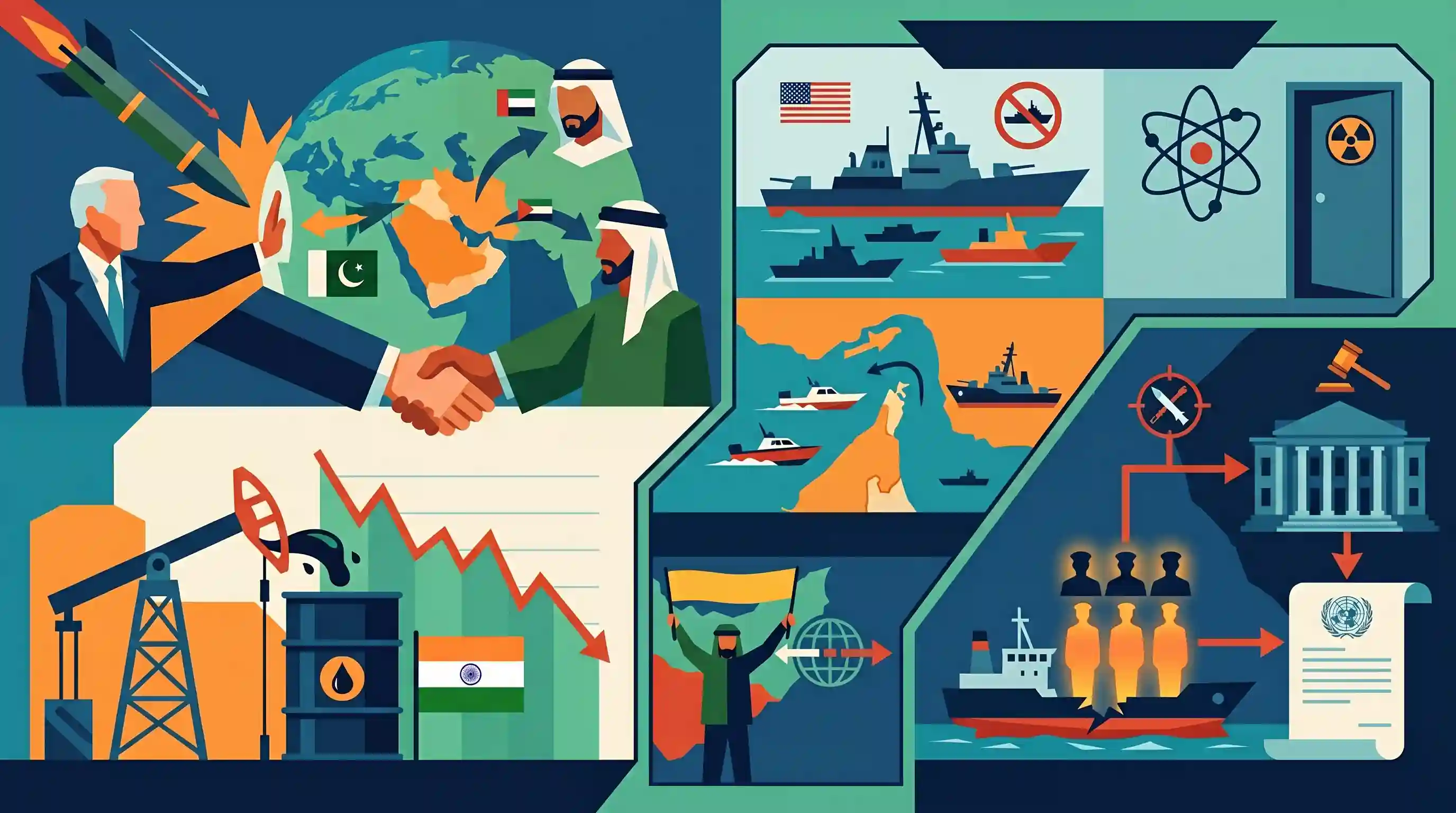
US President Donald Trump announced a halt to planned military strikes on Iran, crediting Pakistan and Gulf nations for their mediation efforts. The diplomatic breakthrough brings temporary relief to global oil markets, which is crucial for India given its heavy reliance on Gulf crude. However, tensions persist with a US naval blockade still in place and key issues like Iran's nuclear program, control of the Strait of Hormuz, and Hezbollah unresolved. The conflict has directly impacted India, with the deaths of three Indian sailors in a recent US strike drawing condemnation from the International Maritime Organisation (IMO).
Key Points
- Diplomatic Mediation: Pakistan, alongside Gulf states like Saudi Arabia and Qatar, played a pivotal backchannel role in averting imminent US military strikes on Iran.
- Impact on India: The de-escalation helps stabilize global oil markets, mitigating the risk of supply disruptions and fuel price spikes for India, which relies heavily on Gulf crude imports.
- Indian Casualties: The US-Iran hostilities led to the deaths of three Indian sailors in a US strike on a merchant vessel attempting to evade the ongoing US naval blockade, drawing condemnation from the IMO.
- Unresolved Flashpoints: Despite the temporary settlement, critical issues such as Iran's nuclear program, control over the Strait of Hormuz, and the status of Hezbollah in Lebanon remain significant sticking points.
Important Terms
International Maritime Organisation (IMO)

A United Nations specialized agency responsible for global shipping regulations, safety, security, and the prevention of marine and atmospheric pollution by ships.
UPSC context
GS Paper II (International Relations) and GS Paper III (Environment); tested in the context of maritime safety and global governance.
Hezbollah
A Lebanon-based Shia militant group and political party backed by Iran; it is a key member of the 'Axis of Resistance' and designated as a terrorist group by several nations.
UPSC context
GS Paper II (International Relations/West Asia); critical for understanding regional security dynamics and non-state actors' impact on Indian interests.
Strait of Hormuz
The world's most critical oil chokepoint, connecting the Persian Gulf to the Gulf of Oman; roughly 20-30% of global oil passes through this narrow passage.
UPSC context
GS Paper I (World Geography) and GS Paper III (Energy Security); vital for India as nearly 40-70% of its crude/LNG imports transit this route.
Energy Security
The uninterrupted availability of energy sources at an affordable price, involving long-term resilience against supply shocks and short-term response to sudden changes in supply-demand.
UPSC context
GS Paper III (Economy/Infrastructure); fundamental for India which imports over 85% of its crude oil and faces geopolitical supply risks.
Indian Diaspora
The vast community of Indian nationals and persons of Indian origin living abroad, particularly the ~9-11 million people in the Gulf contributing significantly to India's remittances.
UPSC context
GS Paper II (International Relations/Effect of policies on Indian interests); focuses on citizen safety in conflict zones and economic importance of remittances.
Strategic Petroleum Reserves (SPR)
Emergency fuel storage facilities intended to cushion against supply disruptions; India maintains these in underground rock caverns at Visakhapatnam, Mangaluru, and Padur.
UPSC context
GS Paper III (Internal Security/Energy Infrastructure); tested as a defensive strategy against global oil shocks and supply-chain vulnerabilities.
Prelims Trap
The IMO enforces naval blockades and deploys security forces to protect merchant vessels.
The IMO is a UN regulatory agency that develops frameworks (like SOLAS) for maritime safety. It has no military enforcement powers or mandate to police blockades.
Static Concepts Connected
What is the geographical and strategic importance of the Strait of Hormuz?
- Location: Connects the Persian Gulf to the Gulf of Oman and the Arabian Sea.
- Bordering Nations: Bounded by Iran to the north and Oman (Musandam Peninsula) and the UAE to the south.
- Energy Chokepoint: Facilitates roughly 20% of global oil consumption; an indispensable transit route for India's crude imports.
What is the mandate of the International Maritime Organization (IMO)?
- UN Agency: A specialized UN agency headquartered in London, responsible for regulating safe and secure international shipping.
- Key Treaties: Administers critical global maritime conventions like SOLAS (Safety of Life at Sea) and MARPOL.
- Enforcement Limit: Lacks direct enforcement or military powers; relies entirely on flag states to implement its conventions.
Cross-Topic Patterns
Energy Security & Strategic Reserves
Disruptions in the Strait of Hormuz underscore the critical need to rapidly expand India's Strategic Petroleum Reserves (ISPRL) to cushion against sudden crude supply shocks.
Pakistan's Geopolitical Rent-Seeking
Pakistan consistently leverages its geographic location—previously during the War on Terror, and now as an Iranian neighbor—to extract diplomatic relevance and concessions from Washington.
Think West & Diaspora Evacuations
The death of Indian sailors highlights the vulnerability of India's 8.5 million Middle East diaspora, potentially testing rapid evacuation protocols reminiscent of Operations Raahat or Ajay.

Expect a 2026 prelims mapping question on Persian Gulf chokepoints combined with IMO's mandate regarding civilian vessels in conflict zones.
Linked PYQs · 3
Linked PYQs · 3
- 2025MainsGS2
"Energy security constitutes the dominant kingpin of India's foreign policy, and is linked with India's overarching influence in Middle Eastern countries.” How would you integrate energy security with India's foreign policy trajectories in the coming years?
- 2025MainsGS3
Why is maritime security vital to protect India's sea trade? Discuss maritime and coastal security challenges and the way forward.
- 2022MainsGS3
What are the maritime security challenges in India ? Discuss the organisational, technical and procedural initiatives taken to improve the maritime security.
