US Warns India on Russian Oil Imports Amid Trade Concessions
Source:Indian Express ↗
Why It Matters
This is a textbook example of the tension between strategic autonomy and alignment in international relations. It illustrates the real-world pressures India faces in balancing its energy security needs (met by Russian oil) against the strategic and trade leverage exerted by its primary partner, the United States. It is highly relevant for GS-2 IR questions regarding India's foreign policy choices in a multipolar world.
Summary
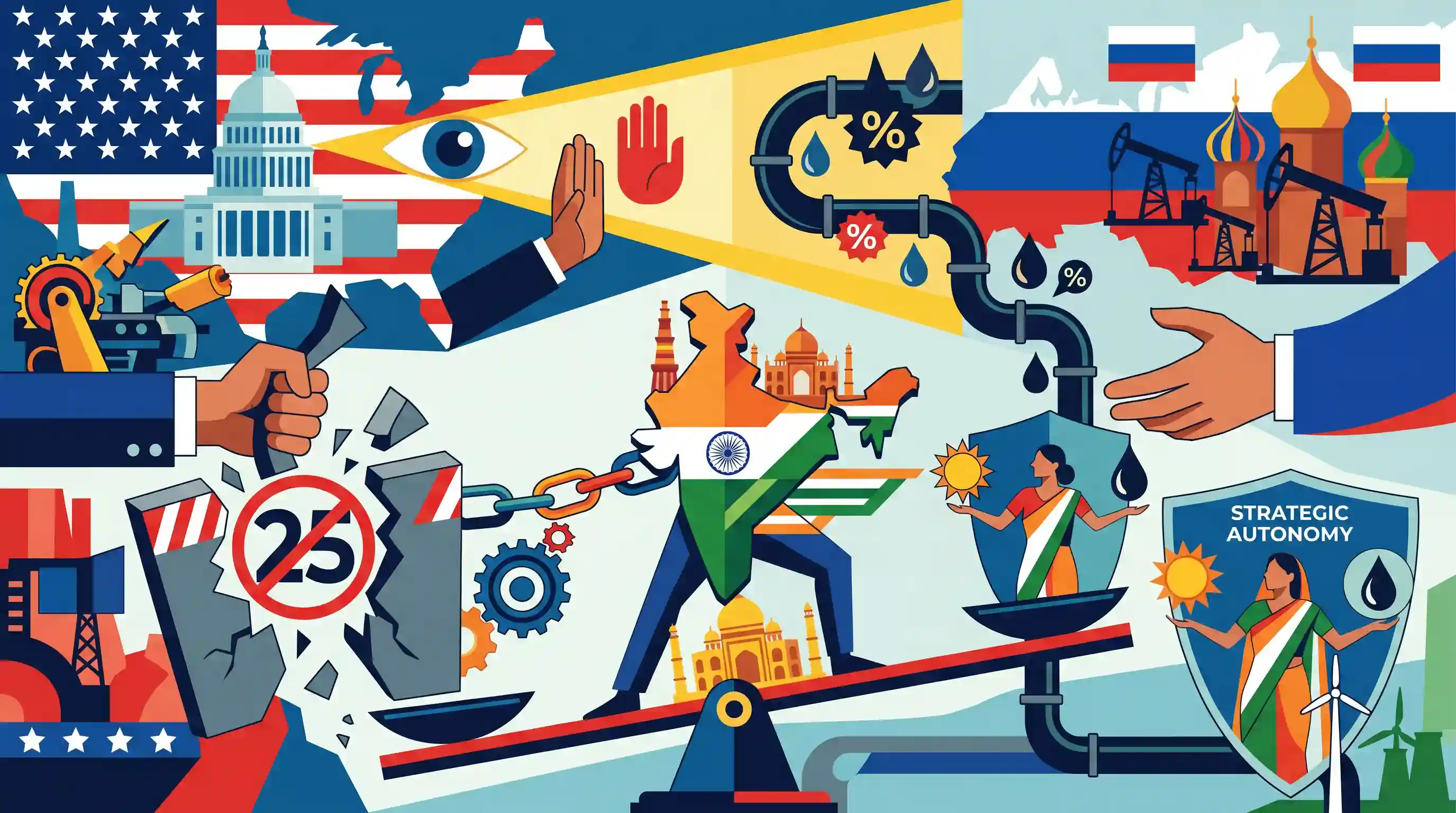
U.S. President Donald Trump has decided to scrap a proposed 25% trade penalty on India but coupled the concession with a stark warning against India's continued purchase of Russian oil. Trump explicitly stated that Washington is closely monitoring India's energy trade with Moscow. The diplomatic maneuver underscores the complex balancing act for India's foreign policy, which seeks to maintain a strong strategic partnership with the United States while defending its strategic autonomy and energy security through imports of discounted Russian crude.
Key Points
- President Donald Trump has scrapped a 25% trade penalty previously proposed against India.
- Simultaneously, Trump issued a stern warning, demanding that India stop purchasing Russian oil.
- The U.S. administration explicitly noted that it is closely monitoring India's oil trade moves with Moscow.
- The development highlights the ongoing friction between U.S. efforts to isolate Russia economically and India's strategy of ensuring domestic energy security via discounted crude imports.
Important Terms
Strategic Autonomy

A nation's ability to make sovereign foreign and defense policy decisions without being constrained by alliance obligations or external pressures.
UPSC context
GS Paper 2 (International Relations); essential for analyzing India's independent stance amidst global power shifts and multi-alignment strategy.
Energy Security
The uninterrupted availability of energy sources at an affordable price, encompassing physical availability, economic accessibility, and reliability of supply.
UPSC context
GS Paper 3 (Economy/Infrastructure); critical for understanding India’s import dependency, fiscal health, and sustainable growth roadmap.
Trade Tariffs
Taxes or financial duties imposed by a country on imports from another nation, often used as a tool for economic protectionism.
UPSC context
GS Paper 3 (Indian Economy); involves trade wars, bilateral economic tensions, and the impact of protectionism on exports.
Strategic Partnership
A multi-dimensional relationship between nations focused on defense, technology, and economic convergence to address regional and global challenges.
UPSC context
GS Paper 2 (International Relations); core topic concerning India's significant bilateral ties and its role in Indo-Pacific stability.
Secondary Sanctions
Penalties imposed by a country on entities from a third nation that engage in trade with a sanctioned state.
UPSC context
GS Paper 2 (International Relations); tests understanding of extraterritorial laws like CAATSA affecting India's energy and defense imports.
Prelims Trap
India is legally bound under international law to comply with US sanctions on Russian oil.
UPSC often blends UN sanctions with unilateral US sanctions. India is only legally bound by UN Security Council sanctions, not unilateral frameworks like US sanctions on Russia.
Static Concepts Connected
What is CAATSA and how does it impact India?
- Core Target: A US federal law penalizing countries engaging in significant transactions with Russian, Iranian, and North Korean defense or intelligence sectors.
- Unilateral Coercion: It acts as an extraterritorial application of US domestic law. India does not recognize unilateral sanctions, citing its strategic autonomy.
- Waiver Provision: The US President can grant specific waivers, a provision previously debated and utilized when India purchased the Russian S-400 missile system.
What defines India's current crude oil import profile?
- High Dependency: India relies on imports for over 85% of its crude oil requirements, making domestic inflation highly vulnerable to global supply shocks.
- Supplier Shift: Russia recently surged past traditional suppliers like Iraq and Saudi Arabia to become India's top oil source, driven by steep discounts.
- Payment Complexities: Sourcing from sanctioned nations forces India to continuously explore alternative settlement mechanisms outside the SWIFT and dollar-dominated financial system.
Cross-Topic Patterns
Rupee Internationalization & Oil Payments
Bypassing US dollar mechanisms for Russian oil directly intersects with RBI's push for Rupee internationalization and the operationalization of Special Rupee Vostro Accounts (SRVAs) to settle trades.
Trade Tariffs as Geopolitical Weapons
Linking a 25% trade penalty to oil choices demonstrates the weaponization of trade policy, blurring the lines between WTO-regulated commerce and strategic foreign policy enforcement.

Expect a 2026 question linking unilateral sanctions, India's changing crude oil import basket, and alternate currency trade mechanisms.
Linked PYQs · 2
Linked PYQs · 2
- 2025MainsGS2
"Energy security constitutes the dominant kingpin of India's foreign policy, and is linked with India's overarching influence in Middle Eastern countries.” How would you integrate energy security with India's foreign policy trajectories in the coming years?
- 2012MainsGS2
Discuss the likely negative impact of the protectionist measures proposed by the US on India's software industry.
