Trump Mounts Pressure on NATO Allies at Ankara Summit
Source:Indian Express ↗
Why It Matters
This development illustrates the deep strategic fractures within the Western alliance system (NATO) and the rise of a highly transactionalist, unilateralist US foreign policy. For India, the collapse of the US-Iran understanding poses renewed energy and maritime security risks in West Asia (particularly around the Strait of Hormuz), while the focus on Greenland underscores the accelerating geopolitical race for the resource-rich Arctic, directly affecting India's own Arctic Policy and strategic balancing act.
Summary
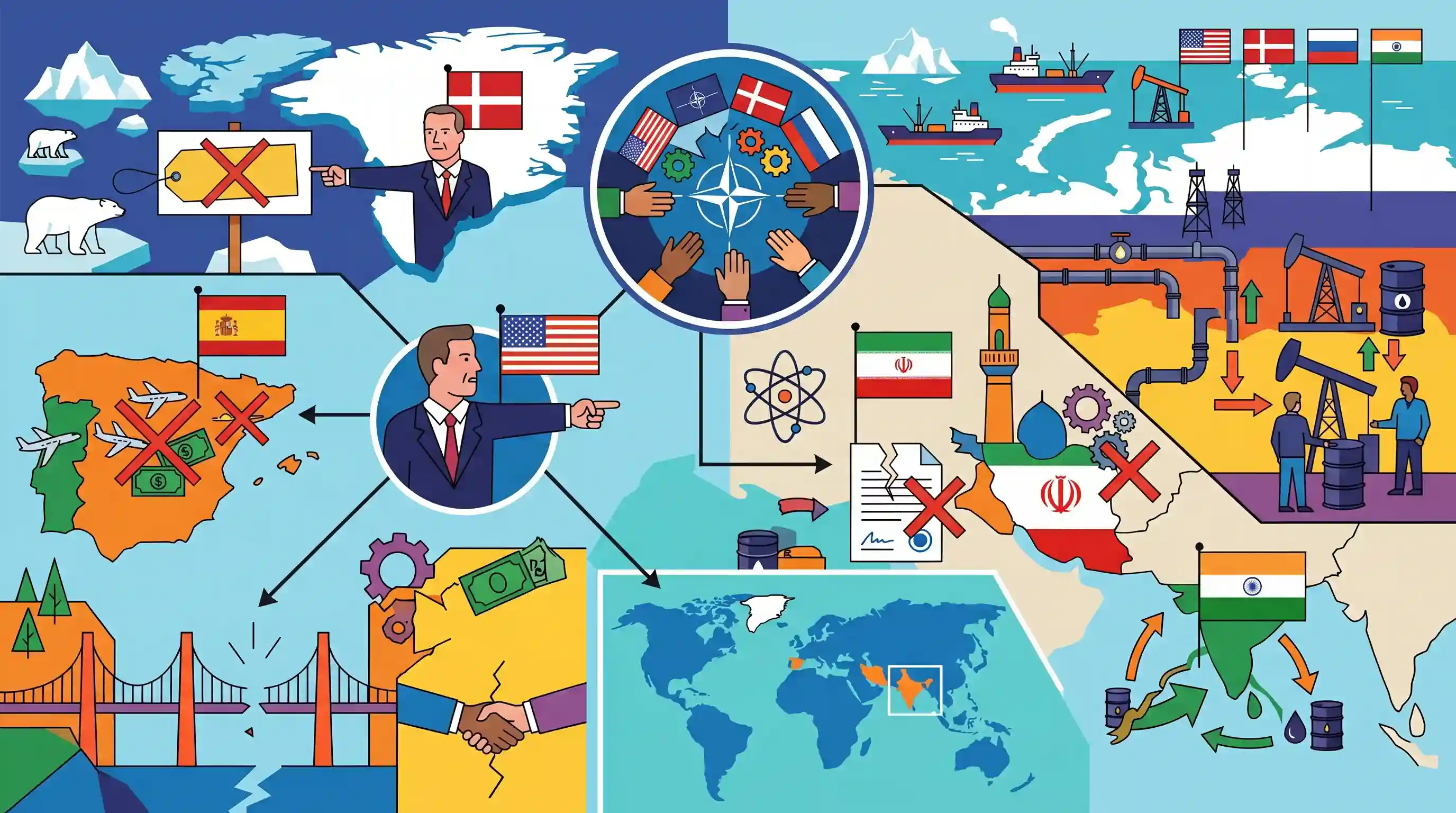
During the NATO Summit in Ankara, Turkey, US President Donald Trump triggered significant diplomatic rifts by threatening to end trade with Spain, declaring the US-Iran interim agreement dead, and renewing his demand for US control over Greenland. Trump accused Spain of failing to contribute sufficiently to NATO and blocking US airspace access during campaigns against Iran. Furthermore, his re-assertion of Greenland's strategic importance in the Arctic prompted Danish Prime Minister Mette Frederiksen to strongly reply that the territory is 'not for sale' and that Denmark will defend its sovereignty. These moves highlight the growing fragmentation within the transatlantic alliance and the shift toward transactional unilateralism.
Key Points
- NATO Burden-Sharing Discord: US President Donald Trump threatened a complete trade cutoff with Spain, calling it a 'wasted cause' and a 'terrible partner' because of its failure to meet the 2% GDP defense spending target and its refusal to grant airspace or base access for US operations against Iran.
- US-Iran Interim Arrangement Collapses: Trump declared the US-Iran interim understanding 'over' following fresh US military strikes on Iranian targets and Washington's decision to revoke licenses allowing Iran to export oil.
- Renewed US Claim on Greenland: Trump revived his demand that the US should control Greenland due to its strategic geographical position in the Arctic, declaring it 'not important for Denmark.'
- Denmark's Rebuttal: Danish Prime Minister Mette Frederiksen firmly rejected the claim, stating that 'Greenland is not for sale' and asserting Denmark's commitment to defending all NATO territories.
- Ankara Summit Fragmentation: The event, which took place in Turkey and was intended to display transatlantic unity, instead highlighted severe strategic fragmentation and the rise of highly transactional bilateral diplomacy.
Important Terms
NATO

An intergovernmental military alliance established in 1949 by the Washington Treaty, consisting of North American and European countries, committed to collective defense and mutual security against external threats.
UPSC context
GS Paper II (Global Groupings); tests understanding of global security architectures and their geopolitical implications for India’s strategic posture.
North Atlantic Treaty
The founding treaty of NATO, signed in 1949, which establishes the legal and military framework for collective defense, notably through Article 5, stating that an attack on one member is an attack on all.
UPSC context
GS Paper II (International Treaties); tests knowledge of collective security frameworks and historical developments of global defense pacts.
US-Iran interim agreement
A short-term diplomatic framework, signed in June 2026, aimed at halting military hostilities, offering temporary U.S. sanctions relief, and allowing supervised maritime passage through the strategic Strait of Hormuz during negotiations.
UPSC context
GS Paper II (West Asia Geopolitics); tests understanding of maritime security, oil transit choke points, and global energy security.
Transactional Unilateralism
A foreign policy approach where a nation acts independently without international consensus, prioritizing immediate, deal-based national benefits over long-term strategic alliances or traditional multilateral norms.
UPSC context
GS Paper II (Policies of Developed Countries); tests conceptual grasp of shifting global governance, trade protectionism, and foreign policy recalibration.
US Department of the Treasury
The executive department of the United States government responsible for managing federal finances, tax collection, international financial sanctions, and the enforcement of economic policies.
UPSC context
GS Paper II (Global Institutions); tests understanding of global economic statecraft, sanctions regimes, and financial diplomacy.
Geopolitics of the Arctic Region
The strategic, economic, and environmental competition among global powers over untapped resources, newly accessible shipping lanes (like the Northern Sea Route), and military presence in the rapidly melting Arctic.
UPSC context
GS Paper II & III (Strategic Importance); tests knowledge of polar diplomacy, environmental governance, and India's Arctic policy.
Prelims Trap
The 2% defense spending target is a legally binding obligation enshrined in the founding North Atlantic Treaty.
The 2% GDP defense spending guideline is a non-binding political commitment agreed at the 2014 Wales Summit, not a legal treaty obligation of the 1949 North Atlantic Treaty.
Static Concepts Connected
What is the strategic significance of the GIUK Gap?
- Geographical Belt: Represents the open ocean chokepoint between Greenland, Iceland, and the United Kingdom.
- Naval Chokepoint: Historically used by Soviet/Russian submarines to enter the Atlantic; vital for NATO's anti-submarine warfare.
- Strategic Infrastructure: Hosts critical undersea telecommunication cables and emerging maritime shipping lanes linking the Arctic.
What is India's scientific and strategic posture in the Arctic?
- Policy Framework: Launched in 2022 to guide India's scientific, environmental, and economic engagement in the region.
- Six Core Pillars: Structures operations around research, climate protection, development, transportation, governance, and national capacity building.
- Svalbard Engagement: India operates 'Himadri' research station in Svalbard, Norway, holding Observer status on the Arctic Council.
Cross-Topic Patterns
Arctic Resources + Critical Minerals Security
Western projects to secure Greenland's massive Rare Earth deposits to bypass China's monopoly align directly with India's efforts under the Minerals Security Partnership.
Transactional Statecraft + WTO Rules
US threats to cut trade over defense spending showcase a shift from multilateral trade rules to unilateral economic coercion, impacting global trade stability.

Strategic significance of the GIUK gap, Greenland's Rare Earth potential, and India's 6-pillar Arctic Policy will likely converge in GS-I/II.
Linked PYQs · 4
Linked PYQs · 4
- 2023MainsGS2
‘The expansion and strengthening of NATO and a stronger US-Europe strategic partnership works well for India.’ What is your opinion about this statement ? Give reasons and examples to support your answer.
- 2018MainsGS1
Why is India taking keen interest in resources of Arctic Region?
- 2026PrelimsGS1
Ships from which of the following countries have to cross the Strait of Hormuz to reach out to the Indian Ocean ? 1. Bahrain 2. Syria 3. Qatar 4. Egypt Select the answer using the code given below :
- 2017MainsGS2
The question of India's Energy Security constitutes the most important part of India's economic progress. Analyze India's energy policy cooperation with West Asian countries.
