US India Bilateral Trade Negotiations and Tariff Talks
Source:Indian Express ↗
Why It Matters
The trajectory of US-India trade relations is a critical component of India's foreign policy. Understanding how the two nations manage disputes over tariffs and protectionism while deepening their strategic alignment is highly relevant for GS Paper 2 (Effect of policies and politics of developed and developing countries on India's interests).
Summary
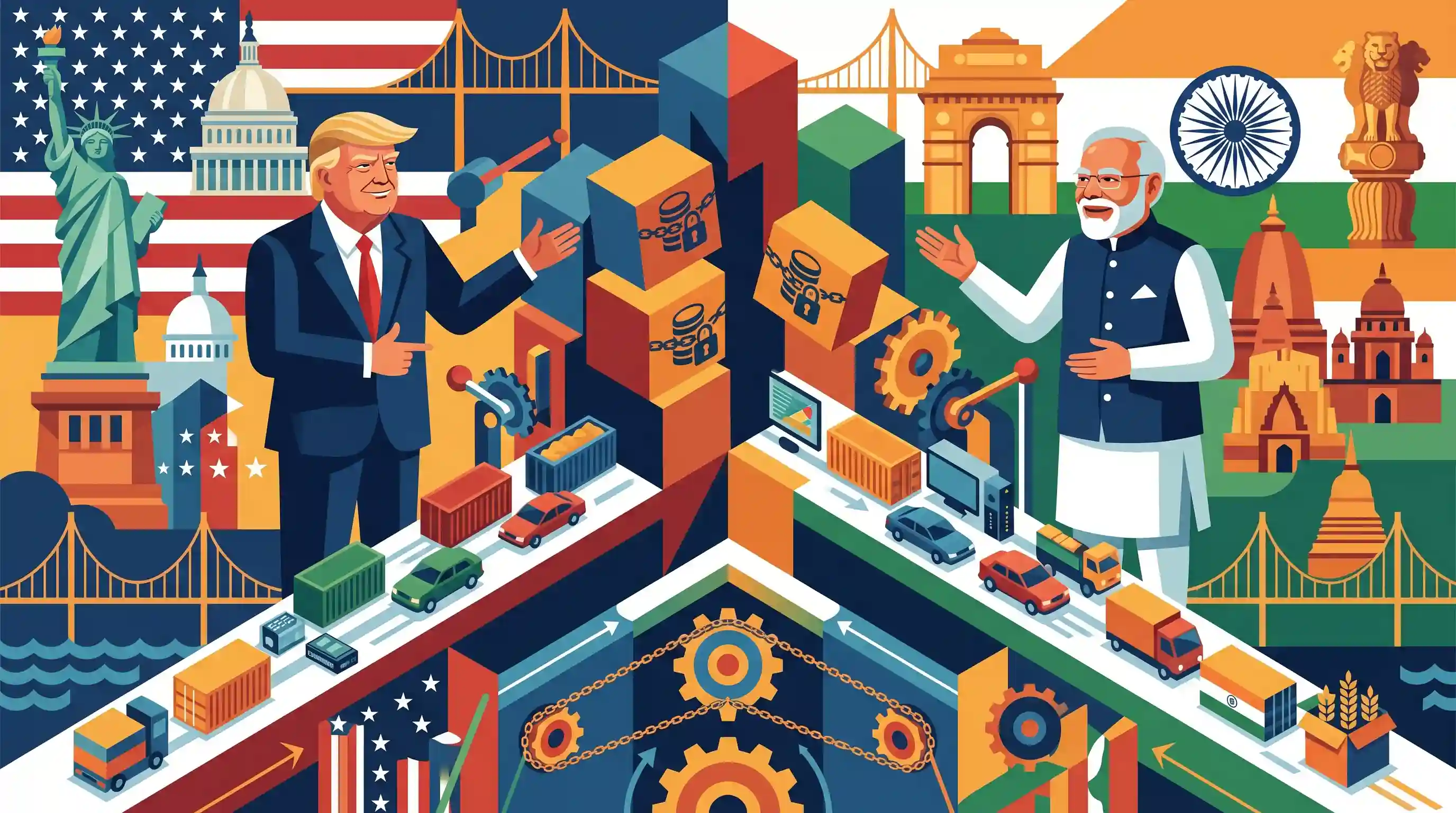
Donald Trump and Indian Prime Minister Narendra Modi recently engaged in talks that signaled a thaw in bilateral relations, with Trump stating that US-India trade negotiations and discussions regarding tariffs are "on track." The conversation highlights the ongoing efforts by both nations to reconcile economic and trade frictions—such as tariff barriers and market access issues—while continuing to strengthen their broader strategic partnership.
Key Points
- Former US President Donald Trump and Indian Prime Minister Narendra Modi held discussions signaling a positive trajectory for US-India bilateral ties.
- Trump emphasized that the ongoing trade negotiations between the two nations, including talks on contested tariffs, are \u2018on track.\u2019
- The dialogue points toward a pragmatic approach to managing bilateral trade frictions while maintaining a strong strategic partnership.
- The talks highlight the broader global context of balancing domestic protectionist impulses with the need for robust economic cooperation between major economies.
Important Terms
Generalized System of Preferences (GSP)

A US trade program providing duty-free entry for thousands of products from designated beneficiary developing countries to promote their economic growth.
UPSC context
GS Paper II (International Relations); key historical friction point in US-India trade and criteria for developing nation status.
Reciprocal Tariff
A trade policy where a country imposes import duties on another nation at levels matching the tariffs that nation levies on its own exports.
UPSC context
GS Paper III (Economy); relates to 'America First' trade tactics and its impact on Indian export competitiveness.
Market Access
The extent to which a country permits foreign goods and services to enter its economy, typically restricted by tariffs, quotas, or non-tariff barriers.
UPSC context
GS Paper III (Economy/Trade); central to WTO negotiations and bilateral trade agreements (BTA) between India and major partners.
Trade Deficit
An economic condition where the value of a country's imports exceeds the value of its exports over a specific period.
UPSC context
GS Paper III (Economy); a primary driver for US protectionist measures and India's trade negotiations.
Protectionism
Government policies that restrict international trade to help domestic industries, often through tariffs, subsidies, or import quotas.
UPSC context
GS Paper III (Economy/Globalisation); tests understanding of trade wars, deglobalization, and their impact on Indian manufacturing.
Bilateral Trade Agreement (BTA)
Trade arrangements between two nations aimed at reducing or eliminating tariffs, quotas, and other trade barriers to encourage commercial exchange.
UPSC context
GS Paper II (International Relations); focuses on the shift from multilateralism (WTO) to focused bilateral economic partnerships.
Prelims Trap
"India currently maintains a significant trade deficit with its largest trading partner, the United States."
India consistently enjoys a significant trade surplus with the US. Aspirants mistakenly assume India runs a deficit with all major economies.
Static Concepts Connected
What is the Generalized System of Preferences (GSP) in international trade?
- Non-reciprocal preference: Developed nations grant non-reciprocal, zero-tariff access to certain imports from developing countries to promote economic growth.
- WTO exemption: It operates as a legal exception to the WTO's Most Favored Nation (MFN) principle under the "Enabling Clause."
- India's status: The US revoked India's GSP beneficiary status in 2019 over market access disputes; its restoration remains a core negotiating point.
What is the India-US Trade Policy Forum (TPF)?
- Institutional mechanism: It is the premier bilateral institutional dialogue mechanism established to resolve trade and investment barriers between the two nations.
- Leadership: The forum is co-chaired by India's Minister of Commerce and Industry and the United States Trade Representative (USTR).
Cross-Topic Patterns
Strategic Ties vs. Trade Protectionism
While the US deepens strategic and tech cooperation via iCET, it simultaneously invokes Section 232 "national security" tariffs on Indian steel, highlighting the paradox between defense ties and economic protectionism.
Trade Surpluses & Currency Watchlists
India's persistent bilateral trade surplus with the US routinely makes it a target for the US Treasury's 'Currency Manipulator Watchlist', directly linking trade metrics to RBI's monetary interventions.

Expect a 2026 prelims statement pairing India's trade surplus with the US against its massive trade deficits with China and Russia.
Linked PYQs · 2
Linked PYQs · 2
- 2018MainsGS2
What are the key areas of reform if the WTO has to survive in the present context of "Trade War', especially keeping in mind the interest of India?
- 2012MainsGS2
Discuss the likely negative impact of the protectionist measures proposed by the US on India's software industry.
