Third Party Mediation Claims and Parliamentary Accountability
Source:The Hindu ↗
Why It Matters
The incident underscores the tension between India's firm stance on bilateral conflict resolution and the transactional diplomacy of the US. It also serves as a practical example of the opposition holding the executive accountable on sensitive foreign policy matters in Parliament.
Summary
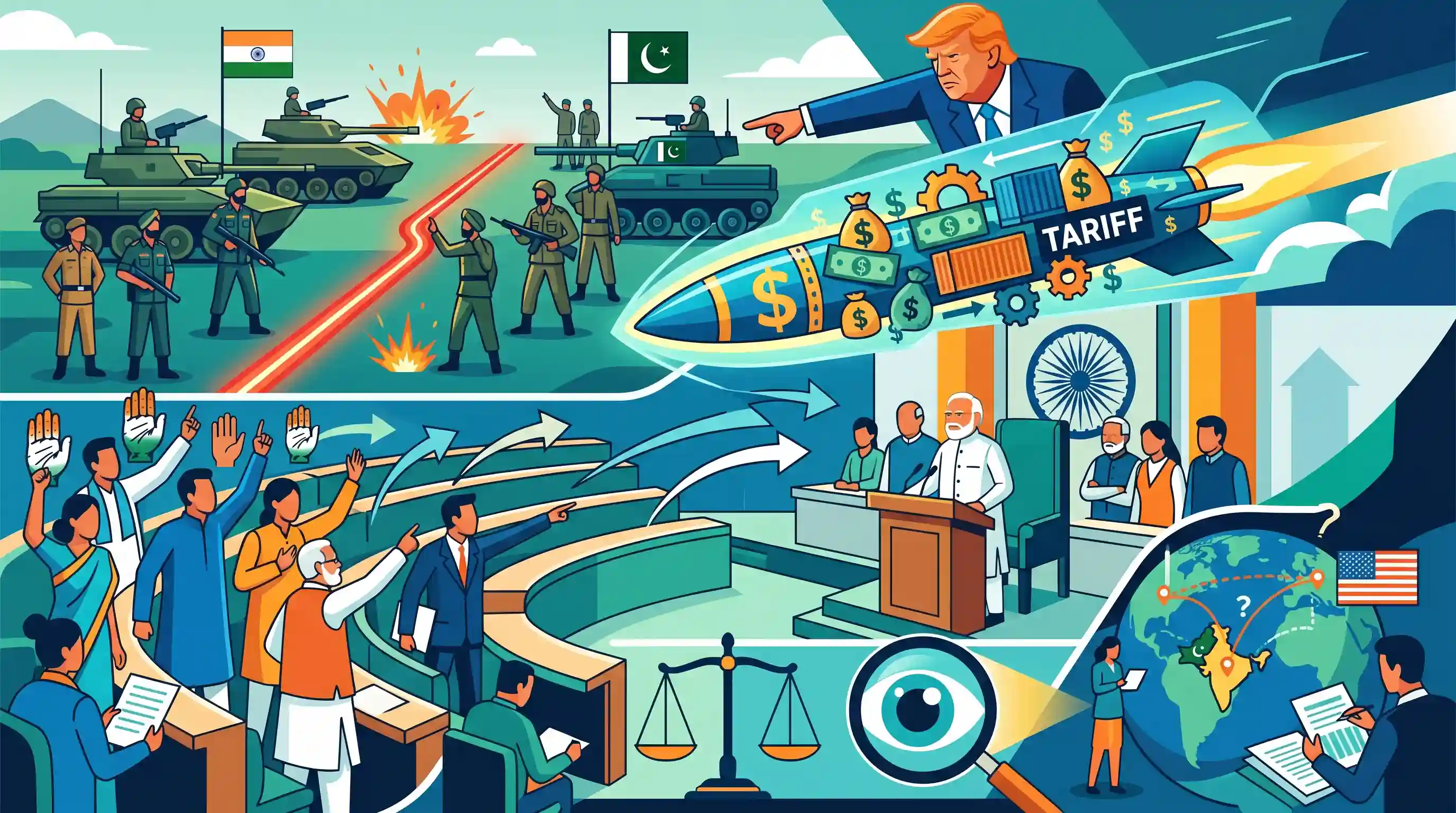
The Congress party is demanding a statement from Prime Minister Narendra Modi in Parliament following claims by US President Donald Trump that he intervened to stop an India-Pakistan military conflict (Operation Sindoor). Trump asserted he used the threat of trade tariffs—which he called a "Trump missile"—to force a ceasefire. While the Indian government maintains that the situation was resolved bilaterally without third-party mediation, the opposition is using the issue to press for executive accountability and transparency regarding national security.
Key Points
- Congress leaders demanded PM Modi address Parliament to clarify US President Donald Trump's claim that he intervened in a brief India-Pakistan military conflict.
- Trump claimed he forced a ceasefire by threatening high trade tariffs (dubbed the 'Trump missile') after five jets were reportedly shot down.
- India's Ministry of External Affairs and Foreign Secretary Vikram Misri denied any third-party mediation, maintaining the escalation was de-escalated bilaterally.
- The opposition's demands highlight the continued push for executive accountability on national security and foreign policy during the Monsoon Session.
Important Terms
Operation Sindoor

A multi-domain military strike launched by India in May 2025 targeting terror camps in Pakistan and PoK after the Pahalgam attack.
UPSC context
GS Paper III/Security; tests India's retaliatory doctrine and strategic evolution in multi-domain warfare.
Bilateralism
The principle of resolving international disputes through direct negotiations between two parties, strictly excluding third-party mediators.
UPSC context
GS Paper II/International Relations; central to India's policy on Pakistan and Kashmir.
Parliamentary Accountability
The constitutional requirement that the executive branch remains answerable to Parliament for its decisions, especially regarding national security.
UPSC context
GS Paper II/Polity; involves mechanisms like 'Question Hour' and 'Statements by Ministers.'
Shimla Agreement
A 1972 peace treaty binding India and Pakistan to resolve disputes bilaterally and establishing the Line of Control (LoC).
UPSC context
GS Paper II/International Relations; the legal basis for India's rejection of external mediation.
Third-Party Mediation
Intervention by an external actor to resolve a dispute between two nations; a role India historically rejects for the Kashmir issue.
UPSC context
GS Paper II/International Relations; tests understanding of diplomatic sovereignty and strategic autonomy.
Line of Control (LoC)
The military line separating Indian and Pakistani-controlled territories in Jammu and Kashmir, formalized after the 1971 war.
UPSC context
GS Paper III/Security; critical for border management and understanding the geography of Indo-Pak conflict.
Prelims Trap
India's rejection of third-party mediation with Pakistan is a constitutional obligation under Article 51's directives.
Article 51 actually encourages the settlement of disputes by arbitration. India's strict rejection of mediation is a diplomatic stance rooted in the 1972 Simla Agreement, not a constitutional mandate.
Static Concepts Connected
What is the diplomatic foundation of India's strict bilateralism with Pakistan?
- Simla Agreement (1972): Signed after the 1971 war, it legally committed both nations to settle their differences by peaceful means through bilateral negotiations, excluding third parties.
- Lahore Declaration (1999): Reaffirmed the bilateral nature of dispute resolution, emphasizing that no foreign power or UN body has a mandate to mediate without mutual consent.
- Rejection of Mediation: India consistently rejects offers from the US, UN, or others to mediate on Kashmir, classifying it strictly as an internal and bilateral issue.
How does the Indian Parliament ensure executive accountability on foreign policy matters?
- Question Hour: MPs can raise starred or unstarred questions to the Ministry of External Affairs regarding foreign engagements, treaties, or international conflicts.
- Calling Attention Motion: Used by MPs to urgently seek a statement from a Minister on a matter of public importance, such as alleged foreign interference.
- Parliamentary Committees: The Departmentally Related Standing Committee on External Affairs scrutinizes MEA demands for grants and policies, though its recommendations are advisory.
Cross-Topic Patterns
Trade Tariffs as Geopolitical Weapons
Using "Trump missiles" (tariffs) to enforce a military ceasefire links economic protectionism directly to hard-security interventions, blurring the lines between WTO trade norms and defense diplomacy.
Evolution of Cross-Border Deterrence
Operation Sindoor's precision strikes follow the Balakot (2019) template, reinforcing India's shift from "strategic restraint" to active, non-contact deterrence against state-sponsored terror.

Expect a 2026 Mains question on the 'weaponization of trade' and how tariff threats challenge the strategic autonomy of developing nations.
Linked PYQs · 3
Linked PYQs · 3
- 2021MainsGS2
To what extent, in your view, the Parliament is able to ensure accountability of the executive in India?
- 2019MainsGS2
‘What introduces friction into the ties between India and the United States is that Washington is still unable to find for India a position in its global strategy, which would satisfy India's national self-esteem and ambitions.’ Explain with suitable examples.
- 2015MainsGS2
Terrorist activities and mutual distrust have clouded India-Pakistan relations. To what extent the use of soft power like sports and cultural exchanges could help generate goodwill between the two countries? Discuss with suitable examples.
