US Administration Evaluates Long Range Missile Supply to Ukraine
Source:Indian Express ↗
Why It Matters
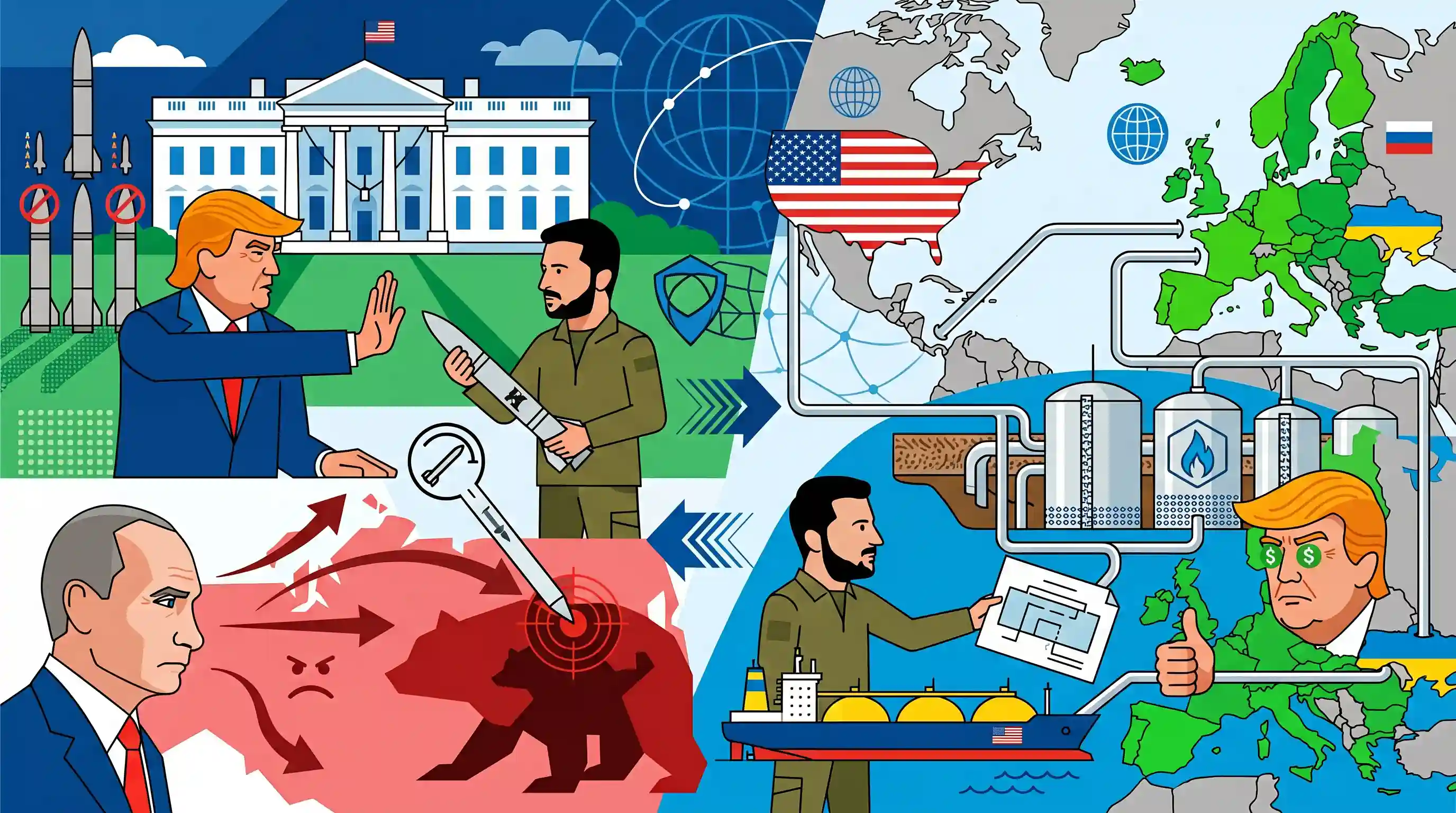
Highlights the evolving strategic dynamics of the Russia-Ukraine conflict under the Trump administration, the geopolitical implications of supplying advanced cruise missiles, and the use of energy diplomacy (LNG storage) for strategic alignment.
Summary
During a White House meeting, US President Donald Trump downplayed the likelihood of supplying Ukraine with long-range Tomahawk cruise missiles, citing the need to maintain US stockpiles. This followed a warning from Russian President Vladimir Putin that such a transfer would severely strain US-Russia relations. Ukrainian President Volodymyr Zelenskyy had sought the 1,600-km range missiles to strike deeper into Russia and force Putin to negotiate. In a strategic shift, Zelenskyy is reportedly preparing to appeal to Trump's economic interests by offering to store American liquefied natural gas (LNG) in Ukraine's facilities, aiming to boost US energy presence in Europe.
Key Points
- US President Donald Trump met Ukrainian President Volodymyr Zelenskyy at the White House, shortly after a phone call with Russian President Vladimir Putin.
- Trump downplayed the prospect of supplying Ukraine with long-range Tomahawk missiles, stating that the US needs to preserve its own stockpiles.
- Ukraine had requested Tomahawk missiles (1,600 km range) to strike deep into Russian territory, arguing it would compel Putin to enter direct negotiations.
- Putin warned Trump that transferring Tomahawks would cause substantial damage to US-Russia relations.
- Zelenskyy plans to pivot to economic diplomacy, offering to store American liquefied natural gas (LNG) in Ukraine to expand US presence in the European energy market.
Important Terms
Tomahawk Cruise Missile

A long-range, all-weather, subsonic cruise missile used for precision land-attack missions, utilizing GPS and terrain-contour mapping (TERCOM) to strike high-value targets with minimal detection.
UPSC context
GS Paper 3 (Defense Technology); tests knowledge of strategic weapons and GS Paper 2 (IR) regarding military aid and escalation.
Liquefied Natural Gas (LNG)
Natural gas cooled to -162°C to facilitate transport and storage in liquid form; crucial for diversifying energy imports and reducing dependency on fixed pipeline infrastructure.
UPSC context
GS Paper 3 (Energy/Economy); GS Paper 2 (Bilateral Relations/Economic Diplomacy) regarding energy-based strategic partnerships.
Missile Technology Control Regime (MTCR)
An informal, non-binding multilateral export control regime (including 35 members like India) that limits the proliferation of missiles and UAVs capable of delivering weapons of mass destruction.
UPSC context
GS Paper 2 (International Relations); essential for understanding global non-proliferation frameworks and India's strategic standing.
Rare Earth Minerals
A group of 17 chemically similar elements (e.g., lithium, titanium) essential for manufacturing high-tech products including semiconductors, electric vehicle batteries, and advanced defense systems.
UPSC context
GS Paper 3 (Economy/Science & Tech); focuses on resource geopolitics and critical mineral supply chains.
Energy Security
The uninterrupted availability of energy sources at an affordable price, involving long-term investments in energy supply and infrastructure to protect national interests from external shocks.
UPSC context
GS Paper 3 (Infrastructure/Energy); GS Paper 2 (International Relations) regarding regional stability and energy diplomacy.
Cruise Missile
A guided missile that remains within the atmosphere and flies at a constant speed (subsonic, supersonic, or hypersonic) for the majority of its flight path to hit specific targets.
UPSC context
GS Paper 3 (Defense Technology); frequently tested in comparison with ballistic missiles for technical characteristics and range.
Prelims Trap
The MTCR legally bans the transfer of Category I missiles (like Tomahawks) to non-member nations under international law.
The MTCR is an informal political understanding, not a legally binding treaty. It mandates a 'strong presumption of denial' for >300km/500kg systems, not an absolute ban.
Static Concepts Connected
What are the core parameters of the Missile Technology Control Regime (MTCR)?
- Informal mechanism: It is an informal political understanding among 35 member states (including India), not a legally binding treaty.
- Category I limits: Aims to restrict the proliferation of missiles and drones capable of carrying a 500 kg payload for at least 300 km.
- Presumption of denial: Transfers of Category I items are subject to a 'strong presumption of denial' rather than a blanket legal prohibition.
How do cruise missiles (like the Tomahawk) differ from ballistic missiles?
- Flight trajectory: Ballistic missiles follow a largely unpowered parabolic arc, whereas cruise missiles are jet-propelled and powered throughout their entire flight.
- Atmospheric flight: Cruise missiles remain within the Earth's atmosphere and fly at low altitudes to evade radar, unlike ballistic missiles that exit into space.
- Guidance & Precision: Cruise missiles use aerodynamic lift and continuous guidance to hit targets with high precision.
Cross-Topic Patterns
Energy storage as geopolitical leverage
Ukraine offering its massive underground gas storage for US LNG reflects how energy transit and storage infrastructure act as strategic currencies to pivot Europe away from Russian dependency.
Defense protectionism and supply chains
US reluctance to supply weapons to preserve domestic stockpiles highlights growing defense protectionism. This trend directly validates India's push for indigenous arms manufacturing (Aatmanirbhar Bharat).

Expect a 2026 prelims question mixing MTCR limits (>300km/500kg) with the technical differences between cruise and ballistic missiles.
Linked PYQs · 3
Linked PYQs · 3
- 2023MainsGS2
‘The expansion and strengthening of NATO and a stronger US-Europe strategic partnership works well for India.’ What is your opinion about this statement ? Give reasons and examples to support your answer.
- 2025MainsGS2
"Energy security constitutes the dominant kingpin of India's foreign policy, and is linked with India's overarching influence in Middle Eastern countries.” How would you integrate energy security with India's foreign policy trajectories in the coming years?
- 2023PrelimsGS1
Consider the following statements: 1. Ballistic missiles are jet-propelled at subsonic speeds throughout their flights, while cruise missiles are rocket-powered only in the initial phase of flight. 2. Agni-V is a medium-range supersonic cruise missile, while BrahMos is a solid-fuelled intercontinental ballistic missile. Which of the statements given above is/are correct?
