US Deliberates Ceasefire and Nuclear Deal with Iran
Source:The Hindu ↗
Why It Matters
The US-Iran dynamic significantly affects global energy markets and geopolitical stability in the Middle East. For UPSC aspirants, understanding the interplay of nuclear diplomacy, economic sanctions, chokepoints like the Strait of Hormuz, and their subsequent impact on India's energy security and bilateral relations is crucial for GS-2 (International Relations) and GS-3 (Economy/Energy).
Summary
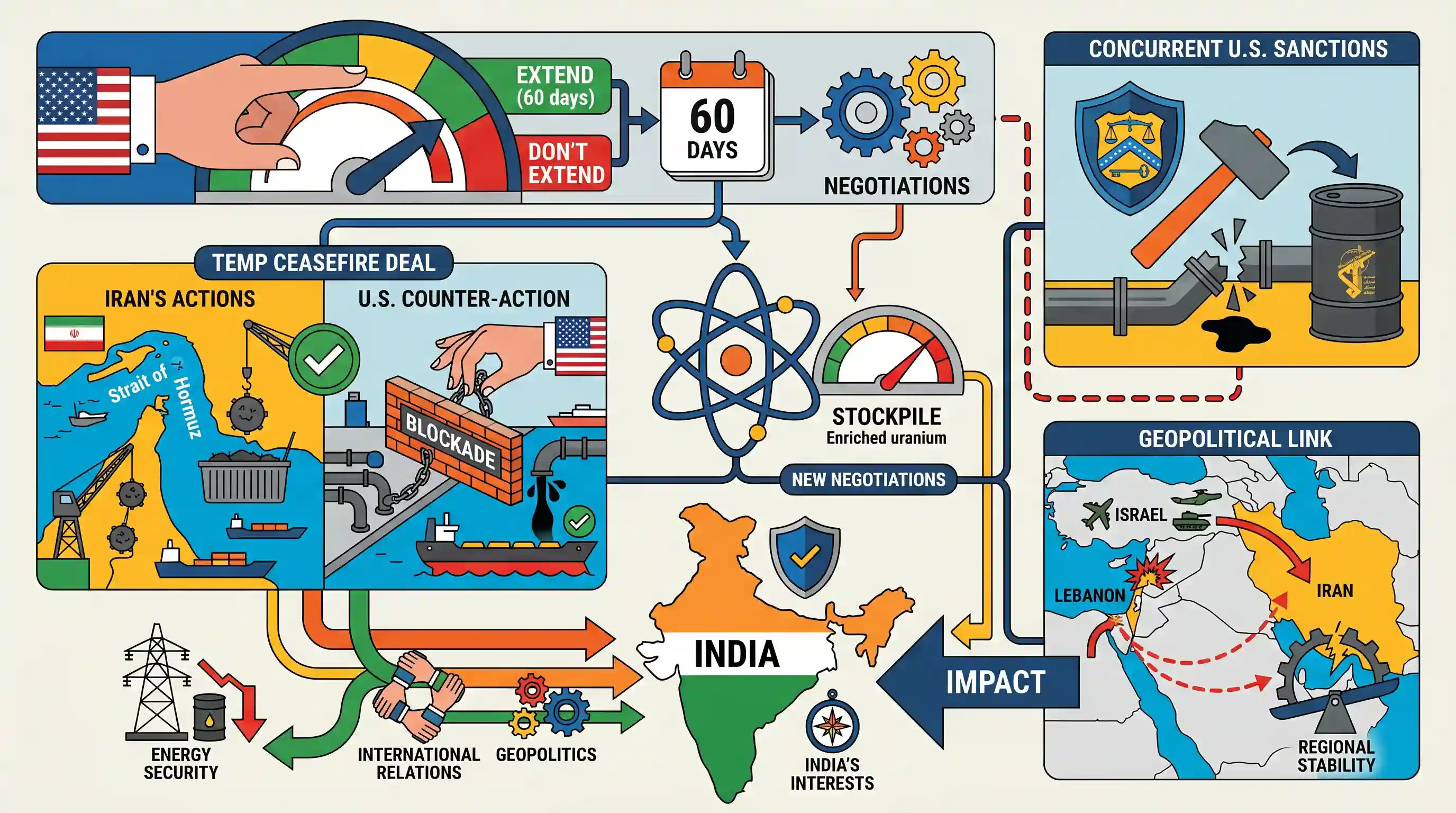
US President Donald Trump is deliberating a final decision on extending a temporary ceasefire deal with Iran for 60 days. The extension aims to initiate new negotiations regarding Iran's advancing nuclear program, which currently possesses a significant stockpile of highly enriched uranium. Key conditions of the deal involve Iran ensuring safe passage through the critical Strait of Hormuz and removing naval mines, in exchange for the US lifting its naval blockade to allow Iranian oil exports. Concurrently, the US Treasury has targeted Iran's military oil sales with fresh sanctions. The geopolitical situation remains complex as Iran links regional stability to an end to Israel's military campaign in Lebanon.
Key Points
- US President Donald Trump held high-level discussions on extending a ceasefire deal with Iran by 60 days to pave the way for new nuclear talks.
- The deal would require Iran to keep the Strait of Hormuz open without imposing tolls and to remove mines within 30 days.
- In exchange, the US would gradually lift its naval blockade on Iranian ports, allowing Iran to export oil, while currently imposing new sanctions on Iran's military oil sales network.
- Iran has amassed highly enriched uranium (440.9 kg at 60% purity), which is a short technical step away from weapons-grade levels.
- Iran also demands an end to Israel's military operations against Hezbollah in Lebanon as part of a broader de-escalation effort.
Important Terms
Strait of Hormuz

A critical maritime chokepoint between the Persian Gulf and the Gulf of Oman, essential for global energy security as it handles approximately one-fifth of the world's oil supply.
UPSC context
GS Paper II: International Relations; crucial for energy security, maritime trade routes, and West Asia geopolitics.
Highly Enriched Uranium (HEU)
Uranium enriched to 20% or more (specifically 60% in Iran's case), representing a significant step toward the 90% purity required for nuclear weapons.
UPSC context
GS Paper III: Science & Technology and Internal Security; relates to nuclear non-proliferation and global security frameworks.
Hezbollah
A Lebanon-based Shia militant group and political party backed by Iran, acting as a key proxy in regional conflicts against Israel.
UPSC context
GS Paper II: International Relations; central to West Asian stability and non-state actor dynamics.
U.S. Department of the Treasury
The US federal department responsible for managing government revenue and enforcing economic sanctions to achieve foreign policy and national security goals.
UPSC context
GS Paper II: International Relations; tests understanding of economic diplomacy and the impact of Western policies on global trade.
Naval Blockade
A military effort to cut off supplies, war material, or communications from a particular area by force, often used as a tool of economic warfare.
UPSC context
GS Paper II/III: International Relations and Security; concerns maritime laws and strategic military doctrines.
International Atomic Energy Agency (IAEA)
An autonomous international organization that seeks to promote the peaceful use of nuclear energy and inhibit its use for any military purpose.
UPSC context
GS Paper II: International Organizations; critical for understanding global governance and nuclear safeguards.
Prelims Trap
"Uranium enriched to 60% purity is classified as weapons-grade and directly usable in nuclear warheads."
Weapons-grade uranium requires ~90% enrichment (U-235). While 60% is Highly Enriched Uranium (HEU) and a dangerous technical threshold, it still requires further enrichment for a bomb.
Static Concepts Connected
What are the geographical parameters of the Strait of Hormuz?
- Water bodies: It connects the Persian Gulf to the Gulf of Oman and the Arabian Sea.
- Bordering nations: It is flanked by Iran to the north and Oman (Musandam Peninsula) to the south.
- Strategic significance: It is a critical maritime chokepoint through which approximately 20% of global oil consumption passes daily.
How is Uranium enrichment classified for civilian and military use?
- Low Enriched (LEU): Contains 3-5% U-235, which is the standard level required for commercial nuclear power reactors.
- Highly Enriched (HEU): Contains 20% or more U-235. Used in research reactors and naval propulsion. Reaching 60% represents a dangerous technical threshold.
- Weapons-grade: Requires approximately 90% U-235 enrichment to sustain the explosive, runaway chain reaction needed for a nuclear bomb.
Cross-Topic Patterns
INSTC and Chabahar Port viability
De-escalation between the US and Iran directly boosts India’s strategic connectivity ambitions, shielding Chabahar Port operations and the International North-South Transport Corridor (INSTC) from secondary US sanctions.
CAATSA and India's energy security
If the US lifts its blockade on Iranian oil, India could resume cheaper energy imports, diversifying its crude basket and easing reliance on Russia and Middle Eastern allies.

Map questions pairing West Asian maritime chokepoints (Hormuz, Bab-el-Mandeb) with proxy-conflict actors are highly probable for 2026.
Linked PYQs · 4
Linked PYQs · 4
- 2018MainsGS2
In what ways would the ongoing US-Iran Nuclear Pact Controversy affect the national interest of India? How should India respond to this situation?
- 2012MainsGS2
How have the US sanctions against Iran affected India's bilateral relations with Iran?
- 2017MainsGS2
The question of India's Energy Security constitutes the most important part of India's economic progress. Analyze India's energy policy cooperation with West Asian countries.
- 2024PrelimsGS1
Consider the following statements : Statement-I : Sumed pipeline is a strategic route for Persian Gulf oil and natural gas shipments to Europe. Statement-II : Sumed pipeline connects the Red Sea with the Mediterranean Sea. Which one of the following is correct in respect of the above statements?
