Executive Authority and Rule of Law in US Politics
Source:Indian Express ↗
Why It Matters
Provides critical insights into the functioning of democratic institutions under pressure from populist leadership, highlighting the vulnerability of the rule of law to overwhelming political power. It is useful for analyzing checks and balances, comparing democratic systems (India vs. US) in GS2, and addressing the ethics of political power and constitutional morality in GS4.
Summary
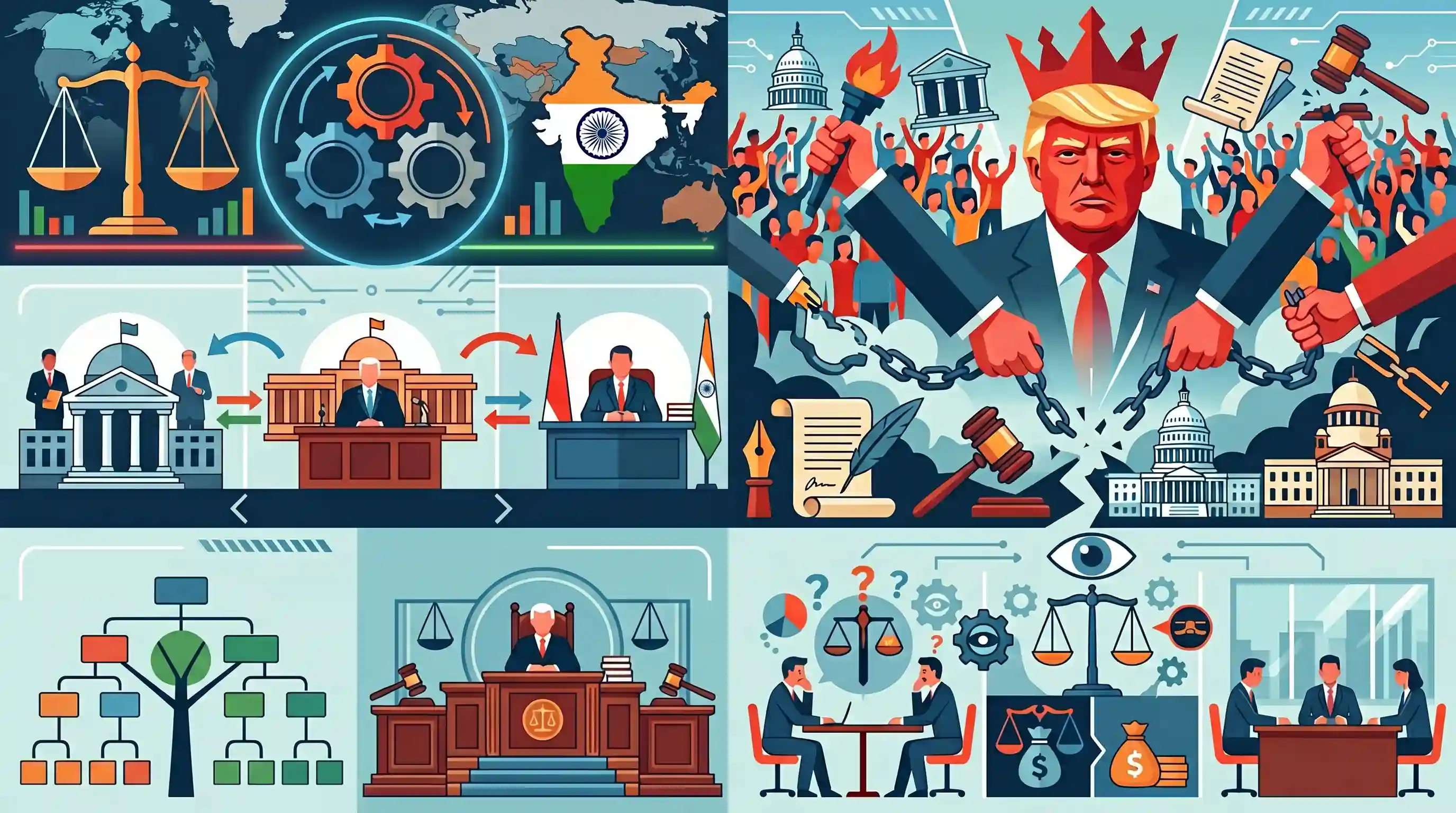
The article analyzes the ongoing dynamics in US politics concerning Donald Trump, arguing that while his actions may challenge established legal norms and the rule of law, his immense political capital and popular mandate give him a distinct upper hand in the broader power game. It highlights the tension between institutional checks and raw political power, raising questions about the resilience of democratic institutions when confronted by populist leaders who leverage their political base to override legal vulnerabilities.
Key Points
- Highlights the conflict between constitutional legal frameworks (rule of law) and popular political mandates in modern democracies.
- Analyzes Donald Trump's strategy of utilizing his political power and popular support to mitigate and transcend legal challenges.
- Raises concerns over the potential erosion of democratic institutions and checks and balances when raw political power supersedes legal accountability.
- Illustrates how a strong populist base can shield leaders from conventional legal consequences, altering the dynamics of governance and executive authority.
- Serves as a comparative case study on the resilience of democratic systems against executive dominance, offering insights relevant to other large democracies facing populist pressures.
Important Terms
Separation of Powers

The doctrine dividing government into legislative, executive, and judicial branches to prevent the concentration of power. The US follows a strict model, while India features functional overlap between the executive and legislature.
UPSC context
GS Paper II: Essential for comparing constitutional schemes and understanding the boundaries between the Judiciary, Executive, and Legislature.
Rule of Law
The principle that all individuals and institutions are subject to and accountable to law that is fairly applied. It is a 'basic structure' feature of the Indian Constitution, ensuring no one is above the law.
UPSC context
GS Paper II: Fundamental to governance and the protection of rights; tests the difference between 'rule of law' and 'rule by law'.
Populism
A political approach appealing to the 'ordinary person' against the 'elite.' In democratic contexts, it often involves leaders leveraging a popular mandate to challenge established institutional checks and legal norms.
UPSC context
GS Paper IV & II: Relevant for discussions on ethical governance, majoritarianism, and challenges to the resilience of democratic institutions.
US Supreme Court
The highest judicial body in the US, known for its life-tenured judges and the 'due process of law' standard. Unlike India's integrated system, it operates within a dual court (federal vs. state) framework.
UPSC context
GS Paper II: Key for the syllabus topic 'Comparison of the Indian constitutional scheme with that of other countries.'
Judicial Review
The power of the judiciary to examine and invalidate legislative or executive actions that violate the constitution. It is explicit in the Indian Constitution but was established as an implied power in the US.
UPSC context
GS Paper II: Central to judicial independence and the 'Basic Structure' doctrine; tests the court's role as a constitutional guardian.
Checks and Balances
Constitutional mechanisms that allow each branch of government to limit the powers of the others. Examples include the Presidential veto in the US and the No-Confidence Motion in India.
UPSC context
GS Paper II: Vital for understanding how democracies prevent authoritarianism through institutional restraint.
Prelims Trap
"The Prime Minister of India enjoys constitutional immunity from criminal proceedings during their term of office."
Article 361 grants criminal immunity only to the President and Governors during their term. The Prime Minister enjoys no such constitutional immunity, making them strictly subject to ordinary laws.
Static Concepts Connected
How does executive immunity differ between the Indian and US constitutional schemes?
- US President: Enjoys absolute immunity from criminal prosecution for official acts within core constitutional powers, per the 2024 US Supreme Court ruling.
- Indian President/Governors: Article 361 grants them absolute immunity from criminal proceedings, but strictly only during their term of office.
- Indian Prime Minister: Possesses no explicit constitutional immunity from criminal proceedings at any time, ensuring strict equality before the law.
What are the core elements of A.V. Dicey's Rule of Law applicable in India?
- Absence of Arbitrary Power: No individual can be punished or made to suffer except for a distinct breach of law established in the ordinary legal manner.
- Equality Before Law: Equal subjection of all citizens, including executive heads, to the ordinary law of the land, as embodied in Article 14.
Cross-Topic Patterns
Populism vs. Constitutional Morality
The tension between a leader's popular mandate and legal constraints links directly to GS4 Ethics case studies on institutional integrity, ethical leadership, and the 'will to power'.
Separation of Powers: US vs India
The US rigid separation relies heavily on judicial interpretation of executive privilege, whereas India checks the executive continuously via the Council of Ministers' collective responsibility to the legislature (Article 75).

Expect a GS2 Mains question comparing executive immunities and the resilience of constitutional morality in India vs the US.
Linked PYQs · 4
Linked PYQs · 4
- 2018MainsGS2
India and USA are two large democracies. Examine the basic tenets on which the two political systems are based.
- 2020MainsGS4
‘The will to power exists, but it can be tamed and be guided by rationality and principles of moral duty.’ Examine this statement in the context of international relations.
- 2025MainsGS2
"Constitutional morality is the fulcrum which acts as an essential check upon the high functionaries and citizens alike...." In view of the above observation of the Supreme Court, explain the concept of constitutional morality and its application to ensure balance between judicial independence and judicial accountability in India.
- 2025MainsGS4
"Constitutional morality is not a natural sentiment but a product of civil education and adherance of the rule of law." Examine the significance of constitutional morality for public servant highlighting the role in promoting good governance and ensuring accountability in public administration.
