US Imposes Trade Tariffs on Nations Doing Business with Iran
Source:The Hindu ↗
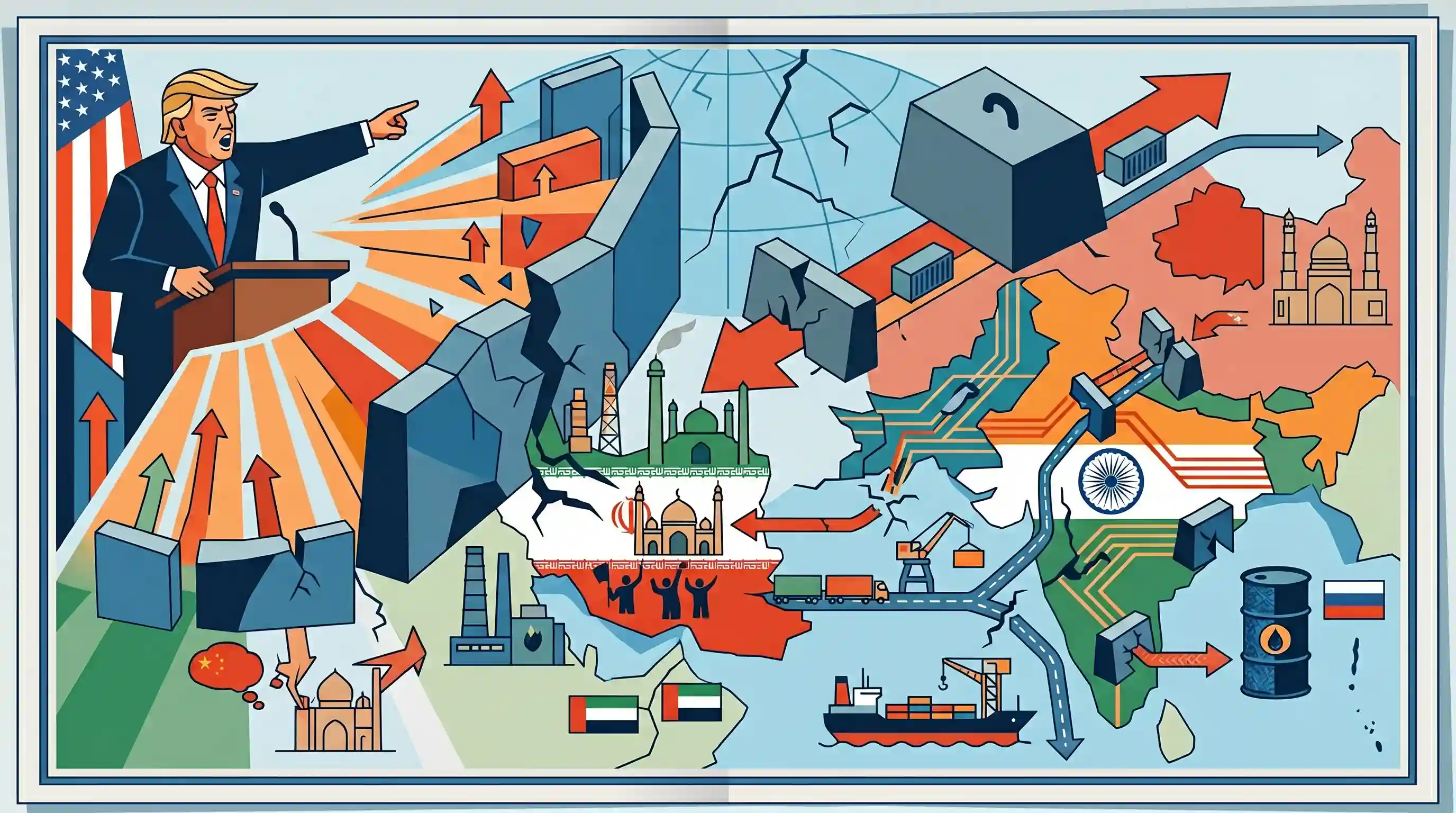
Why It Matters
U.S. tariffs functioning as secondary sanctions directly impinge on India's strategic autonomy, energy security, and major connectivity initiatives like the Chabahar port. Understanding the ripple effects of global protectionism on India's macroeconomic stability and foreign policy is a core UPSC GS2 and GS3 theme.
Summary
U.S. President Donald Trump has announced a 25% tariff on any nation trading with Iran, attempting to pressure Tehran over internal anti-government protests. This move threatens to disrupt trade for major partners like India, China, and the UAE. The announcement follows recently imposed 50% U.S. tariffs on India, which notably include a 25% levy on Russian energy purchases. India-Iran bilateral ties, highlighted by the strategic Chabahar Port project and the International Transport and Transit Corridor, face potential headwinds amid escalating U.S. trade protectionism and sanctions.
Key Points
- U.S. President Donald Trump announced a 25% tariff on any country doing business with Iran to pressure Tehran over its crackdown on anti-government protests.
- The tariffs could heavily impact India, China, and the UAE, who are among Iran's top trading partners.
- The U.S. has already imposed a 50% tariff on India, which includes a 25% levy for purchasing Russian energy.
- India and Iran share critical connectivity ties, notably through the Chabahar Agreement and India's 10-year contract to operate the Shahid Beheshti Terminal at Chabahar Port.
Important Terms
Chabahar Agreement

A 2016 trilateral pact between India, Iran, and Afghanistan creating a transit corridor. In 2024, it was bolstered by a 10-year contract allowing India to operate Iran's Chabahar Port.
UPSC context
GS Paper 2: Strategic connectivity, bypassing Pakistan, and India-Iran-Afghanistan trilateral relations.
International Transport and Transit Corridor (INSTC)
A 7,200-km multi-modal network (ship, rail, road) linking India to Russia via Iran. It aims to reduce transit time by 40% compared to the Suez Canal route.
UPSC context
GS Paper 3: Infrastructure and trade; GS Paper 2: India-Russia-Iran regional cooperation.
India Ports Global Limited (IPGL)
An Indian state-owned company formed to develop and operate ports overseas. It manages the Shahid Beheshti terminal at Chabahar, representing India’s first major overseas port management venture.
UPSC context
GS Paper 2: Institutional mechanisms for implementing India’s maritime and foreign policy.
Ports and Maritime Organisation (PMO) of Iran
The Iranian government body responsible for regulating maritime trade and port infrastructure. It is the official counterpart to India’s IPGL in the Chabahar Port operational contract.
UPSC context
GS Paper 2: Bilateral agreements and regulatory frameworks in international relations.
Secondary Sanctions
Economic penalties applied by a country (e.g., USA) against foreign entities that engage in business with a sanctioned nation (e.g., Iran), often used to enforce extra-territorial policy goals.
UPSC context
GS Paper 2: Effect of policies of developed countries on India’s strategic and economic interests.
Shahid Beheshti Terminal
The specific deep-water terminal at Chabahar Port developed by India. It serves as the primary hub for Indian cargo moving toward Afghanistan and Central Asia.
UPSC context
GS Paper 3: Strategic infrastructure; GS Paper 2: Regional connectivity and trade.
Observatory of Economic Complexity (OEC)
An online data visualization platform that tracks international trade flows and product complexity. It is used by policymakers to analyze bilateral trade dependencies and economic diversification.
UPSC context
GS Paper 3: Indian Economy and trade data analysis.
Prelims Trap
"U.S. secondary sanctions and tariffs on countries trading with Iran are legally binding under international law."
Only sanctions authorized by the UN Security Council are universally binding. U.S. secondary sanctions are unilateral domestic laws applied extraterritorially, lacking international legal authority.
Static Concepts Connected
What is the difference between primary and secondary sanctions?
- Primary sanctions: Prohibits domestic U.S. entities and citizens from engaging in trade, finance, or business with the targeted nation.
- Secondary sanctions: Targets third-party nations (like India), threatening to cut them off from the U.S. financial system if they trade with the sanctioned state.
- Legal standing: Unlike UN Security Council sanctions, secondary sanctions are unilateral domestic measures with extraterritorial reach, lacking international legal backing.
What is the strategic significance of Iran's Chabahar Port for India?
- Strategic Location: Situated in Iran's Sistan-Balochistan province on the Gulf of Oman, it acts as a strategic counterweight to Pakistan's Gwadar port.
- Bypassing Pakistan: Provides India with a direct, alternative multi-modal trade route to landlocked Afghanistan and resource-rich Central Asia, bypassing Pakistan entirely.
- INSTC integration: Functions as a crucial gateway for the International North-South Transport Corridor (INSTC), aiming to reduce freight times to Eurasia.
Cross-Topic Patterns
Energy Security vs Strategic Autonomy
India's 85% dependence on imported crude forces a tightrope walk. Unilateral U.S. tariffs test India's strategic autonomy, forcing a balance between cheap Russian/Iranian oil and access to American export markets.
WTO rules vs Unilateral Tariffs
U.S. extraterritorial tariffs bypass multilateral consensus, directly challenging WTO principles. This links to the ongoing crisis of the paralyzed WTO Appellate Body and the global shift toward protectionism.

Expect a 2026 multi-statement question pairing Chabahar/INSTC geography with the legality of U.S. extraterritorial secondary sanctions.
Linked PYQs · 5
Linked PYQs · 5
- 2012MainsGS2
How have the US sanctions against Iran affected India's bilateral relations with Iran?
- 2018MainsGS2
In what ways would the ongoing US-Iran Nuclear Pact Controversy affect the national interest of India? How should India respond to this situation?
- 2018MainsGS3
How would the recent phenomena of protectionism and currency manipulations in world trade affect macroeconomic stability of India?
- 2025MainsGS3
What are the challenges before the Indian economy when the world is moving away from free trade and multilateralism to protectionism and bilateralism? How can these challenges be met?
- 2025MainsGS2
"Energy security constitutes the dominant kingpin of India's foreign policy, and is linked with India's overarching influence in Middle Eastern countries.” How would you integrate energy security with India's foreign policy trajectories in the coming years?
