Resumption of indirect nuclear talks between US and Iran
Source:Indian Express ↗
Why It Matters
The evolving dynamics of the US-Iran nuclear standoff have significant implications for global energy security, the geopolitical stability of West Asia, and India's strategic and economic interests in the region, including energy imports and the Chabahar Port project.
Summary
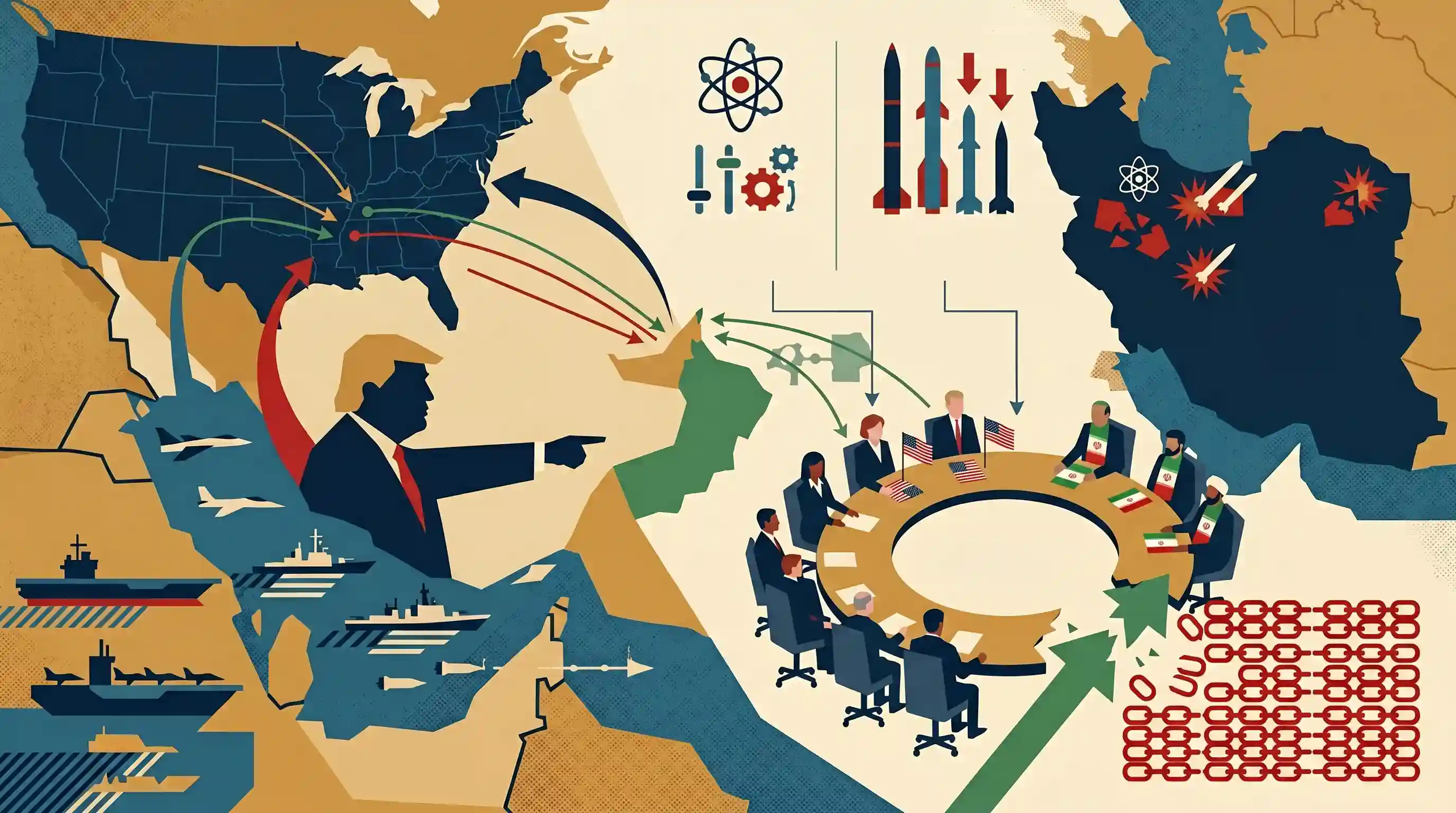
Indirect talks between the United States and Iran have resumed in Geneva, mediated by Oman, focusing on Iran's nuclear program and the lifting of US economic sanctions. The resumption of diplomacy follows a collapse in negotiations in 2025 and subsequent joint US-Israeli military strikes on Iranian nuclear sites. The negotiations are expected to cover nuclear limits and Iran's missile stockpile, with Donald Trump asserting that the display of US military force successfully pressured Tehran back to the negotiating table.
Key Points
- Indirect talks between the US and Iran regarding the latter's nuclear program have resumed in Geneva, with Oman serving as a mediator.
- These negotiations follow the collapse of talks in 2025, which culminated in a joint US-Israeli bombardment of Iranian nuclear facilities in June 2025.
- Key focus areas of the talks include the lifting of US economic sanctions, setting limits on Iran's nuclear potential, and Washington's demand to discuss Iran's missile stockpile.
- Donald Trump has claimed an indirect role in prompting the talks, citing the deterrent effect of military actions, such as the deployment of B-2 stealth bombers.
Important Terms
Joint Comprehensive Plan of Action (JCPOA)

A 2015 landmark agreement where Iran restricted its nuclear program in exchange for the lifting of international economic sanctions. The US unilaterally withdrew in 2018, leading to renewed regional tensions.
UPSC context
GS Paper II (International Relations). Crucial for understanding global non-proliferation regimes and India's balancing act between Iran and the US.
International Atomic Energy Agency (IAEA)
The UN's nuclear watchdog tasked with promoting peaceful nuclear energy while verifying that member states, like Iran, are not diverting nuclear materials for weapons development.
UPSC context
GS Paper II (International Orgs). Focuses on the role of global institutions in maintaining regional security and nuclear transparency.
Economic Sanctions
Financial and trade penalties imposed by the US that affect not only Iran but also third countries (like India) trading with it, primarily targeting oil exports and banking.
UPSC context
GS Paper II/III (IR/Economy). Essential for analyzing challenges to India's energy security and strategic projects like the Chabahar Port.
Strategic Autonomy
India’s foreign policy doctrine of making independent decisions in the national interest without being coerced by major powers, particularly while navigating the US-Israel-Iran rivalry.
UPSC context
GS Paper II (Foreign Policy). Tests the ability to evaluate India’s "Look West" policy amidst polarized global and regional alliances.
Oman Mediation
The diplomatic role of Oman as a neutral facilitator in West Asia, using its "friend to all" policy to bridge gaps between hostile nations like the US and Iran.
UPSC context
GS Paper II (Regional Groupings). Highlights the significance of neutral third-party states in resolving geopolitical stalemates affecting Indian interests.
Prelims Trap
Oman shares the Strait of Hormuz with Iran and is a key signatory to the JCPOA.
Oman is a crucial mediator and shares the Strait of Hormuz with Iran, but it is NOT a signatory to the JCPOA (which was P5+1).
Static Concepts Connected
What is the strategic geography of the Strait of Hormuz?
- Connectivity: Connects the Persian Gulf to the Gulf of Oman and the Arabian Sea.
- Bordering Nations: Bordered by Iran to the north and Oman (via the Musandam Peninsula) to the south.
- Strategic value: A critical global maritime chokepoint through which approximately 20% of the world's oil supply transits.
How do US secondary sanctions impact third-party nations like India?
- CAATSA mechanism: Penalizes non-US entities for conducting significant transactions with sanctioned countries (like Iran, Russia, and North Korea).
- Financial leverage: Enforced by threatening to cut off foreign banks and companies from the US financial system, leveraging dollar dominance.
- Chabahar exemption: India previously had to secure narrow carve-outs for the Chabahar port project due to its strategic role in Afghan reconstruction.
Cross-Topic Patterns
Iran Sanctions & Rupee-Rial Trade
The reimposition of US sanctions pushed India to explore alternative payment mechanisms, linking West Asian geopolitical crises directly to the broader push for the internationalization of the Indian Rupee.
UN vs US Sanctions Frameworks
UPSC often tests the difference between UN Security Council-mandated sanctions (binding on all members) and unilateral US sanctions (enforced extraterritorially via dollar hegemony and secondary laws).
Chokepoint Geopolitics: Bab el-Mandeb to Hormuz
The interplay of regional proxies connects maritime security in the Red Sea (Houthis) to nuclear negotiations concerning the Strait of Hormuz, testing holistic map awareness.

Map questions on Persian Gulf chokepoints (Hormuz) & mechanics of US secondary sanctions (CAATSA) are highly probable for 2026 Prelims.
Linked PYQs · 2
Linked PYQs · 2
- 2018MainsGS2
In what ways would the ongoing US-Iran Nuclear Pact Controversy affect the national interest of India? How should India respond to this situation?
- 2012MainsGS2
How have the US sanctions against Iran affected India's bilateral relations with Iran?
