US Proposed Additional Tariffs and Implications for Indian Exports
Source:Indian Express ↗
Why It Matters
This development is crucial for UPSC aspirants as it directly impacts India's macroeconomic stability, export sector, and bilateral relations with its largest trading partner. It provides a real-world case study of global protectionist trends and trade negotiations.
Summary
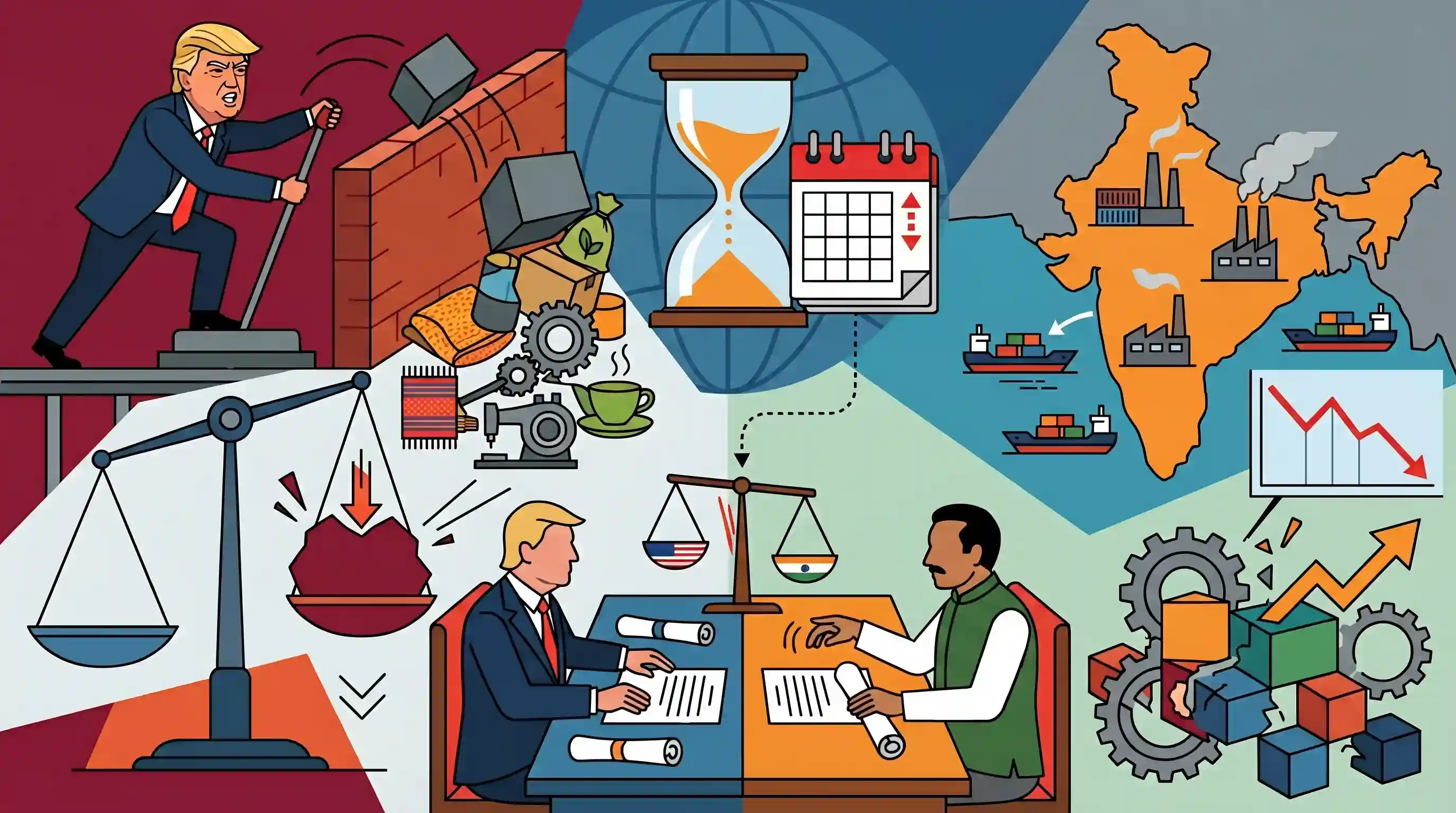
US President Donald Trump announced a sharp increase in tariffs on Indian goods, proposing a doubling of the effective rate to 50% through an additional 25% levy. However, he provided a 21-day window for trade negotiations between the two nations before the tariffs take full effect. This move is indicative of a broader protectionist trade policy aimed at leveraging trade barriers for bilateral negotiations, which could have significant implications for India's exports and macroeconomic stability.
Key Points
- The US administration under Donald Trump has proposed an additional 25% tariff on Indian imports, effectively raising the tariff rate to 50%.
- A 21-day negotiation window has been offered to India, providing an opportunity for diplomatic engagement to avert the tariff hikes.
- The proposed tariffs highlight growing protectionist trade policies in the US and could significantly impact India's export competitiveness.
- The situation necessitates strategic economic diplomacy from India to safeguard its trade interests and manage bilateral economic relations with the US.
Important Terms
World Trade Organization (WTO)

A global intergovernmental organization (est. 1995) that regulates and facilitates international trade between 164 member nations. It operates on principles of non-discrimination, transparency, and consensus-based decision-making.
UPSC context
GS Paper 2/3 (International Relations & Economy); tests knowledge of global governance and India's role in multilateral trade frameworks.
Reciprocal Tariff
A trade policy where a nation matches the import duties of a trading partner. It aims to create a 'level playing field' by retaliating against higher tariffs imposed by other countries.
UPSC context
GS Paper 3 (Economy); relevant for discussing bilateral trade tensions, India-US relations, and shifts in global trade norms.
Most Favored Nation (MFN)
A core WTO principle requiring that any trade favor or concession granted to one member nation must be extended immediately and unconditionally to all other WTO members.
UPSC context
GS Paper 3 (Economy); central to understanding non-discrimination in international trade law and WTO compliance.
Generalized System of Preferences (GSP)
A preferential trade program where developed nations provide reduced or zero-tariff access to products from developing countries to support their economic growth without requiring reciprocal concessions.
UPSC context
GS Paper 2/3; vital for historical context on India-US trade disputes and special treatment for developing economies.
Protectionism
Economic policy of restricting imports through tariffs, quotas, or regulations to shield domestic industries and workers from foreign competition.
UPSC context
GS Paper 3 (Economy); essential for analyzing globalization, 'America First' policies, and Aatmanirbhar Bharat.
Trade Deficit
An economic condition where the total value of a nation's imports of goods and services exceeds the total value of its exports within a specific period.
UPSC context
GS Paper 3 (Economy); fundamental concept for Balance of Payments (BoP) and analyzing national macroeconomic stability.
Prelims Trap
"India maintains a trade deficit with the United States, which prompted these unilateral tariff hikes."
India actually holds a massive trade surplus (over $45 billion) with the US. Aspirants often confuse India's overall global trade deficit with its bilateral surplus with America.
Static Concepts Connected
What is the difference between GSP and MFN under WTO rules?
- Most Favored Nation (MFN): A core WTO principle requiring nations to treat all member countries equally without discrimination in trade tariffs.
- Generalized System of Preferences (GSP): A permitted exception to MFN where developed nations grant preferential, duty-free market access to developing nations' exports.
- India's Status: The US revoked India's GSP beneficiary status in 2019, making Indian exports fully subject to standard US tariffs.
What are the primary trade remedy measures permitted by the WTO?
- Anti-dumping Duty: Imposed on imports that are priced below their normal fair market value in the exporting country.
- Countervailing Duty: Levied to neutralize the negative effects of specific subsidies provided by the exporting country's government.
- Safeguard Duty: A temporary emergency measure to restrict unexpected surges in imports that cause serious injury to domestic industries.
Cross-Topic Patterns
Protectionism vs. China Plus One Strategy
While the US seeks deeper strategic defense ties with India (Quad, iCET) to counter China, unilateral tariff barriers contradict these efforts by undermining India's integration into US-led resilient supply chains.
Tariff Threats + Currency Watchlist
The US often uses the Treasury's 'currency manipulator' watchlist alongside unilateral tariff threats to pressure nations running substantial bilateral trade surpluses into making rapid market-access concessions.

Expect a 2026 Prelims question linking US-India trade surplus data, GSP revocation history, and WTO MFN exceptions.
Linked PYQs · 3
Linked PYQs · 3
- 2025MainsGS3
What are the challenges before the Indian economy when the world is moving away from free trade and multilateralism to protectionism and bilateralism? How can these challenges be met?
- 2018MainsGS3
How would the recent phenomena of protectionism and currency manipulations in world trade affect macroeconomic stability of India?
- 2012MainsGS2
Discuss the likely negative impact of the protectionist measures proposed by the US on India's software industry.
