US Proposes Steep Tariffs on Copper and Pharmaceuticals
Source:Indian Express ↗
Why It Matters
Understanding protectionist policies by major economies like the US is crucial for UPSC candidates, as they directly impact India's export sectors (such as pharmaceuticals and IT) and broader macroeconomic stability. It touches upon GS2 (International Relations) and GS3 (Economy).
Summary
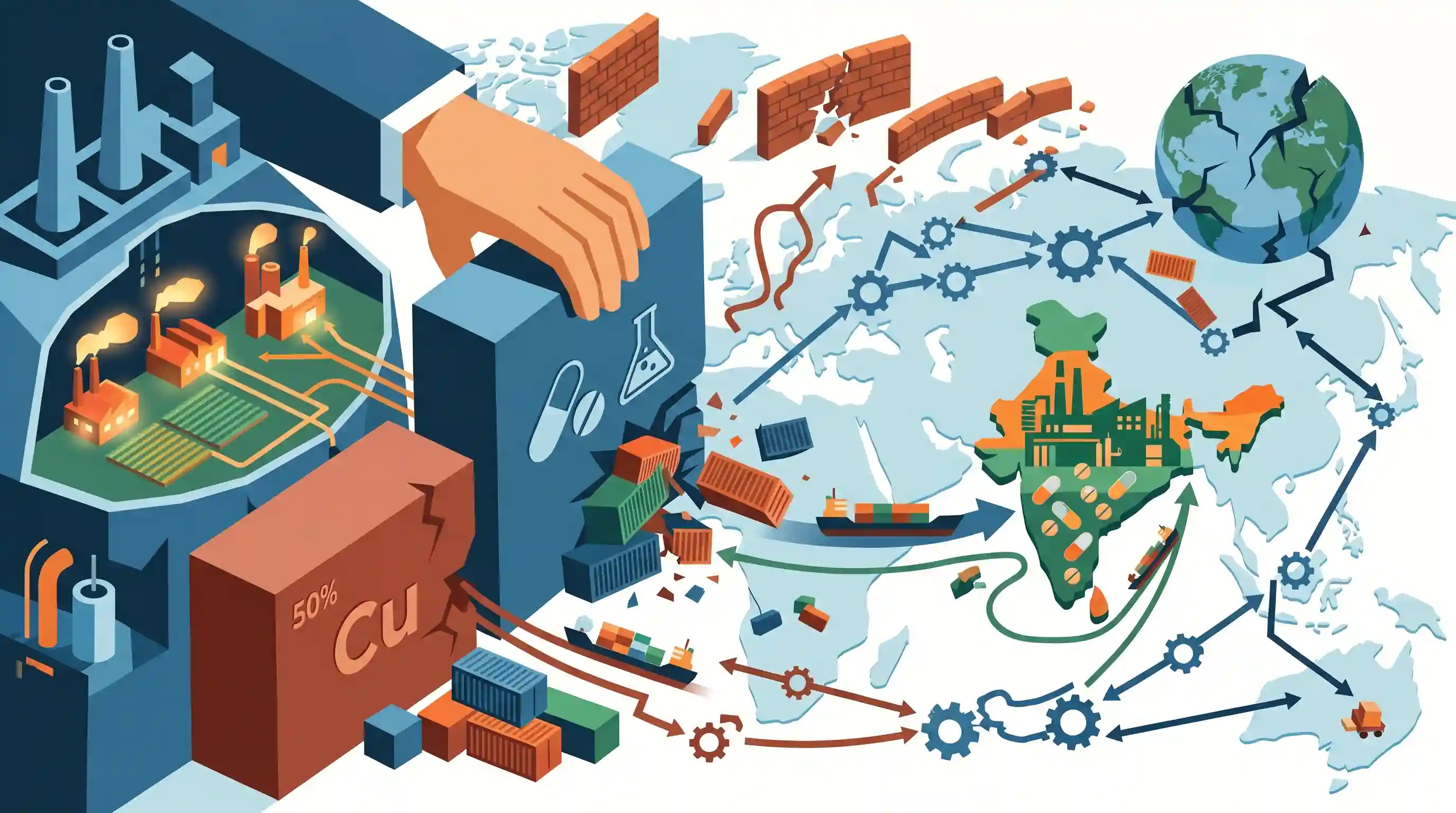
Former US President Donald Trump has proposed significant new tariffs, including a 50% duty on copper and a potential 200% tariff on pharmaceutical imports. These measures are intended to incentivize domestic manufacturing and protect US industries but threaten to severely disrupt global supply chains. For India, the pharmaceutical tariffs pose a major risk to its robust generic drug export sector. These developments reflect a broader global shift toward aggressive protectionist trade policies, challenging multilateralism and requiring strategic economic recalibration by affected nations.
Key Points
- Donald Trump has proposed a 50% tariff on imported copper, aimed at protecting domestic mining but likely to disrupt global base metal markets and increase costs for industries like electric vehicles.
- He additionally floated the possibility of imposing up to 200% tariffs on pharmaceutical imports to compel domestic manufacturing.
- This aggressive protectionist stance presents a direct threat to India's pharmaceutical export sector, which is a major global supplier of generic drugs.
- The proposed tariffs highlight an escalating shift towards bilateralism and trade protectionism by developed economies, posing macroeconomic challenges for emerging markets reliant on global trade.
Important Terms
Protectionism

Economic policy of restricting imports from other countries through methods such as high tariffs, quotas, and subsidies to shield domestic industries and workers from foreign competition.
UPSC context
GS Paper 3: Economic Development. Tests understanding of trade barriers and their impact on domestic manufacturing versus global economic integration.
World Trade Organization (WTO)
The only global international organization dealing with the rules of trade between nations, established in 1995 to ensure trade flows as smoothly, predictably, and freely as possible.
UPSC context
GS Paper 2: International Relations. Tests knowledge of international institutions and their role in resolving trade disputes and maintaining rules-based order.
Generic Drugs
Medicines manufactured without a patent that have the same active ingredients as brand-name drugs. India is the largest global provider, often called the 'Pharmacy of the World.'
UPSC context
GS Paper 3: Indian Economy. Crucial for understanding India's export strengths and the impact of external trade policies on key industrial sectors.
Tariff
A tax or duty imposed by a government on imported or exported goods, used as a tool to protect domestic industry or as a source of revenue.
UPSC context
GS Paper 3: Economic Development. Tests understanding of fiscal policy instruments and their consequences for international trade and consumer pricing.
Global Supply Chain
The worldwide network of processes and facilities that convert raw materials into finished products for delivery to customers across international borders.
UPSC context
GS Paper 3: Economy and GS Paper 2. Tests awareness of modern trade vulnerabilities and strategies like "China Plus One" for economic resilience.
Multilateralism
An alliance of multiple countries pursuing a common goal through cooperation, often formalized in international organizations based on inclusivity and shared responsibility.
UPSC context
GS Paper 2: International Relations. Tests the ability to analyze shifts from global cooperation to unilateral or bilateral trade policies.
Prelims Trap
Unilateral tariffs imposed to compel domestic manufacturing are classified as Safeguard Duties under WTO rules.
Safeguard duties are temporary, WTO-approved measures against unforeseen import surges. The proposed tariffs are unilateral, punitive measures bypassing WTO frameworks entirely.
Static Concepts Connected
What are the three WTO-compliant trade remedial measures?
- Anti-dumping Duty: Levied on imports priced below their normal value in the exporter's domestic market to protect domestic industries.
- Countervailing Duty: Imposed to neutralize the negative effects of unfair subsidies granted by the exporting country's government.
- Safeguard Duty: A temporary restriction applied to protect domestic industry from an unforeseen, massive surge in specific imports.
What are the structural vulnerabilities of India's pharma export sector?
- Export Concentration: The US is the single largest market for Indian generics, making the sector highly sensitive to US regulatory and tariff policy shifts.
- API Dependence: India relies heavily on China for Active Pharmaceutical Ingredients (APIs), creating dual supply-chain risks when Western markets erect trade barriers.
Cross-Topic Patterns
Trade Protectionism + Green Transition
Copper is a critical base metal for EVs and renewable infrastructure. Protectionist tariffs on such metals directly inflate the cost of climate change mitigation and global energy transition.
US Tariffs + India's PLI Scheme
The US push for onshoring via tariffs mirrors the global de-risking trend, reinforcing the strategic necessity of India's PLI scheme to build self-reliance in APIs and critical manufacturing.

Expect a 2026 Prelims question distinguishing WTO trade remedies from unilateral tariffs, paired with India's pharma export destinations.
Linked PYQs · 4
Linked PYQs · 4
- 2025MainsGS3
What are the challenges before the Indian economy when the world is moving away from free trade and multilateralism to protectionism and bilateralism? How can these challenges be met?
- 2018MainsGS3
How would the recent phenomena of protectionism and currency manipulations in world trade affect macroeconomic stability of India?
- 2012MainsGS2
Discuss the likely negative impact of the protectionist measures proposed by the US on India's software industry.
- 2021PrelimsGS1
Why is there a concern about copper smelting plants? 1. They may release lethal quantities of carbon monoxide into environment. 2. The copper slag can cause the leaching of some heavy metals into environment. 3. They may release sulphur dioxide as a pollutant. Select the correct answer using the code given below.
