US leadership expresses optimism for Gaza ceasefire
Source:The Hindu ↗
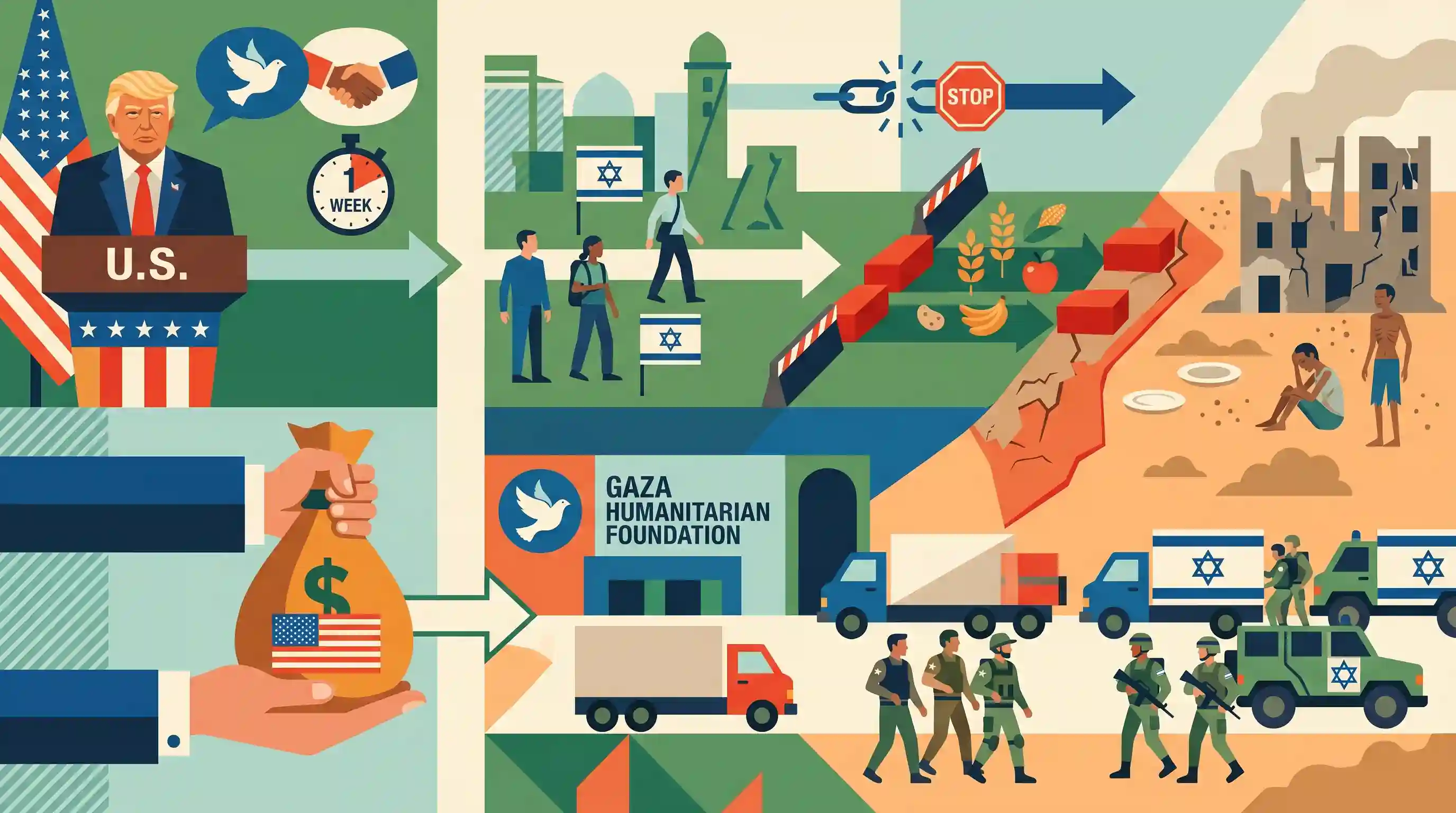
Why It Matters
The Gaza conflict directly impacts global energy security, Middle Eastern geopolitical stability, and international humanitarian law. Understanding the roles of external powers like the U.S. and the mechanisms of humanitarian aid in conflict zones is essential for analyzing international relations dynamics.
Summary
U.S. President Donald Trump has expressed hope for a renewed Gaza ceasefire between Israel and Hamas potentially occurring within a week. This follows a period of intense conflict after Israel walked back from a previous U.S.-brokered truce. Concurrently, efforts are being made to address the dire humanitarian crisis and looming famine in Gaza, where Israel had blocked food supplies for months. Aid is now set to resume via the newly established Gaza Humanitarian Foundation, a $30 million U.S.-funded initiative that involves private security contractors working alongside Israeli forces.
Key Points
- U.S. President Donald Trump expressed optimism about a potential Gaza ceasefire agreement between Israel and Hamas as early as next week.
- The development follows Israel's earlier declaration that the previous U.S.-brokered ceasefire was over, resulting in resumed airstrikes.
- Gaza faces a severe humanitarian crisis, with food and supplies having been blocked by Israel for over two months, raising warnings of famine.
- Food delivery is resuming through the controversial Gaza Humanitarian Foundation, which involves U.S. funding ($30 million), security contractors, and coordination with Israeli troops.
Important Terms
Hamas

A Palestinian Sunni-Islamic militant organization governing Gaza since 2007. In current peace negotiations, it remains a primary actor facing demands for disarmament and the release of hostages in exchange for a permanent ceasefire.
UPSC context
GS Paper II: International Relations. Relevant for understanding non-state actors in the Israel-Palestine conflict and India’s West Asia policy.
Gaza Humanitarian Foundation (GHF)
A U.S.-Israeli-backed nonprofit established in 2025 to deliver aid in Gaza. It utilizes private security contractors to secure distribution, aiming to bypass traditional UN agencies like UNRWA amidst conflict.
UPSC context
GS Paper II: International Relations/Humanitarian Aid. Tests the shift from multilateral (UN) to private/bilateral aid mechanisms in conflict zones.
Board of Peace
A specialized U.S. administrative body established by the Trump administration to oversee policy, reconstruction, and security in Gaza, specifically implementing the "Comprehensive 20-Point Plan" for regional stabilization.
UPSC context
GS Paper II: International Relations. Focuses on U.S. foreign policy structures and diplomatic initiatives in the Middle East.
West Asia Geopolitics
The complex interplay of political, economic, and security interests in the Middle East. It involves power struggles between state and non-state actors and the influence of external powers like the U.S.
UPSC context
GS Paper II: International Relations. Essential for analyzing regional stability, energy security, and India’s strategic "Link West" policy.
Private Security Contractors
Private companies providing armed security services. In Gaza, they have been tasked with guarding aid distribution sites under GHF, raising legal and ethical questions about the "militarization" of humanitarian assistance.
UPSC context
GS Paper III: Security. Concerns the role of non-state military actors in international law and humanitarian operations.
Comprehensive 20-Point Plan
A strategic framework proposed by the U.S. in late 2025 involving three phases: a ceasefire, the disarmament of militant factions (like Hamas), and the establishment of a technocratic Palestinian government.
UPSC context
GS Paper II: International Relations. Relevant for studying conflict resolution models and peace-building efforts in the Middle East.
Prelims Trap
The Gaza Humanitarian Foundation is a specialized agency under the United Nations established to replace UNRWA.
The Gaza Humanitarian Foundation is a $30 million U.S.-funded ad-hoc initiative using private security contractors. It is not a UN agency or multilateral institution.
Static Concepts Connected
How does International Humanitarian Law (IHL) treat starvation as a warfare method?
- Geneva Conventions: Starvation of civilians as a method of warfare is explicitly prohibited under the Additional Protocols to the 1949 Geneva Conventions.
- Rome Statute: The International Criminal Court (ICC) classifies intentional starvation by depriving civilians of indispensable objects as a prosecutable war crime.
- Relief Access: IHL mandates all parties to a conflict to allow and facilitate rapid, unimpeded passage of impartial humanitarian relief for civilians.
How are Private Military and Security Companies (PMSCs) regulated under international law?
- Montreux Document: A 2008 intergovernmental document (though non-binding) that reaffirms existing international legal obligations regarding PMSCs operating in armed conflicts.
- State Responsibility: Contracting states cannot outsource their obligations; they remain legally responsible for IHL or human rights violations committed by the PMSCs they employ.
- Accountability Gaps: PMSCs operate outside conventional state military chains of command, presenting highly complex jurisdictional and accountability challenges for war crime prosecution.
Cross-Topic Patterns
Bypassing UN frameworks in aid
Shifting aid from the UN Relief and Works Agency (UNRWA) to ad-hoc bodies like the U.S.-funded Gaza Humanitarian Foundation reflects a growing trend of bypassing multilateral UN institutions in geopolitics.
IMEC and regional instability
Ongoing West Asian volatility, requiring constant U.S.-brokered ceasefires, highlights why geoeconomic mega-projects like the India-Middle East-Europe Economic Corridor (IMEC) remain stalled pending sustained conflict resolution.

Expect 2026 Prelims to test UNRWA's mandate vs. ad-hoc aid bodies, or a multi-statement question on IHL provisions regarding starvation.
Linked PYQs · 3
Linked PYQs · 3
- 2018PrelimsGS1
The term "two-state solution" is sometimes mentioned in the news in the context of the affairs of
- 2023PrelimsGS1
Consider the following statements: Statement-I: Israel has established diplomatic relations with some Arab States. Statement-II: The 'Arab Peace Initiative' mediated by Saudi Arabia was signed by Israel and Arab League. Which one of the following is correct in respect of the above statements?
- 2018MainsGS2
“India’s relations with Israel have, of late, acquired a depth and diversity, which cannot be rolled back.” Discuss.
