US Section 122 Global Tariffs and Impact on Indian Exports
Source:Indian Express ↗
Why It Matters
Students must understand the economic fallout of shifting global trade paradigms from multilateral free trade to unilateral protectionism, specifically its impact on India's export economy, macroeconomic stability, and the relevance of the WTO.
Summary
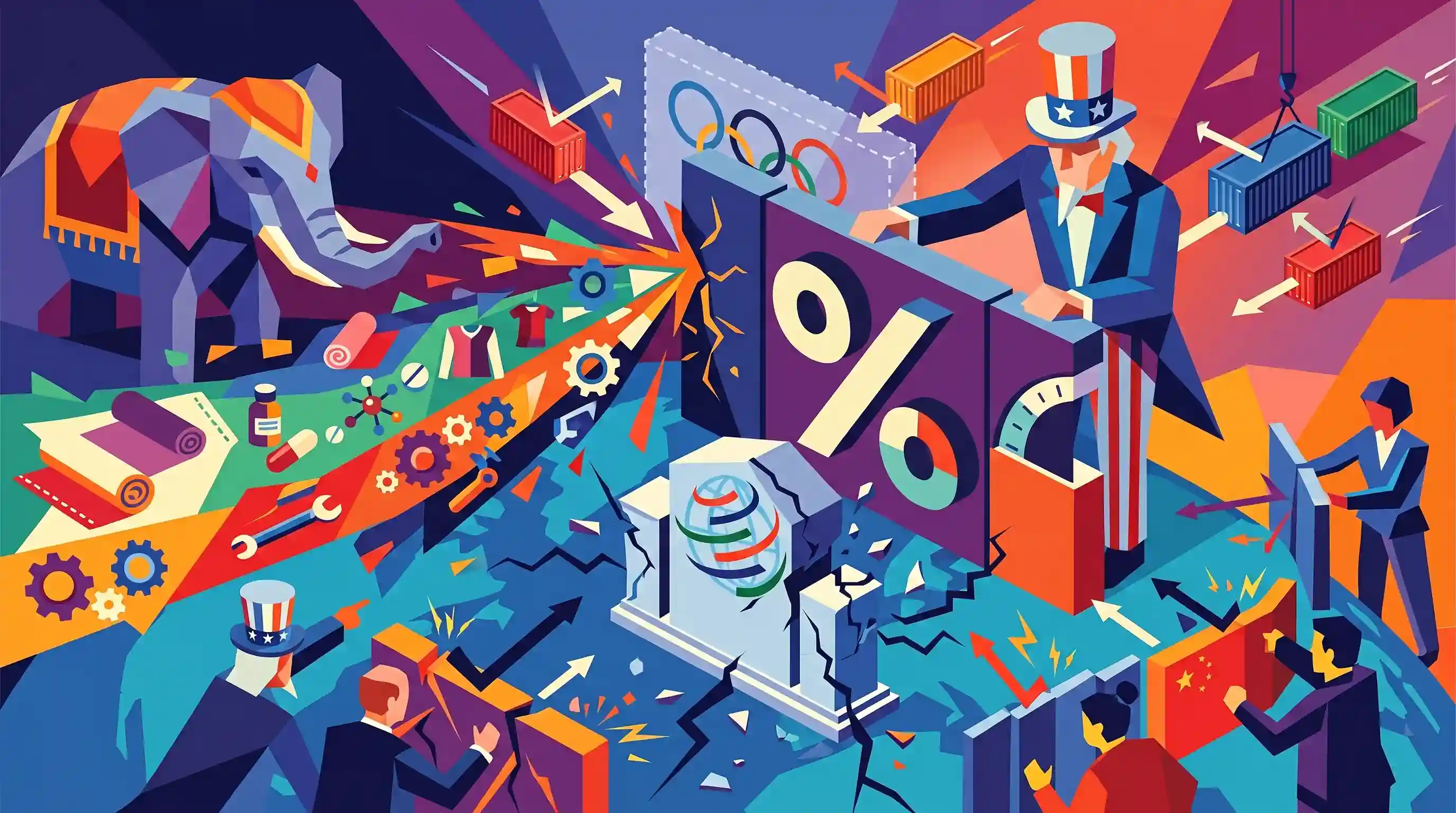
The article examines the implementation of a new 10% global tariff on imports by the US, invoked under Section 122 of the Trade Act of 1974 to address balance-of-payments deficits. Originally floated at 15%, the blanket tariff signals a strong pivot towards protectionism. The US being India's largest trading partner, this move will significantly impact Indian exports across key sectors such as textiles, pharmaceuticals, and engineering goods. Beyond bilateral impacts, the unilateral action undermines the World Trade Organization's (WTO) free-trade mechanisms and raises the imminent risk of retaliatory tariffs from other major economies, potentially triggering a broader global trade war.
Key Points
- The US administration has invoked Section 122 of the Trade Act of 1974 to impose a 10% blanket global tariff on imports, aimed at addressing the country's balance-of-payments deficit.
- Although scaled back from a proposed 15%, this unilateral tariff represents a major escalation in protectionist trade policies by the US.
- The move will directly hurt Indian exports, particularly in crucial sectors like pharmaceuticals, gems and jewellery, engineering goods, and textiles, by making them less competitive in the American market.
- This broad-based tariff bypasses the multilateral frameworks of the World Trade Organization (WTO) and threatens to trigger global retaliatory trade wars, further disrupting supply chains.
Important Terms
Section 122 of the Trade Act of 1974

A U.S. law granting the President authority to impose temporary import surcharges (up to 15%) for 150 days to address "large and serious" balance-of-payments deficits.
UPSC context
GS Paper 2 & 3; important for analyzing unilateral trade measures and executive powers in international trade.
World Trade Organization (WTO)
The global international organization that deals with the rules of trade between nations, ensuring trade flows as smoothly, predictably, and freely as possible.
UPSC context
GS Paper 2; central to global governance and the rules-based multilateral trading system.
Protectionism
Economic policies, such as tariffs and quotas, designed to restrict imports to shield domestic industries and employment from foreign competition.
UPSC context
GS Paper 3; critical for discussing globalization challenges and their impact on Indian export competitiveness.
Retaliatory Tariffs
Additional duties imposed by a country in response to tariffs or trade barriers levied by a partner country, aimed at forcing the removal of the original barrier.
UPSC context
GS Paper 2; essential for understanding bilateral trade friction and the mechanics of a trade war.
Balance of Payments (BoP) Deficit
An economic situation where a country's total expenditure on imports and capital transfers abroad exceeds its total income from exports and foreign investments.
UPSC context
GS Paper 3; a fundamental macroeconomic concept for analyzing the external sector and currency stability.
Most-Favored-Nation (MFN) Status
A core WTO principle requiring that a trade advantage granted to one member country must be extended to all other WTO members without discrimination.
UPSC context
GS Paper 3; tests knowledge of international trade agreements and non-discriminatory trade practices.
Prelims Trap
The WTO completely prohibits member nations from imposing broad import restrictions to address balance-of-payments deficits.
False. Under GATT Article XII, the WTO *does* permit temporary BOP-related import restrictions, provided they are non-discriminatory and undergo multilateral review by the WTO BOP Committee and IMF.
Static Concepts Connected
How does the WTO regulate import restrictions for Balance-of-Payments (BOP) deficits?
- GATT Article XII: Allows member states to restrict imports temporarily to safeguard their external financial position and balance of payments.
- Strict Conditions: Measures must be price-based (like surcharges), non-discriminatory, and not exceed what is necessary to stop a serious decline in foreign exchange reserves.
- IMF Consultation: The WTO BOP Committee must consult the International Monetary Fund (IMF) to objectively assess the member's financial claims and external reserve levels.
What are the structural realities of India-US bilateral trade?
- Largest Trading Partner: The US is consistently India's top export destination and largest overall trading partner, frequently alternating the top spot with China depending on the fiscal year.
- Trade Surplus: Unlike its massive deficit with China, India maintains a significant bilateral trade surplus with the US across both goods and services.
- Export Basket: Major Indian goods exported include pharmaceuticals, gems and jewellery, textiles, and engineering goods—employment-intensive sectors highly vulnerable to US tariff hikes.
Cross-Topic Patterns
Protectionism vs. India's FTA Push
As the US turns protectionist, India's recent drive to diversify markets via FTAs (UAE, Australia, EFTA) is critical to buffer shocks and meet its $2 trillion 2030 export target.
Global Tariffs and Currency Dynamics
US blanket tariffs curb imports and typically strengthen the Dollar. This strains emerging market currencies like the Rupee, increasing India's imported inflation burden, especially for crude oil.

Expect a 2026 Prelims question on WTO exceptions (GATT Art XII/XXI) or a Mains question on India's export resilience amid deglobalization.
Linked PYQs · 3
Linked PYQs · 3
- 2025MainsGS3
What are the challenges before the Indian economy when the world is moving away from free trade and multilateralism to protectionism and bilateralism? How can these challenges be met?
- 2018MainsGS3
How would the recent phenomena of protectionism and currency manipulations in world trade affect macroeconomic stability of India?
- 2018MainsGS2
What are the key areas of reform if the WTO has to survive in the present context of "Trade War', especially keeping in mind the interest of India?
