United States President Sets Two Week Deadline for Ukraine Peace Talks
Source:The Hindu ↗
Why It Matters
The US-led push for peace in the Russia-Ukraine war is a crucial geopolitical development. The outcome of these negotiations will directly impact global security architectures, East-West relations, and energy markets. Furthermore, India's endorsement highlights its ongoing diplomatic tightrope walk to maintain strategic autonomy while preserving robust ties with both the US and Russia.
Summary
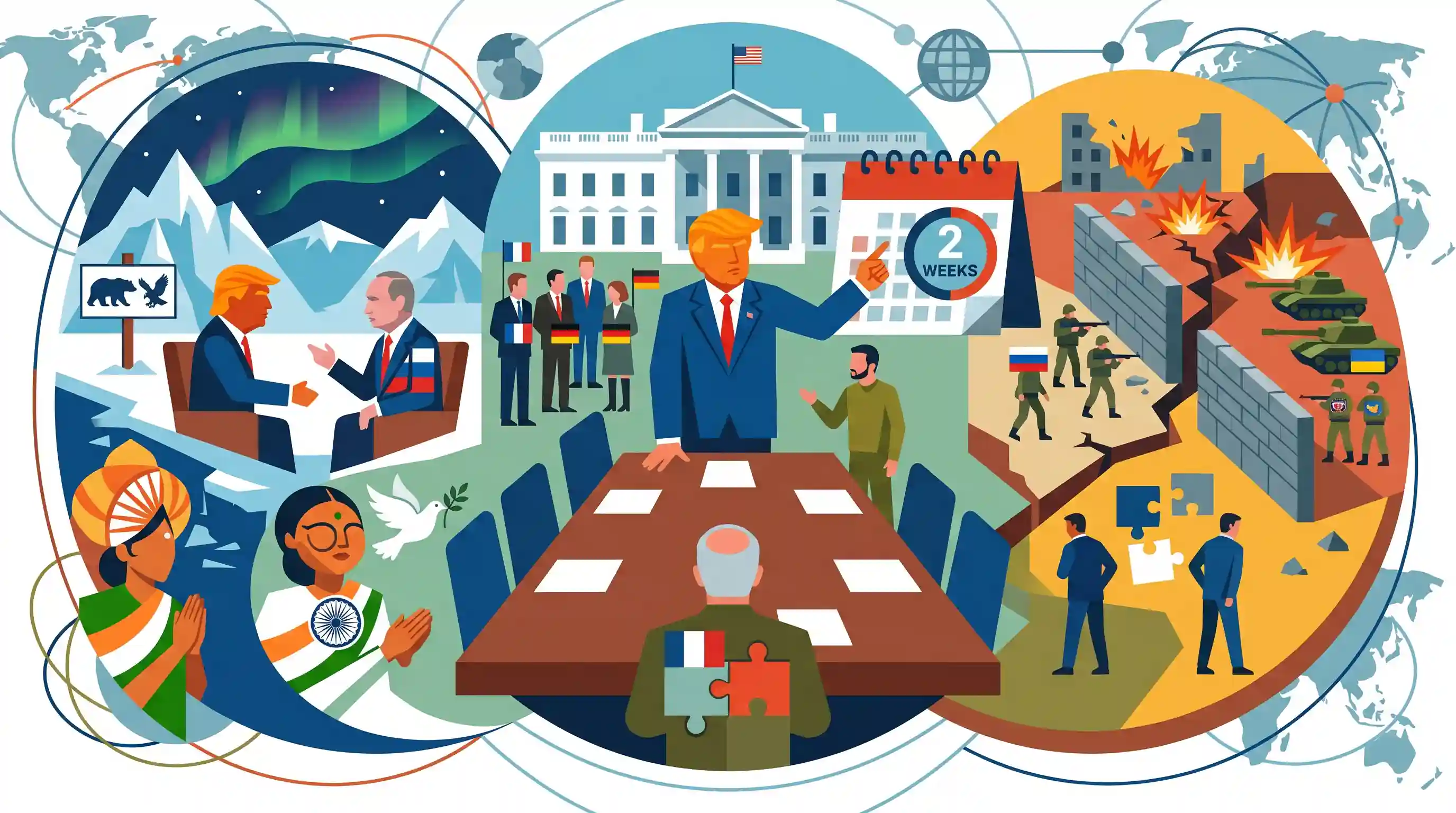
U.S. President Donald Trump has established a two-week deadline to assess the viability of peace negotiations concerning the Russia-Ukraine war. This development follows a high-profile but inconclusive summit with Russian President Vladimir Putin in Alaska, along with separate meetings involving Ukrainian President Volodymyr Zelenskyy and European allies at the White House. Both warring nations remain deadlocked, trading accusations over incompatible security demands and reluctance to engage in direct talks. Notably, India endorsed the diplomatic efforts at the Alaska summit, reflecting its continuous support for a negotiated settlement.
Key Points
- US President Donald Trump has issued a two-week timeframe to evaluate the potential for peace negotiations between Russia and Ukraine.
- A recent summit in Alaska between Trump and Russian President Vladimir Putin concluded without reaching an accord.
- Trump has also held consultations with Ukrainian President Volodymyr Zelenskyy and European allies at the White House.
- Negotiations remain stalled as Ukraine accuses Russia of avoiding meetings, while Russia claims Ukraine is demanding incompatible security guarantees.
- India has officially endorsed the Trump-Putin summit in Alaska, reiterating its stance that diplomacy and dialogue are key to resolving the conflict.
Important Terms
Strategic Autonomy

India's ability to take independent foreign policy and security decisions based on national interest without being constrained by external powers or formal military alliances.
UPSC context
GS Paper II (International Relations). Core principle explaining India's balanced stance between Russia and the West.
Summit Diplomacy
Direct negotiations and high-level meetings between heads of state or government to resolve critical international issues or forge strategic agreements.
UPSC context
GS Paper II. Tests understanding of how personal leadership impacts global conflict resolution and power shifts.
Negotiated Settlement
The resolution of a dispute through peaceful dialogue, bargaining, and compromise between parties, aiming for a mutually acceptable agreement rather than military victory.
UPSC context
GS Paper II. India's official diplomatic position regarding the Russia-Ukraine war and other global conflicts.
Geopolitics
The study of how geographical factors (location, resources, terrain) influence international politics and the strategic relationships between nations.
UPSC context
GS Paper II. Critical for analyzing regional power dynamics and the global impact of major power conflicts.
White House
The official residence and office of the U.S. President; metonymically represents the executive branch and U.S. foreign policy decision-making authority.
UPSC context
GS Paper II. Examines the effect of U.S. executive policies on global stability and India's strategic interests.
Territorial Integrity
The principle under international law that sovereign states should not attempt to promote border changes or secessions in other states through the use of force.
UPSC context
GS Paper II. A key legal concept in international disputes, sovereignty, and the UN Charter.
Prelims Trap
"India explicitly endorsed the US-brokered peace plan at the Alaska summit and agreed to formally mediate."
India endorsed the diplomatic effort (the summit itself), not a specific peace formula, and has consistently avoided becoming a formal mediator, advocating instead for general 'dialogue.'
Static Concepts Connected
What is the strategic and geographical significance of the Bering Strait?
- Location: Separates the Seward Peninsula of Alaska (USA) from the Chukchi Peninsula of Russia, connecting the Arctic Ocean to the Pacific Ocean.
- Geopolitics: Serves as a vital maritime chokepoint for the emerging Northern Sea Route, gaining prominence amid melting Arctic ice and great power competition.
How has India demonstrated 'strategic neutrality' during the Russia-Ukraine war?
- UN Stance: Consistently abstaining from UN resolutions that explicitly condemn Russia, emphasizing a return to 'diplomacy and dialogue.'
- Economic Pragmatism: Securing discounted Russian crude oil to ensure domestic energy security and check inflation despite Western sanctions.
- Global South Voice: Continuously amplifying the concerns of developing nations facing food, fuel, and fertilizer shortages due to the conflict.
Cross-Topic Patterns
Arctic Geopolitics & US-Russia Borders
The Alaska summit emphasizes the physical proximity of the US and Russia across the Bering Strait, tying European geopolitical conflicts to emerging Arctic maritime and resource competition.
India's Global South Leadership Strategy
India uses the conflict's disruption of global food, fuel, and fertilizer supply chains to assert itself as the voice of the Global South, bridging entrenched East-West diplomatic divides.

Prelims 2026 map questions will likely target the Bering Strait/Arctic chokepoints or the Donbas region alongside NATO's eastward expansion.
Linked PYQs · 3
Linked PYQs · 3
- 2023PrelimsGS1
Consider the following pairs: Regions often mentioned in news Reason for being in news 1. North Kivu and Ituri : War between Armenia and Azerbaijan 2. Nagorno-Karabakh : Insurgency in Mozambique 3. Kherson and Zaporizhzhia : Dispute between Israel and Lebanon How many of the above pairs are correctly matched?
- 2023PrelimsGS1
Consider the following pairs: Area of conflict mentioned in news Country where it is located 1. Donbas : Syria 2. Kachin : Ethiopia 3. Tigray : North Yemen How many of the above pairs are correctly matched?
- 2025MainsGS2
"The reform process in the United Nations remains unresolved, because of the delicate imbalance of East and West and entanglement of the USA vs. Russo-Chinese alliance.” Examine and critically evaluate the East-West policy confrontations in this regard.
