US Extends Iran Ceasefire Following Diplomatic Mediation by Pakistan
Source:Indian Express ↗
Why It Matters
Evaluates the shifting geopolitical dynamics in the Middle East, the elevation of Pakistan's diplomatic stature through high-stakes mediation, and the subsequent implications for India's foreign policy, neighborhood security, and energy supply chains.
Summary
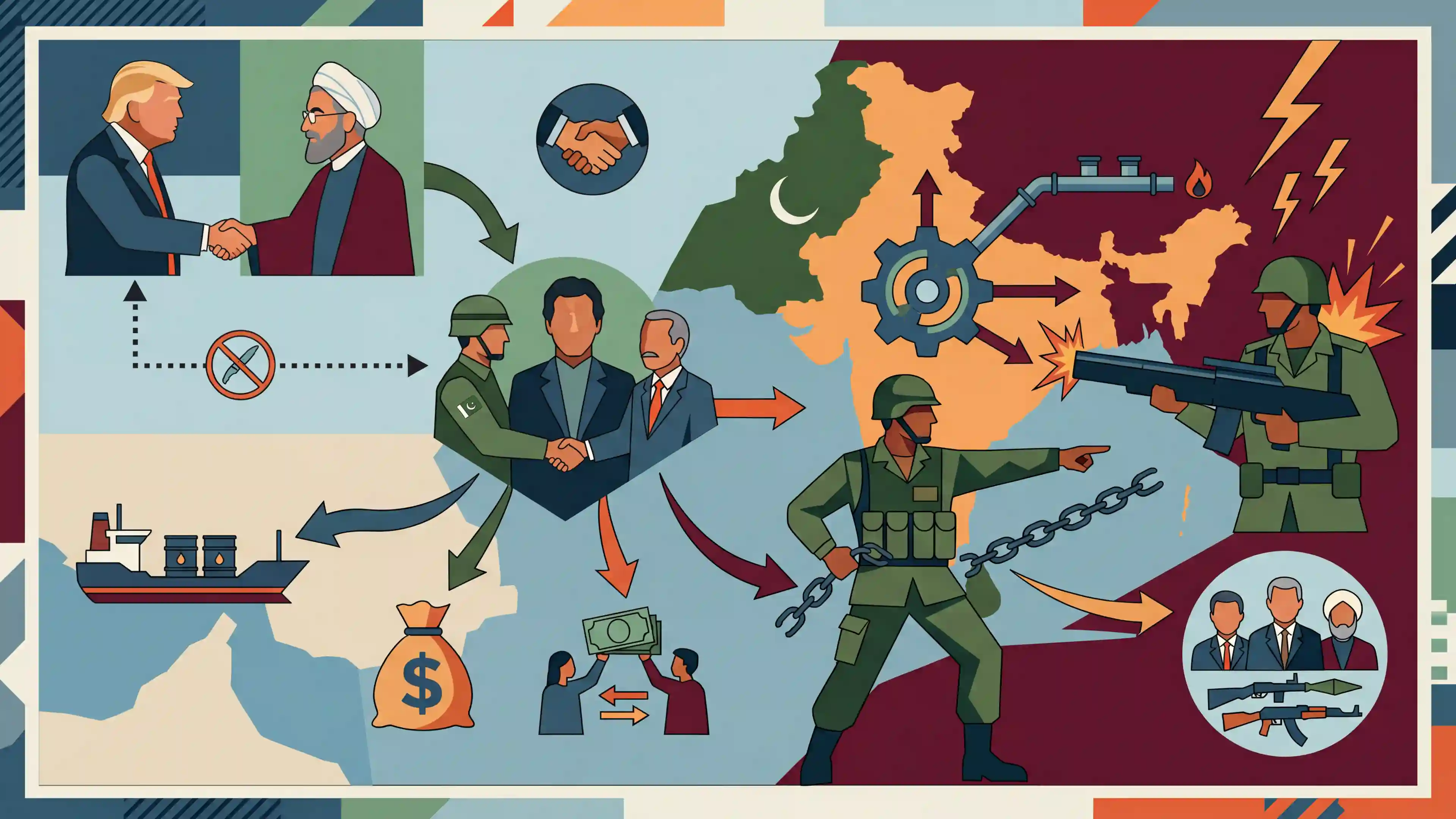
US President Donald Trump has indefinitely extended the US-Iran ceasefire, directly crediting Pakistan's mediation led by PM Shehbaz Sharif and Field Marshal Asim Munir. Pakistan's diplomatic intervention is driven by domestic economic imperatives, notably securing vital fuel imports via the Strait of Hormuz, maintaining foreign reserves under an IMF program, and safeguarding diaspora remittances. While successfully brokering peace significantly elevates Pakistan's diplomatic standing and bolsters its civil-military "hybrid regime," it presents long-term strategic concerns for India. A militarily emboldened Pakistan that successfully breaks its diplomatic isolation could unlock military arms sales and reignite neighborhood hostilities, despite the short-term benefits of broader regional stability.
Key Points
- US President Donald Trump extended the US-Iran ceasefire indefinitely, acknowledging Pakistan's mediation role led by PM Shehbaz Sharif and Field Marshal Asim Munir.
- Pakistan's mediation is motivated by severe domestic economic crises, reliance on Strait of Hormuz fuel imports, and the need to protect crucial Gulf diaspora remittances.
- A successful mediation transforms Pakistan's international image from a struggling economy to a pivotal global peacemaker, potentially attracting necessary loans and foreign investments.
- The diplomatic achievement highlights the effectiveness of Pakistan's "hybrid regime," where civilian and military leaderships closely coordinate on foreign policy.
- For India, the end of the conflict brings immediate economic relief via stabilized energy markets, but Pakistan overcoming its diplomatic isolation and empowering its military poses long-term regional security risks.
Important Terms
Strait of Hormuz

A critical maritime chokepoint between the Persian Gulf and Gulf of Oman; it handles nearly 20% of global oil and 33% of liquefied natural gas trade.
UPSC context
GS Paper 1 (Geography) & GS 2 (IR/Energy Security); tests vulnerability of India's energy imports from West Asia.
International Monetary Fund (IMF)
A global institution of 190 countries that provides financial assistance (loans) to members facing balance-of-payments crises while promoting monetary cooperation and financial stability.
UPSC context
GS Paper 2 (Global Institutions) & GS 3 (Economy); central to understanding regional economic bailouts and global financial architecture.
Extended Fund Facility (EFF)
An IMF lending facility providing medium-to-long-term assistance to countries with deep structural economic problems; funds are released in 'tranches' conditional on specific policy reforms.
UPSC context
GS Paper 3 (Economy/Development); relevant for analysis of neighboring economies (Pakistan/Sri Lanka) and sovereign debt management.
Hybrid Regime
A political system where democratic features like elections coexist with authoritarian traits, notably the significant, often decisive, influence of the military over civilian government.
UPSC context
GS Paper 2 (IR/Political Science); tests understanding of Pakistan's internal power dynamics and their impact on regional security.
Gulf Cooperation Council (GCC)
A regional bloc comprising Saudi Arabia, UAE, Qatar, Kuwait, Oman, and Bahrain, focusing on political and economic integration among Arab states of the Persian Gulf.
UPSC context
GS Paper 2 (Bilateral/Regional Groupings); vital for India's 'Link West' policy, energy security, and diaspora remittances.
Diplomatic Isolation
A state where a nation is excluded from diplomatic engagements or international support, often used as a tool of statecraft to pressure changes in behavior.
UPSC context
GS Paper 2 (IR); tests strategies of neighborhood management and India's efforts to influence regional geopolitics.
Prelims Trap
"The Strait of Hormuz is the primary maritime route connecting the Persian Gulf directly to the Red Sea."
Hormuz connects the Persian Gulf to the Gulf of Oman (Arabian Sea). UPSC frequently swaps it with the Bab-el-Mandeb strait, which links the Red Sea.
Static Concepts Connected
What are the key maritime chokepoints governing West Asian energy flows?
- Strait of Hormuz: Connects the Persian Gulf to the Gulf of Oman. Bordered by Iran, Oman, and the UAE. It handles roughly 20% of global oil supplies.
- Bab-el-Mandeb: Connects the Red Sea to the Gulf of Aden. Bordered by Yemen, Djibouti, and Eritrea. Crucial for Suez Canal maritime traffic.
How do worker remittances factor into the Balance of Payments (BoP)?
- Current Account: Remittances are recorded as 'current transfers' under the Invisibles section of the Current Account, requiring no reciprocal exchange of goods or services.
- Deficit Buffer: They provide a crucial foreign exchange buffer, helping import-dependent economies like India and Pakistan offset structural trade deficits generated by energy imports.
Cross-Topic Patterns
Energy Chokepoints + Strategic Petroleum Reserves
Ceasefires near Hormuz alleviate immediate energy shocks, but expose structural reliance on chokepoints, driving India's imperative to expand its Strategic Petroleum Reserves (SPR) and diversify to alternative crudes.
De-hyphenation policy + US Arms Sales
Pakistan's renewed diplomatic utility to the US threatens India's "de-hyphenation" policy. It risks unlocking suspended US military aid, complicating India's two-front security calculus.

Expect a 2026 Prelims map question linking West Asian straits to bordering states, or a Mains Q on Pakistan's diplomatic resurgence.
Linked PYQs · 3
Linked PYQs · 3
- 2025MainsGS2
"Energy security constitutes the dominant kingpin of India's foreign policy, and is linked with India's overarching influence in Middle Eastern countries.” How would you integrate energy security with India's foreign policy trajectories in the coming years?
- 2017MainsGS2
The question of India's Energy Security constitutes the most important part of India's economic progress. Analyze India's energy policy cooperation with West Asian countries.
- 2015MainsGS2
Terrorist activities and mutual distrust have clouded India-Pakistan relations. To what extent the use of soft power like sports and cultural exchanges could help generate goodwill between the two countries? Discuss with suitable examples.
