US-China Trade Tensions Rise as Beijing Replaces WTO Negotiator
Source:Indian Express ↗
Why It Matters
The evolving US-China trade war directly affects global trade dynamics, the relevance and functioning of the WTO, and the security of critical mineral supply chains, which are highly pertinent topics in GS2 (International Relations) and GS3 (Economy/Resources).
Summary
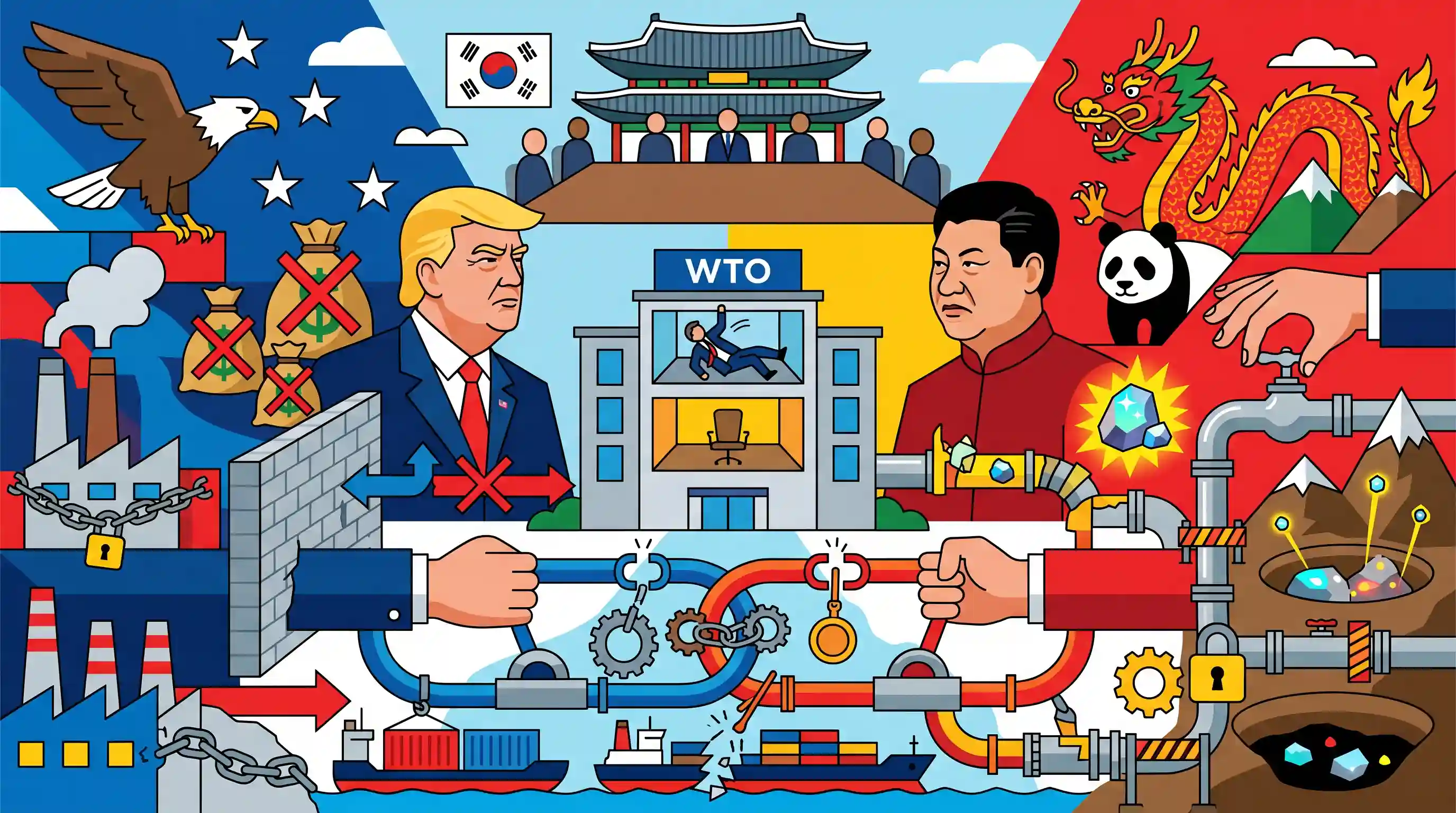
As US-China trade tensions intensify, US President-elect Donald Trump has stated his expectation for a "fair trade deal" between the two nations. In a significant move ahead of potential negotiations, Beijing removed its top negotiator, Li Chenggang, from his post at the World Trade Organization (WTO). The backdrop includes a spiral of retaliatory economic measures, such as US sanctions on foreign firms and China imposing new export restrictions on rare earths and critical minerals. Further dialogue is anticipated as Trump and Chinese President Xi Jinping prepare for a prospective meeting at the forthcoming APEC summit in South Korea, reflecting the high stakes of bilateral relations and global supply chain stability.
Key Points
- US President-elect Donald Trump anticipates a 'fair trade deal' with China amid escalating bilateral trade and economic tensions.
- China has removed its top trade negotiator, Li Chenggang, from his post as permanent representative to the World Trade Organization (WTO).
- Trade frictions have spiked following US sanctions on foreign firms and Beijing's retaliatory export restrictions on rare earths and critical minerals.
- Trump and Chinese President Xi Jinping are expected to meet at the upcoming APEC summit in South Korea to address these geopolitical differences.
Important Terms
World Trade Organization (WTO)

The only global international organization dealing with the rules of trade between nations. It operates via consensus to lower trade barriers, manage trade agreements, and resolve commercial disputes among its 166 members.
UPSC context
GS Paper 2 (International Institutions). Tests understanding of multilateralism, rule-based trade, and challenges like protectionism and appellate body paralysis.
Asia-Pacific Economic Cooperation (APEC)
A regional economic forum of 21 member economies established to promote free trade and sustainable development in the Asia-Pacific. It operates on non-binding commitments and open dialogue.
UPSC context
GS Paper 2 (Regional Groupings). Relevant for discussions on India’s 'Act East' policy and its status as a non-member observer.
Critical Minerals
Elements (like lithium and rare earths) essential for high-tech, defense, and green energy. They are 'critical' due to their strategic importance and high risk of supply chain disruption.
UPSC context
GS Paper 3 (Resources/Economy). Tests knowledge of mineral security, resource nationalism, and global supply chain vulnerabilities (China's dominance).
Trade War
An economic conflict where countries impose retaliatory tariffs, quotas, or sanctions on each other's exports to protect domestic industries or gain geopolitical leverage through economic coercion.
UPSC context
GS Paper 3 (Economic Development). Significant for analyzing global economic stability, protectionism trends, and impacts on Indian exports.
US Treasury Department
The U.S. federal department responsible for managing government finances, economic policy, and international financial sanctions, often serving as a primary tool for economic diplomacy and statecraft.
UPSC context
GS Paper 2 (International Relations). Tests understanding of unilateral sanctions (e.g., CAATSA) and their extraterritorial impact on global trade and India.
Prelims Trap
India is a full member of the Asia-Pacific Economic Cooperation (APEC) owing to its Act East Policy.
India is NOT a member of APEC. Despite its major Asian economic footprint and "Act East" policy, India only holds observer status, as APEC membership was frozen.
Static Concepts Connected
What are the three standard trade remedy measures under the WTO?
- Anti-dumping duties: Levied on imports priced below their fair domestic market value to protect local industries from predatory pricing.
- Countervailing duties: Imposed to neutralize the negative effects of subsidies provided by a foreign government to its exporters.
- Safeguard measures: Temporary restrictions (tariffs or quotas) applied when a sudden, unforeseen surge in imports threatens domestic producers.
Why are Rare Earth Elements (REEs) highly vulnerable to trade weaponization?
- Processing monopoly: While geographically abundant, extracting and processing REEs is environmentally toxic and complex. China controls nearly 90% of global refining capacity.
- Future-tech dependency: They are irreplaceable in modern high-tech manufacturing, including electric vehicles, wind turbines, and advanced defense systems.
Cross-Topic Patterns
Trade weaponization + Minerals Security Partnership
India joined the US-led Minerals Security Partnership (MSP) to secure critical mineral supply chains, directly responding to the risk of Chinese export curbs disrupting India's EV and green energy transition.
WTO paralysis + Rise of Minilaterals
As major powers bypass the WTO's stalled Appellate Body using unilateral tariffs and export controls, global economic governance is fracturing into minilateral blocs like the Indo-Pacific Economic Framework (IPEF).

Expect a 2026 prelims question linking India's Critical Mineral Mission, the US-led MSP, and Chinese dominance in rare earths processing.
Linked PYQs · 2
Linked PYQs · 2
- 2018MainsGS2
What are the key areas of reform if the WTO has to survive in the present context of "Trade War', especially keeping in mind the interest of India?
- 2021MainsGS2
“The USA is facing an existential threat in the form of a China, that is much more challenging than the erstwhile Soviet Union.” Explain.
