United States Middle East Diplomacy and Strategic Alliances
Source:The Hindu ↗
Why It Matters
The delicate balancing act by the US between supporting Israel and negotiating a nuclear pact with Iran directly affects Middle Eastern stability, global energy security, and major power dynamics. For India, these developments are crucial due to its strategic ties with the US, Israel, and Iran, as well as its significant energy and diaspora interests in the region.
Summary
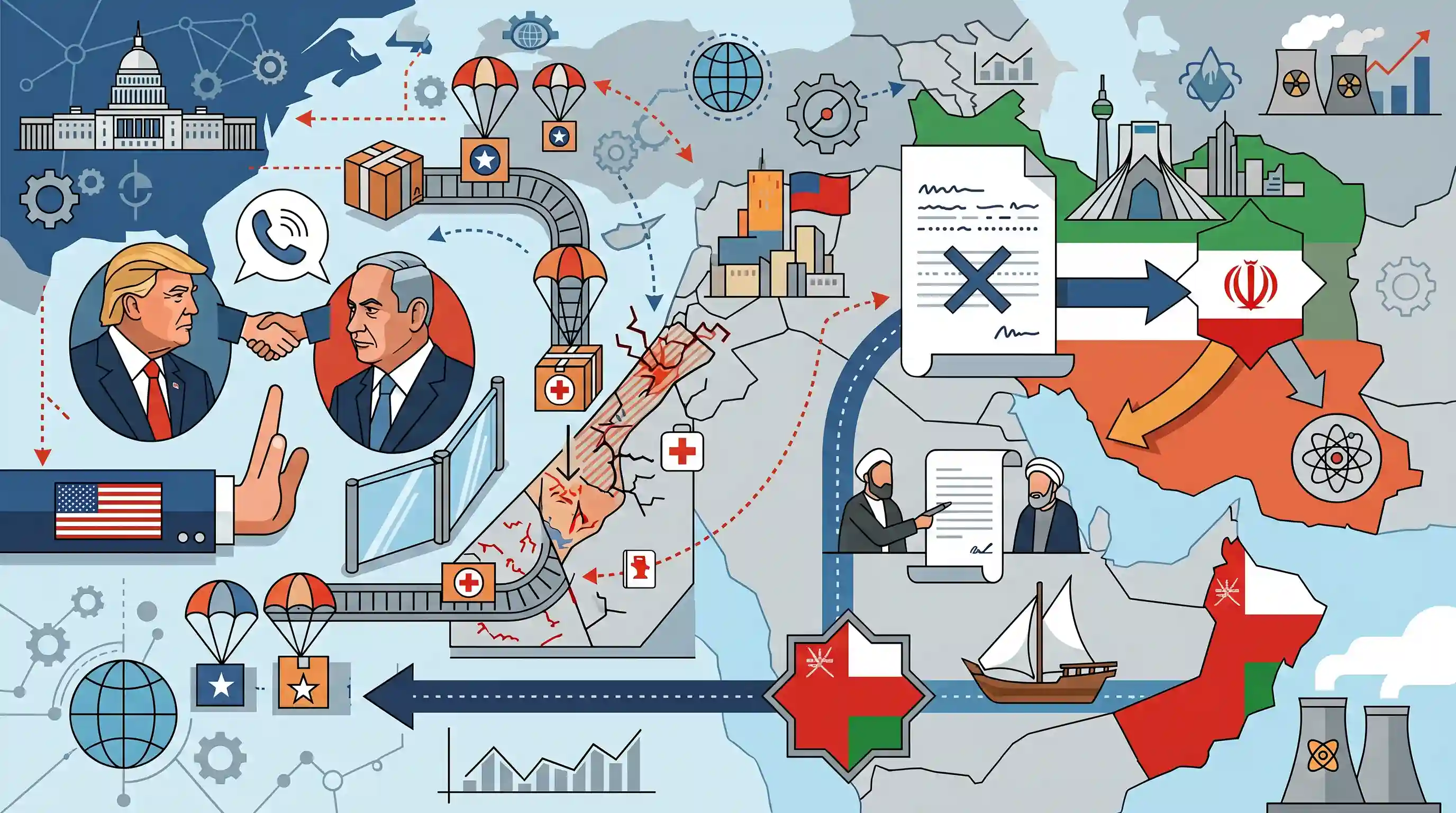
US President Donald Trump is set to converse with Israeli Prime Minister Benjamin Netanyahu amid crucial diplomatic efforts in the Middle East. The US is focused on accelerating aid into Gaza and advancing nuclear talks with Iran. Trump has cautioned Netanyahu against actions that might disrupt these sensitive negotiations. Meanwhile, Iran is preparing to deliver a counter-proposal for a nuclear deal to the US via Oman, following an initial US offer that Tehran rejected.
Key Points
- US President Donald Trump scheduled a call with Israeli PM Benjamin Netanyahu to address regional tensions and diplomatic initiatives.
- The US administration is actively attempting to accelerate humanitarian aid deliveries into Gaza.
- Trump has explicitly warned Netanyahu against taking military or political actions that could derail ongoing nuclear negotiations with Iran.
- Iran is preparing to submit a counter-proposal for a nuclear deal to the US through Omani mediation, after rejecting an initial US offer as unacceptable.
Important Terms
Joint Comprehensive Plan of Action (JCPOA)

A 2015 landmark agreement (P5+1) limiting Iran's nuclear activities in exchange for sanctions relief; its 2026 status involves intense renegotiations following U.S. withdrawal and regional conflict.
UPSC context
GS Paper 2: International Relations; crucial for understanding nuclear non-proliferation and India's energy/strategic interests in the Middle East.
West Asia Geopolitics
The complex interplay of power, conflict, and diplomacy in the Middle East, currently centered on the Israel-Gaza war, Iran's nuclear ambitions, and U.S. regional mediation.
UPSC context
GS Paper 2: Effect of policies of developed countries on India's interests; tests regional stability and maritime security.
Omani Mediation
The Sultanate of Oman's long-standing diplomatic role as a neutral intermediary between the U.S. and Iran, facilitating indirect talks and nuclear counter-proposals in Muscat.
UPSC context
GS Paper 2: Bilateral and regional groupings; highlights "quiet diplomacy" and its impact on regional peace and Indian diaspora security.
Economic Sanctions
Financial and trade penalties used as a diplomatic tool to compel policy changes; central to the U.S. strategy of "maximum pressure" vs. Iran's demand for relief.
UPSC context
GS Paper 2: International Institutions; tests understanding of global economic governance and impacts on India's trade (e.g., Chabahar Port).
IAEA (International Atomic Energy Agency)
The UN's nuclear watchdog responsible for verifying that nuclear programs remain peaceful; it plays a critical monitoring role in any potential Iran nuclear deal.
UPSC context
GS Paper 2: Important International institutions; essential for questions on global security architecture and nuclear safety.
Two-State Solution
The proposed diplomatic resolution to the Israeli-Palestinian conflict involving an independent State of Palestine alongside the State of Israel, a recurring theme in global peace plans.
UPSC context
GS Paper 2: India's Foreign Policy; reflects India's historical stance and long-term regional stability goals.
Prelims Trap
The Strait of Hormuz connects the Persian Gulf to the Red Sea and is jointly controlled by Oman and Yemen.
The Strait of Hormuz connects the Persian Gulf to the Gulf of Oman (Arabian Sea), bordered by Iran and Oman. Bab-el-Mandeb connects the Red Sea.
Static Concepts Connected
What is India's "de-hyphenation" policy regarding West Asia?
- Core Philosophy: Managing bilateral relations with Israel and Palestine independently, treating neither as a zero-sum geopolitical equation.
- Policy Shift: Moved India away from historical constraints, allowing open, overt strategic and defense ties with Israel without alienating Arab partners.
- UN Stance: Despite closer Israeli ties, India continues to officially back a sovereign, independent two-state solution for Palestine at the UN.
What are the primary maritime chokepoints affecting West Asian trade?
- Strait of Hormuz: Links the Persian Gulf to the Gulf of Oman; crucial for Iranian and Arab oil exports destined for India's energy security.
- Bab-el-Mandeb: Connects the Red Sea to the Gulf of Aden; vulnerable to regional escalations disrupting broader Suez Canal commercial traffic.
Cross-Topic Patterns
JCPOA Revival & India's Connectivity
Lifting US sanctions on Iran is critical for fully operationalizing the Chabahar port and INSTC, shifting India's access to Central Asia away from Pakistan.
I2U2 Grouping & Middle East Stability
The I2U2 minilateral relies on Arab-Israeli normalization. Continued hostilities involving Israel and Iran threaten to stall joint investments in food security and clean energy corridors.

Expect a 2026 map-based Prelims question pairing West Asian chokepoints (Hormuz/Bab-el-Mandeb) with mediating nations like Oman.
Linked PYQs · 3
Linked PYQs · 3
- 2018MainsGS2
In what ways would the ongoing US-Iran Nuclear Pact Controversy affect the national interest of India? How should India respond to this situation?
- 2018MainsGS2
“India’s relations with Israel have, of late, acquired a depth and diversity, which cannot be rolled back.” Discuss.
- 2022MainsGS2
How will I2U2 (India, Israel, UAE and USA) grouping transform India's position in global politics?
