Proposed US H-1B Visa Fee Hike and Consequences for Indian IT Sector
Source:Indian Express ↗
Why It Matters
This development represents a major shift in US immigration and labor policy with direct consequences for the Indian IT industry, service exports, and the Indian diaspora. It highlights the growing trend of protectionism in developed nations, making it highly relevant for GS Paper 2 (International Relations) and GS Paper 3 (Economy).
Summary
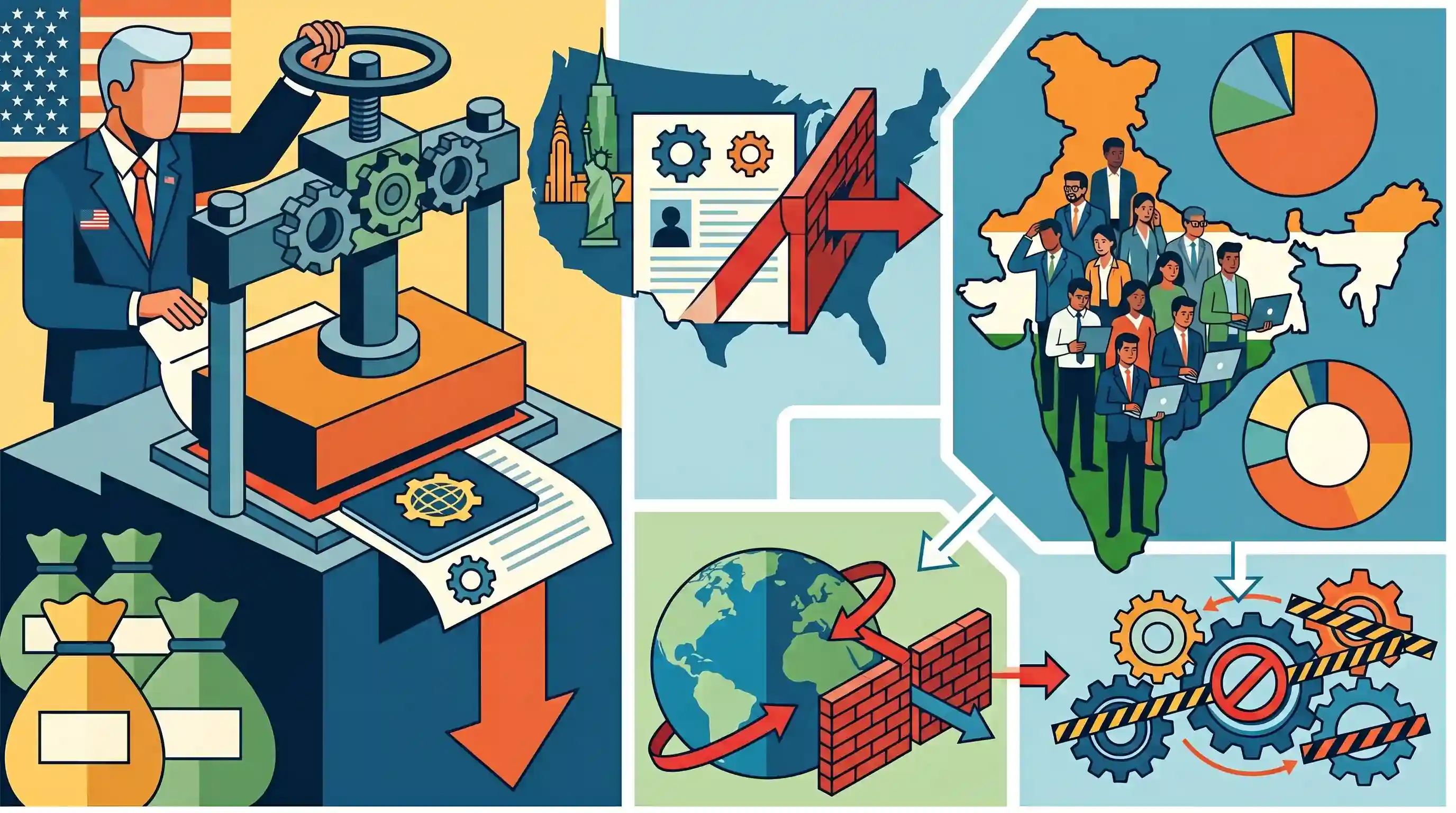
The US administration under Donald Trump is preparing to implement a new $100,000 application fee for H-1B worker visas as part of a broader immigration crackdown. This fee aims to severely restrict the entry of foreign high-skilled professionals and discourage companies from using the visa program, which critics argue displaces American workers and depresses wages. The anticipated proclamation also includes directives to revise prevailing-wage levels. The move carries significant implications for India, as Indian nationals constituted 71% of H-1B beneficiaries last year, and it threatens to disrupt the operations of major Indian IT services companies and the flow of skilled talent to the US tech sector.
Key Points
- US President Donald Trump is expected to introduce a $100,000 application fee for H-1B worker visas to restrict their usage.
- The policy targets the reliance of tech and staffing companies on foreign high-skilled labour, addressing arguments that the H-1B program suppresses domestic wages.
- The expected presidential proclamation will also order the Department of Labor to overhaul prevailing-wage regulations to prevent the undercutting of American workers.
- Indian nationals are the largest beneficiaries of the H-1B program, accounting for 71% of approved beneficiaries in the last fiscal year, making this policy highly impactful for Indian IT companies and professionals.
Important Terms
H-1B visa program

A non-immigrant U.S. visa allowing companies to temporarily employ foreign workers in "specialty occupations" requiring technical expertise and at least a bachelor's degree.
UPSC context
GS Paper II: International Relations; crucial for understanding India-US bilateral ties, skilled migration, and the impact of foreign policies on Indian citizens.
Indian Diaspora
The community of Indian citizens living abroad and persons of Indian origin. They are major H-1B beneficiaries and a key source of remittances (approx. 27.7% from the US).
UPSC context
GS Paper II: Effect of policies of developed countries on India's interests. Tests knowledge of the diaspora's economic and strategic role in bilateral relations.
Protectionism
Economic policies, such as high fees or tariffs, designed to restrict imports or foreign labor to protect domestic industries and workers from foreign competition.
UPSC context
GS Paper III: Indian Economy and Globalization. Relevant for discussing global trade barriers and the "America First" policy's impact on India's service exports.
Prevailing-wage levels
The average wage paid to similarly employed workers in a specific occupation and geographic area, used by the U.S. government to ensure foreign workers don't depress local wages.
UPSC context
GS Paper II: International Relations/Migration. Understanding technical barriers used to regulate foreign labor and their impact on the competitiveness of Indian IT firms.
Cognizant
A major multinational IT services firm. Alongside companies like Infosys and TCS, it is a leading sponsor of H-1B visas, often targeting "outsourcing" models under US scrutiny.
UPSC context
GS Paper II/III: Corporate impact on foreign policy. Illustrates how US immigration shifts disrupt specific Indian-centric business sectors and service delivery models.
Presidential Proclamation
An official directive issued by the U.S. President to manage federal government operations, often used in immigration to bypass slow legislative processes in Congress.
UPSC context
GS Paper II: Comparative Constitutions/International Relations. Highlights the executive powers of the US President in shaping global migration and trade policies.
Prelims Trap
H-1B visa fees are classified as tariff barriers under the WTO's General Agreement on Tariffs and Trade (GATT).
Visa restrictions are non-tariff barriers (NTBs) affecting services trade. They fall under the General Agreement on Trade in Services (GATS) Mode 4 (Presence of natural persons), not GATT (goods).
Static Concepts Connected
How does the WTO classify the trade in services under GATS?
- Mode 1 (Cross-border): Services supplied from one country to another (e.g., telemedicine, software licensing).
- Mode 2 (Consumption abroad): Consumers travelling to another country to avail services (e.g., tourism, international students).
- Mode 3 (Commercial presence): A service provider establishing a physical branch in another country (e.g., a US bank opening in Mumbai).
- Mode 4 (Natural persons): Individuals travelling temporarily to another country to provide a service (e.g., Indian IT professionals on H-1B).
How do inward remittances reflect in India's Balance of Payments (BoP) account?
- Current Account component: Remittances are recorded under the 'Current Account' section of the BoP, specifically as 'Current Transfers' or secondary income.
- Unilateral Transfers: They represent one-way, unilateral transfers with no expected return of goods or services, helping bridge India's Current Account Deficit (CAD).
- Top Source Nation: The United States is currently the largest source of inward remittances to India, having recently overtaken the UAE.
Cross-Topic Patterns
Protectionism vs India's GCC pivot
Exorbitant visa fees act as non-tariff barriers, forcing Indian IT to shift from traditional 'body-shopping' service exports to establishing domestic Global Capability Centres (GCCs) to bypass Mode 4 restrictions.
Remittances and Current Account buffering
U.S. immigration hurdles threaten India's largest remittance corridor (~27%). Reduced dollar inflows directly pressure India's Current Account Deficit and complicate the RBI's forex management strategy.

Expect a 2026 prelims statement testing H-1B visa rules as 'non-tariff barriers' under GATS Mode 4, paired with remittance trends.
Linked PYQs · 4
Linked PYQs · 4
- 2020MainsGS2
Indian diaspora has a decisive role to play in the politics and economy of America and European Countries'. Comment with examples.
- 2023MainsGS2
Indian diaspora has scaled new heights in the West. Describe its economic and political benefits for India.
- 2025MainsGS3
What are the challenges before the Indian economy when the world is moving away from free trade and multilateralism to protectionism and bilateralism? How can these challenges be met?
- 2018MainsGS3
How would the recent phenomena of protectionism and currency manipulations in world trade affect macroeconomic stability of India?
