US Trade Pressure and Tariff Implications for Imported Motorcycles
Source:Indian Express ↗
Why It Matters
Trade diplomacy and tariff disputes are central to India-US bilateral relations. Understanding how protectionist policies impact foreign investment and global trade negotiations is crucial for answering questions on international relations (GS2) and economic development (GS3).
Summary
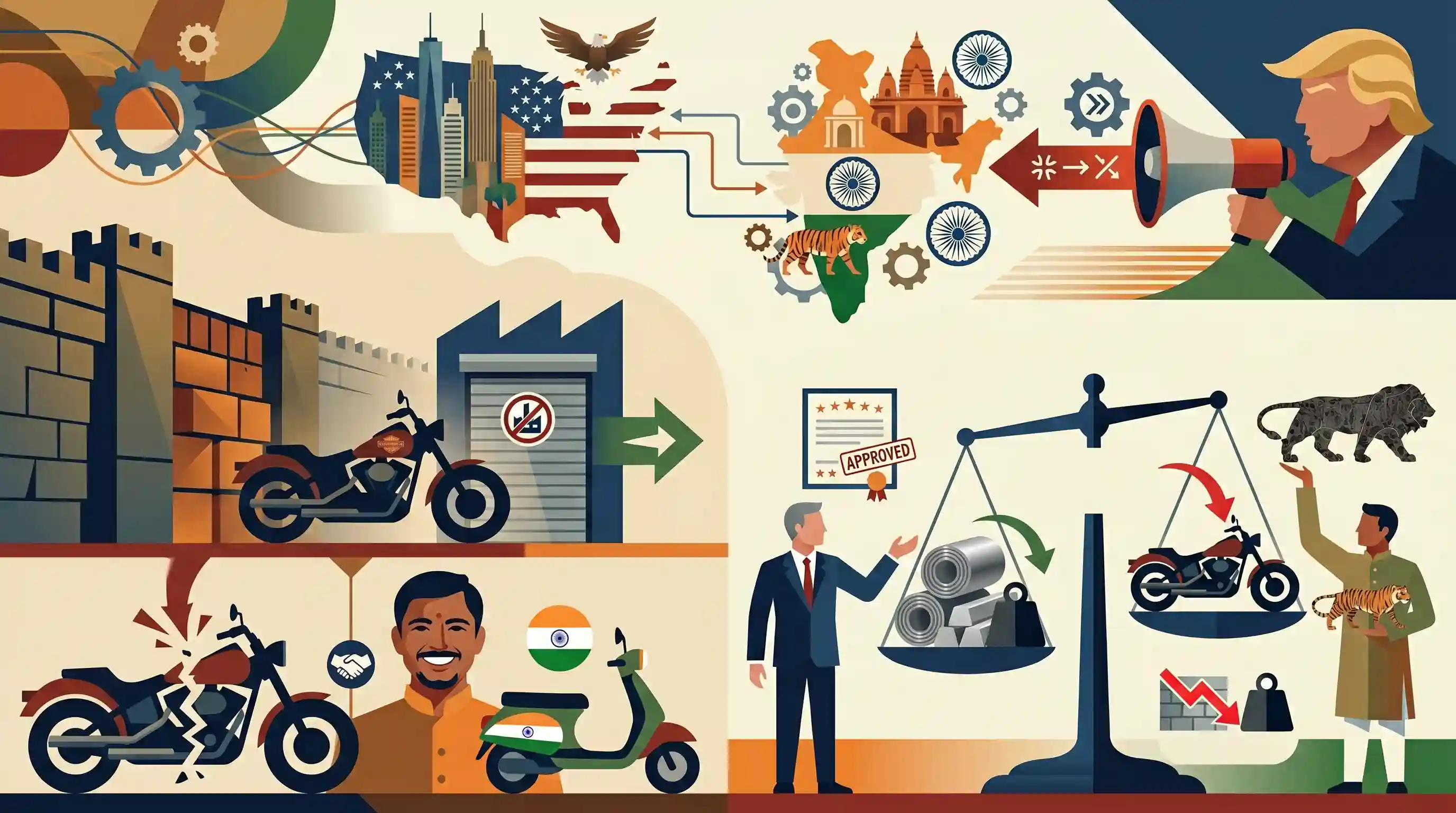
The article discusses the potential return or expansion of Harley-Davidson's direct presence in India as a result of ongoing bilateral trade negotiations heavily influenced by the 'Trump effect.' During Donald Trump's previous administration, India's steep tariffs on fully assembled imported motorcycles became a major point of contention, leading to pressure that saw some duty reductions. Despite this, Harley-Davidson previously shut down its independent Indian manufacturing operations, pivoting to a partnership with Hero MotoCorp. A new US-India trade pact could involve India further slashing customs duties on high-end bikes to secure reciprocal concessions from the US, such as the restoration of Generalized System of Preferences (GSP) benefits or the removal of tariffs on Indian steel and aluminum. This dynamic underscores the persistent tension between India's protectionist 'Make in India' policies and international demands for free market access.
Key Points
- The 'Trump effect' continues to influence US-India trade relations, particularly concerning India's historically high tariffs on imported premium goods like motorcycles.
- India's customs duties on Completely Built Units (CBUs) have been a frequent target of criticism from Donald Trump, who previously termed India the 'tariff king'.
- Harley-Davidson had exited its independent manufacturing in India due to high taxes and low sales, opting for a strategic partnership with Hero MotoCorp.
- A potential 'mini-trade deal' could see India lowering import duties on heavy motorcycles in exchange for the US lifting tariffs on Indian steel and aluminum or restoring GSP trade benefits.
- The development highlights the ongoing friction between India's 'Make in India' protectionist measures aimed at boosting domestic manufacturing and the US demand for reciprocal market access.
Important Terms
Generalized System of Preferences (GSP)

A US trade program providing non-reciprocal, duty-free entry for specific products from designated developing countries to promote their economic growth. India was a major beneficiary until 2019.
UPSC context
GS Papers 2 & 3: Crucial for topics on India-US trade friction, preferential treatment, and international trade diplomacy.
Make in India
A flagship government initiative launched in 2014 to transform India into a global manufacturing hub by incentivizing domestic production and attracting foreign direct investment.
UPSC context
GS Paper 3: Relevant for manufacturing policy, employment generation, and the transition from an import-dependent to an export-oriented economy.
Protectionism
Economic policy of restricting imports through high tariffs, quotas, or regulations to shield domestic industries from foreign competition and preserve local manufacturing jobs.
UPSC context
GS Paper 3: Central to debates on global trade wars, "Vocal for Local," and the challenges of globalization.
World Trade Organization (WTO)
An international organization that regulates global trade, provides a framework for negotiating agreements, and operates a dispute settlement mechanism to resolve conflicts between members.
UPSC context
GS Papers 2 & 3: Key for international institutions, multilateralism, and resolving bilateral trade disputes through standardized rules.
Harley-Davidson
An iconic American motorcycle manufacturer whose Indian operations became a symbolic flashpoint for high import tariffs, leading to a shift from independent manufacturing to a local partnership model.
UPSC context
GS Papers 2 & 3: Used as a case study for India-US trade pressure and "tariff king" allegations in high-end manufacturing.
Hero MotoCorp
India's largest two-wheeler manufacturer and Harley-Davidson’s local partner for distribution and co-development, representing the "partnering for market access" model in the Indian automobile sector.
UPSC context
GS Paper 3: Illustrates corporate strategy, FDI impact, and the evolution of domestic manufacturing through global alliances.
Prelims Trap
"The Generalized System of Preferences (GSP) is a reciprocal trade agreement..."
GSP is strictly non-reciprocal. Developed nations offer tariff concessions to developing nations without expecting equivalent market access in return. It functions as a recognized exception to the WTO's MFN principle.
Static Concepts Connected
What is the Most-Favoured-Nation (MFN) principle and its exceptions under WTO?
- MFN Principle: Standard WTO rule requiring member nations to treat all trading partners equally without discrimination in tariff applications.
- GSP Exception: Allows developed nations to offer non-reciprocal, preferential tariff rates to developing nations under the 'Enabling Clause'.
- RTA Exception: Countries within formalized free trade agreements (FTAs) or customs unions can offer exclusive preferential access to each other.
How does India structure automotive import tariffs to boost domestic manufacturing?
- CBU Tariffs: India imposes peak customs duties (50-100%+) on fully assembled vehicles to disincentivize direct imports and curb forex outflows.
- CKD Tariffs: Levies significantly lower duties on vehicle parts imported for local assembly, encouraging domestic value addition and job creation.
- FDI Policy: Permits 100% Foreign Direct Investment via the automatic route in the auto sector to support capital inflow and technology transfer.
Cross-Topic Patterns
Make in India vs. Free Trade Reciprocity
The tension between securing export access via GSP and protecting domestic auto sectors through high CBU tariffs directly tests the limits of India's 'Atmanirbhar Bharat' strategy and reciprocal FTA negotiations.
National Security exceptions in WTO Trade
The US invoking 'national security' to tax Indian steel reflects a growing global trend of weaponizing GATT Article XXI to bypass standard WTO tariff commitments and disrupt global supply chains.

Expect a 2026 prelims multi-statement question testing WTO's MFN exceptions (like GSP) against "national security" trade barriers.
Linked PYQs · 3
Linked PYQs · 3
- 2018MainsGS2
What are the key areas of reform if the WTO has to survive in the present context of "Trade War', especially keeping in mind the interest of India?
- 2012MainsGS2
Discuss the likely negative impact of the protectionist measures proposed by the US on India's software industry.
- 2016MainsGS2
The broader aims and objectives of WTO are to manage and promote international trade in the era of globalization. But the Doha round of negotiations seem doomed due to differences between the developed and the developing countries." Discuss in the Indian perspective.
