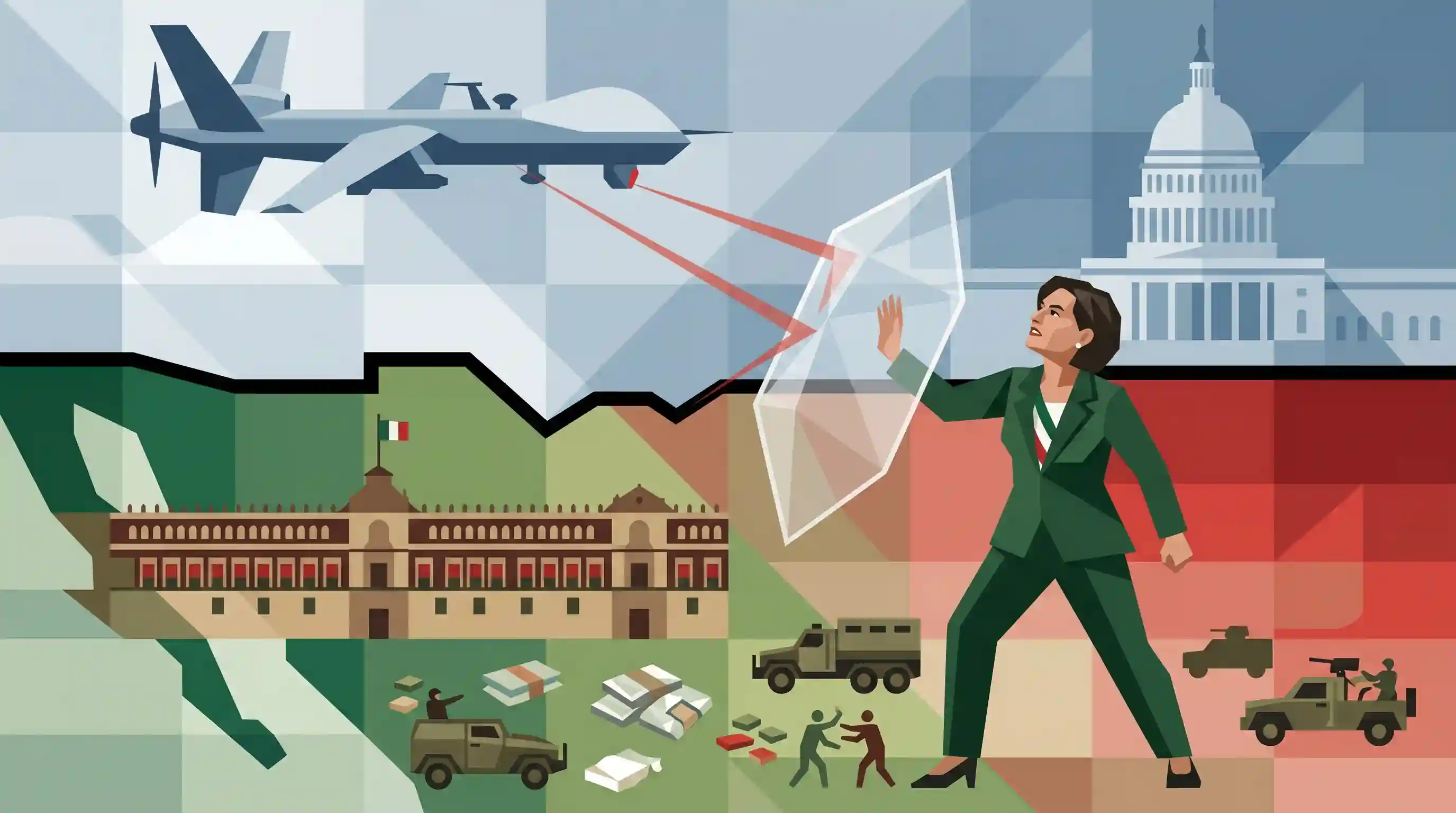
Unilateral US Military Intervention and Mexican Sovereignty Disputes
Source:Indian Express ↗
Why It Matters
For UPSC aspirants, this issue serves as a contemporary case study on transnational organized crime, narco-terrorism, and border management (GS3). It also touches upon International Relations (GS2), illustrating the tension between a nation's sovereign rights and another state's security imperatives, specifically regarding unilateral military actions like surgical strikes or drone warfare against non-state actors operating from foreign territory.
Summary
The incoming US Trump administration has indicated it might employ unilateral drone strikes against Mexican drug cartels to curb the influx of fentanyl and other illegal narcotics into the United States. In response, Mexican President Claudia Sheinbaum has categorically rejected any unapproved US military intervention, warning that such actions would constitute a grave breach of Mexico's sovereignty. The escalating rhetoric underscores the growing friction over border security, transnational organized crime, and the contentious legalities of preemptive or extraterritorial military strikes ('hot pursuit') against non-state actors on foreign soil without host-country consent.
Key Points
- The US Trump administration is considering using drone strikes against Mexican drug cartels to combat the smuggling of fentanyl and other narcotics.
- Mexican President Claudia Sheinbaum strongly condemned any potential unilateral military action by the US, terming it a severe violation of Mexico's national sovereignty.
- US officials, including Defense Secretary Pete Hegseth, have refused to rule out military options, framing the cartels' activities as equivalent to terrorism.
- The situation highlights the complex geopolitical tension between neighboring states when dealing with transnational organized crime and border security.
- This scenario mirrors concepts of 'hot pursuit' and 'surgical strikes' in international relations, raising questions about international law and the extraterritorial use of force.
Important Terms
UN Charter (Article 2(4))

A foundational international law principle prohibiting member states from using or threatening force against the territorial integrity or political independence of any other state.
UPSC context
GS Paper 2 (International Relations); tests understanding of the legal framework governing global peace and the limits of unilateral military action.
Sovereignty
The supreme authority of a state over its territory and domestic affairs, including the right to be free from outside interference or unilateral military intervention.
UPSC context
GS Paper 2 (International Relations); critical for discussing bilateral tensions over border security and extraterritorial use of force.
Narco-terrorism
The synergistic relationship between drug traffickers and terrorist organizations, where narcotics trade proceeds are used to fund insurgencies and violence against the state.
UPSC context
GS Paper 3 (Internal Security); relevant for studying the 'crime-terror nexus' and its impact on national stability.
Surgical Strikes
Precise, targeted military operations intended to damage or destroy a specific target while minimizing collateral damage to surrounding infrastructure and civilians.
UPSC context
GS Paper 3 (Security/Defense); relates to evolving doctrines of 'pre-emptive self-defense' against non-state actors on foreign soil.
Hot Pursuit
A legal doctrine allowing a state to pursue and arrest violators of its laws beyond its borders, provided the chase is immediate and continuous.
UPSC context
GS Paper 3 (Maritime/Border Security); tests legal complexities of pursuing non-state actors into sovereign foreign territory.
Transnational Organized Crime (TOC)
Self-perpetuating associations of individuals who operate across national borders to obtain power and profit through illegal activities like drug and human trafficking.
UPSC context
GS Paper 3 (Internal Security); fundamental for analyzing global security threats and the effectiveness of international law enforcement cooperation.
Prelims Trap
"The right of 'hot pursuit' on land across international borders is formally codified under the UN Charter."
Hot pursuit on land is a political/military term; legally, international law (UNCLOS Art 111) only formally codifies 'hot pursuit' for maritime operations.
Static Concepts Connected
How does international law govern the extraterritorial use of force?
- General Prohibition: UN Charter Article 2(4) strictly prohibits the threat or use of force against the territorial integrity or political independence of any sovereign state.
- Self-Defense Exception: Article 51 allows for the inherent right of individual or collective self-defense if an armed attack occurs, though preemptive strikes remain heavily debated.
- Host State Consent: Military action on foreign soil is legally permissible and doesn't violate sovereignty if the host country provides explicit consent for the operation.
What characterizes the internal security threat of Narco-Terrorism?
- Symbiotic Threat: A symbiotic relationship where terrorists use drug trafficking for funding, while cartels employ terrorist tactics (bombings, assassinations) to protect their illicit enterprises.
- Geographical Vulnerability: India's proximity to major opium regions (Golden Crescent and Golden Triangle) exacerbates cross-border narco-terror funding, particularly in border states like Punjab and Manipur.
- Asymmetric Methods: Cartels and terrorists increasingly rely on dual-use technology, such as drones, to smuggle drugs, arms, and ammunition across heavily guarded international borders.
Cross-Topic Patterns
Surgical strikes & the Myanmar/Pakistan precedent
The US-Mexico dynamic directly mirrors India's cross-border actions against non-state actors in PoK and Myanmar, blurring the lines between territorial sovereignty and preemptive self-defense against terror groups.
Synthetic opioids & border security evasion
Unlike plant-based heroin, lab-made synthetics like fentanyl (or meth in India's Northeast) remove the need for agricultural cultivation, severely complicating traditional supply-reduction border security strategies.

Expect a 2026 GS-2/GS-3 question testing the 'unwilling or unable' doctrine, linking India's cross-border strikes to global precedents.
Linked PYQs · 4
Linked PYQs · 4
- 2016MainsGS3
The terms 'Hot Pursuit' and 'Surgical Strikes' are often used in connection with armed action against terrorist attacks. Discuss the strategic impact of such actions.
- 2022MainsGS3
Discuss the types of organised crimes. Describe the linkages between terrorists and organised crime that exist at the national and transnational levels.
- 2024MainsGS3
Explain how narco-terrorism has emerged as a serious threat across the country. Suggest suitable measures to counter narco-terrorism.
- 2023MainsGS3
The use of unmanned aerial vehicles (UAVs) by our adversaries across the borders to ferry arms/ammunitions, drugs, etc., is a serious threat to the internal security. Comment on the measures being taken to tackle this threat.
