Federal Enforcement Actions and Domestic Public Order Management
Source:Indian Express ↗
Why It Matters
Provides a comparative international perspective on federalism, illustrating the constitutional and political friction that arises when a central government unilaterally deploys armed forces for domestic law enforcement and border management against a state's wishes.
Summary
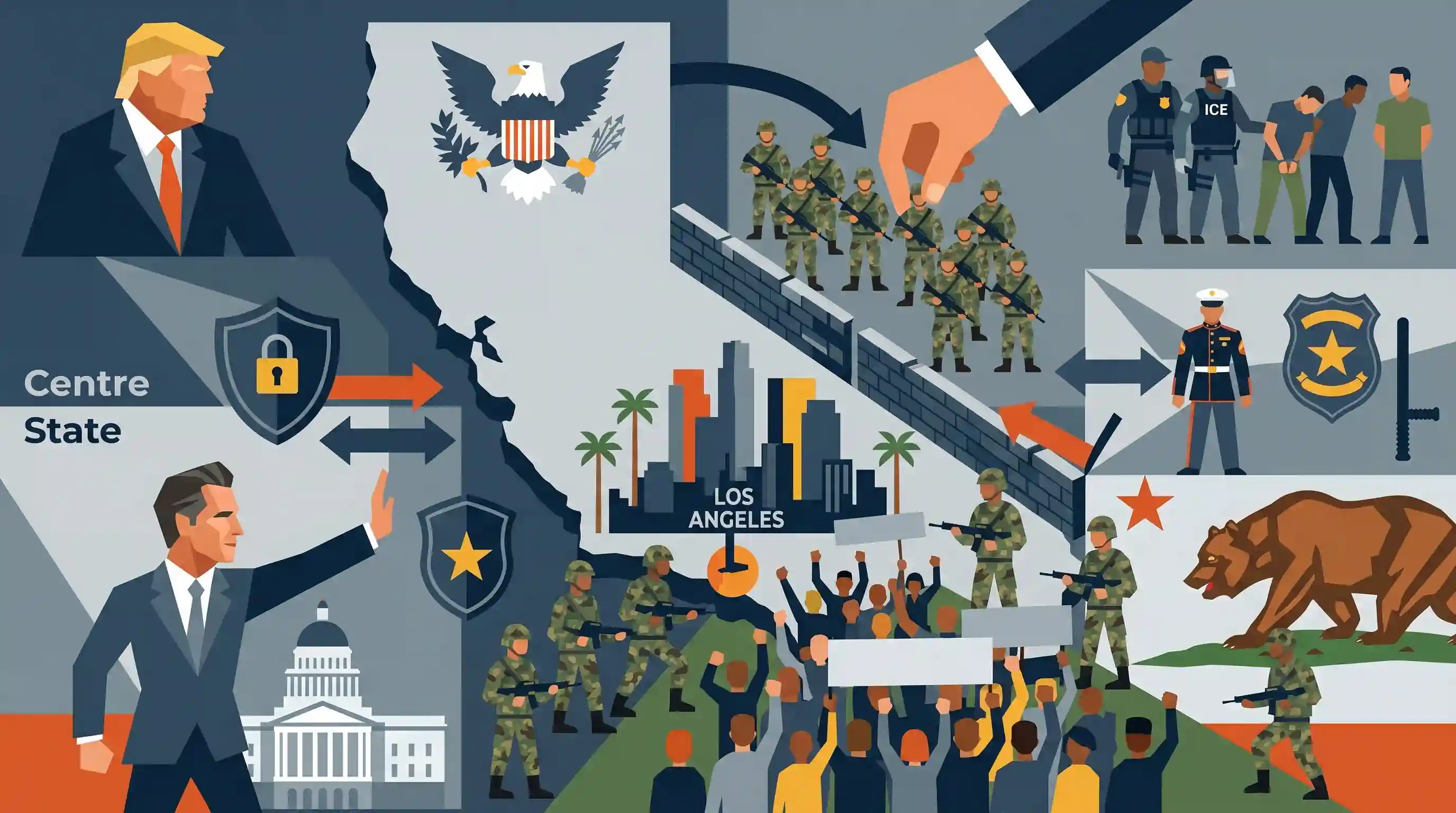
US President Donald Trump deployed 2,000 National Guard troops to Los Angeles to quell protests triggered by sweeping federal immigration (ICE) raids, a move heavily opposed by California Governor Gavin Newsom. The federal administration has also threatened to deploy active-duty Marines if violence persists. The incident has sparked a major federalism dispute over state autonomy, domestic law enforcement, and the militarization of immigration crackdowns.
Key Points
- Federal Immigration and Customs Enforcement (ICE) raids in Los Angeles triggered widespread protests and violent clashes.
- President Donald Trump federalized and deployed 2,000 National Guard troops to Los Angeles to curb 'lawlessness', overriding local authorities.
- California Governor Gavin Newsom strongly opposed the deployment, calling it purposefully inflammatory and an erosion of public trust.
- Defense Secretary Pete Hegseth warned that active-duty Marines from Camp Pendleton could also be mobilized if the unrest persists.
- The conflict highlights severe federalism disputes in the US regarding state autonomy, the enforcement of immigration policies, and the militarization of domestic public order.
Important Terms
National Guard

A state-based military force serving dual roles as state militias (under Governors) and a reserve component of the U.S. Army/Air Force. It can be 'federalized' by the President during emergencies.
UPSC context
GS II/III (Internal Security). Comparative study of paramilitary/reserve forces in civil administration and state-federal security dynamics.
US Immigration and Customs Enforcement (ICE)
A federal agency under the Department of Homeland Security (DHS) responsible for interior immigration enforcement, investigating transnational crimes, and managing the detention and removal of undocumented persons.
UPSC context
GS II/III (Border Management/Immigration Policy). Tests knowledge of interior enforcement agencies vs. border patrolling and human rights in deportations.
Department of Homeland Security (DHS)
A cabinet-level department created post-9/11 to unify internal security. It oversees ICE, Border Patrol, and FEMA, focusing on anti-terrorism, border security, and disaster management.
UPSC context
GS III (Internal Security). Equivalent to India’s Ministry of Home Affairs; vital for comparative governance and institutional security structures.
US Marine Corps
An active-duty branch of the U.S. Armed Forces primarily used for expeditionary operations. Its domestic deployment is strictly limited by law to prevent military interference in civilian policing.
UPSC context
GS II/III (Security). Tests the principle of separating military and police powers and constitutional limits on domestic military use.
Federalism
A system where power is constitutionally divided between a central government and states. It involves disputes over state autonomy versus federal authority in areas like immigration.
UPSC context
GS II (Basic Structure/Centre-State Relations). Fundamental concept regarding the division of powers and state-central jurisdictional conflicts.
Posse Comitatus Act
An 1878 federal law generally prohibiting the use of federal military personnel for domestic law enforcement, maintaining a clear boundary between the military and civil police.
UPSC context
GS II/III (Legal Frameworks/Security). Critical for comparing legal safeguards against domestic militarization, similar to debates around AFSPA in India.
Prelims Trap
The Union government requires the consent of the state government to deploy Central Armed Police Forces (CAPF).
Under Article 355 and Entry 2A of the Union List, the Centre can deploy central forces (CAPFs) suo motu to tackle internal disturbance, even without state consent.
Static Concepts Connected
How does Article 355 empower the Union regarding internal security?
- Constitutional Duty: Mandates the Union government to protect every State against external aggression and internal disturbance.
- Suo Motu Deployment: Allows the Centre to deploy Central forces in a state without its consent to restore public order.
- Entry 2A (Union List): Inserted by the 42nd Amendment, it grants Parliament exclusive power over the deployment of armed forces in aid of civil power.
What are the legal grounds for military aid to civil authority in India?
- CrPC Sections 130/131: An Executive Magistrate can requisition armed forces to disperse an unlawful assembly to maintain public security.
- AFSPA, 1958: Allows the Governor or the Central Government to deploy the military in designated 'disturbed areas' with overriding powers.
- Principle of Minimum Force: The armed forces acting in aid of civil power must act under the magistrate's direction and use minimum necessary force.
Cross-Topic Patterns
Comparative Federalism: US vs India
US 'dual federalism' normally reserves police powers to states, whereas India's constitution explicitly grants the Centre overriding emergency security mandates (Entry 2A of Union List) to manage internal disturbances.
Jurisdictional friction of Central Agencies
ICE raids sparking state pushback structurally parallels Indian states withdrawing 'general consent' for the CBI or challenging the NIA's overriding federal jurisdiction over local police.

Expect a 2026 Prelims statement testing the Union's power to deploy CAPFs suo motu under Article 355 and Entry 2A of the Union List.
Linked PYQs · 4
Linked PYQs · 4
- 2024MainsGS2
What changes has the Union Government recently introduced in the domain of Centre-State relations ? Suggest measures to be adopted to build the trust between the Centre and the States and for strengthening federalism.
- 2022MainsGS2
“While the national political parties in India favour centralisation, the regional parties are in favour of State autonomy.” Comment.
- 2023MainsGS3
What are the internal security challenges being faced by India? Give out the role of Central Intelligence and Investigative Agencies tasked to counter such threats.
- 2016MainsGS3
Border management is a complex task due to difficult terrain and hostile relations with some countries. Elucidate the challenges and strategies for effective border management.
