G7 Summit Disagreements: US Stance on Middle East Geopolitics
Source:Indian Express ↗
Why It Matters
The event underscores shifting dynamics within prominent global groupings like the G7. Understanding the diverging diplomatic strategies between the US and European nations is crucial for analyzing the geopolitical stability of the Middle East and the future of Iran's nuclear constraints, which indirectly affect India's energy security and strategic partnerships.
Summary
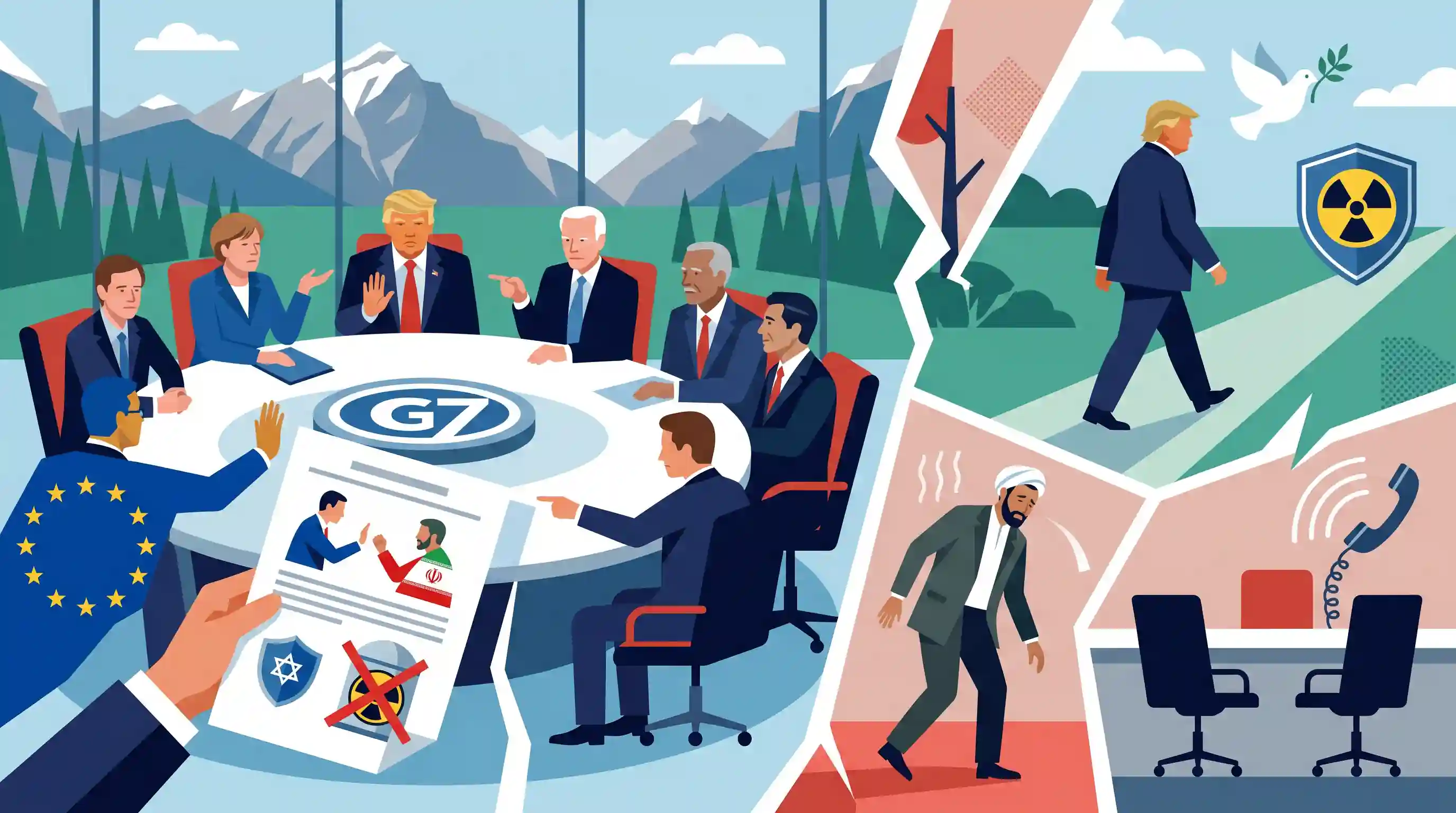
At the G7 Summit in the Canadian Rockies, US President Donald Trump declined to sign a joint European-led draft statement addressing the Israel-Iran conflict. The draft sought to de-escalate tensions, affirm Israel's right to self-defense, and ensure Iran does not acquire a nuclear weapon. The White House defended the move, stating that Trump is independently leading efforts for peace and nuclear non-proliferation in the region, while Trump himself remarked that Iran is 'not winning' and should engage in talks. This incident highlights internal policy divergences within the G7, particularly between the US and its European allies, on managing Middle Eastern geopolitics.
Key Points
- US President Donald Trump refused to sign a joint G7 draft statement concerning the ongoing Israel-Iran conflict during the summit in Canada.
- The European-led draft called for regional de-escalation, supported Israel's right to self-defense, and urged measures to ensure Iran does not develop nuclear weapons.
- The White House justified the refusal by stating Trump is already spearheading efforts to restore peace and prevent a nuclear-armed Iran.
- Trump asserted that Iran is 'not winning the war' and suggested immediate negotiations.
- The diplomatic divergence highlights differing approaches between the US and its European allies regarding Middle East geopolitics and conflict resolution.
Important Terms
G7 (Group of Seven)

An informal forum of seven of the world's most advanced economies: Canada, France, Germany, Italy, Japan, the United Kingdom, and the United States.
UPSC context
GS-II: Important for 'Bilateral, regional and global groupings'. Tests understanding of Western-led governance and India's role as a frequent invitee.
White House
The executive office and residence of the President of the United States, serving as the center for US foreign policy and national security decision-making.
UPSC context
GS-II: IR. Essential for analyzing the 'Executive' vs 'Legislative' influence on US foreign policy and bilateral relations with India.
Nuclear Proliferation
The spread of nuclear weapons, fissionable material, and weapons-applicable nuclear technology and information to nations which are not recognized as "Nuclear Weapon States."
UPSC context
GS-II/III: Security and International Relations. A recurring theme in West Asian stability and global regimes like NPT and NSG.
Geopolitics
The study of the effects of geography (human and physical) on politics and international relations, particularly regarding power dynamics and territory.
UPSC context
GS-II: Overarching framework for 'Effect of policies of developed and developing countries on India’s interests'.
Strategic Autonomy
The ability of a nation-state to pursue its own national interests and preferred foreign policy without being constrained by other states.
UPSC context
GS-II: A central pillar of Indian foreign policy; tested through comparisons with US unilateralism or China's rise.
Prelims Trap
"G7 joint communiques and resolutions are legally binding on its member states."
The G7 is an informal bloc without a founding charter. Its declarations are merely political commitments, not legally binding treaties, and rely entirely on voluntary compliance and absolute consensus.
Static Concepts Connected
What distinguishes the structural framework of the G7 from formal international organizations?
- Informal nature: It lacks a formal charter, international treaty, or permanent secretariat. The presidency simply rotates annually among its member states.
- EU status: The European Union participates fully in summits and negotiations but is a "non-enumerated" member, meaning it does not assume the rotating presidency.
- Consensus driven: Summit outcomes and communiques are non-binding political commitments requiring unanimous agreement, leaving them vulnerable to unilateral vetoes or opt-outs.
What is the P5+1 grouping and its role in the JCPOA?
- P5+1 Members: The grouping consists of the UN Security Council's five permanent members (China, France, Russia, UK, US) plus Germany.
- Core objective: To lift severe economic sanctions on Iran in exchange for strict limitations and stringent IAEA inspections on its nuclear enrichment program.
- Current status: The agreement was severely weakened after the US unilaterally withdrew in 2018, exposing transatlantic fault lines between the US and European powers over Middle East strategy.
Cross-Topic Patterns
Energy Security + Chokepoint Geopolitics
The Israel-Iran conflict threatens the Strait of Hormuz. UPSC frequently links Middle East instability to India's crude oil dependency, widening current account deficit, and imported inflation dynamics.
Retreat of Western Multilateralism
US unilateralism at the G7 mirrors its past actions like WTO appellate body paralysis, reflecting a broader structural shift from multilateral consensus to transactional bilateralism in global governance.

A 2026 Mains question will likely ask to evaluate the declining efficacy of consensus-based groupings (G7) amidst rising unilateralism.
Linked PYQs · 4
Linked PYQs · 4
- 2018MainsGS2
In what ways would the ongoing US-Iran Nuclear Pact Controversy affect the national interest of India? How should India respond to this situation?
- 2022MainsGS2
How will I2U2 (India, Israel, UAE and USA) grouping transform India's position in global politics?
- 2025MainsGS2
"Energy security constitutes the dominant kingpin of India's foreign policy, and is linked with India's overarching influence in Middle Eastern countries.” How would you integrate energy security with India's foreign policy trajectories in the coming years?
- 2020PrelimsGS1
In which one of the following groups are all the four countries members of G20?
