US President Criticizes Israel Airstrike Over Iran Peace Deal Impact
Source:Indian Express ↗
Why It Matters
The shifting alliances in the Middle East—specifically the US-Iran peace efforts and the US's uncharacteristic friction with Israel—can significantly alter regional stability. For India, this evolving geopolitical landscape is vital due to its balanced strategic ties with Israel, Iran, and the US, alongside heavy energy dependence and an extensive diaspora in the region.
Summary
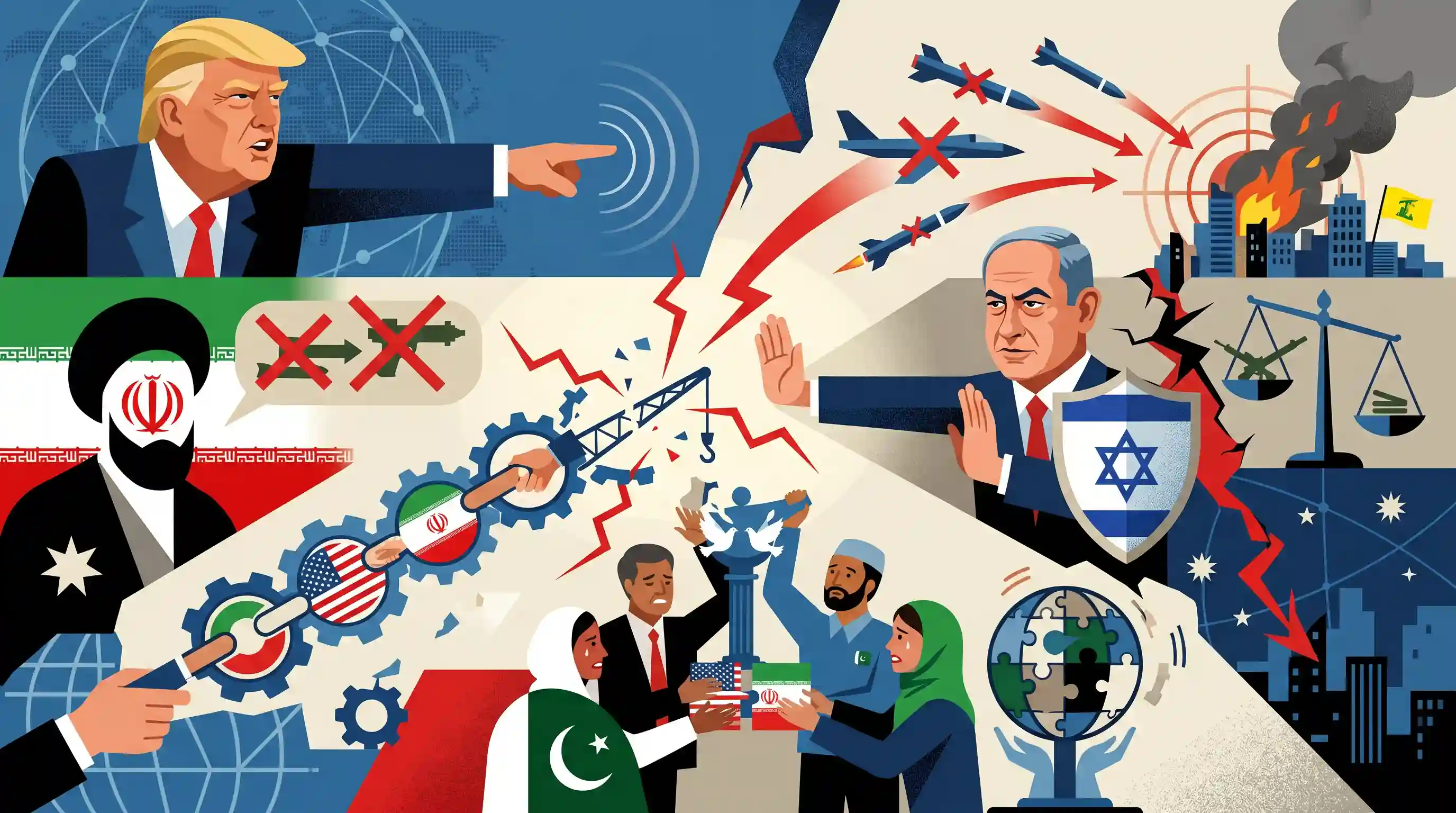
US President Donald Trump criticized Israel for an airstrike in Beirut, Lebanon, arguing that such military actions could jeopardize an impending US-Iran peace deal. With Pakistan and other mediators facilitating the negotiations, the proposed deal is reportedly a setback for Israel, prompting resistance from Prime Minister Benjamin Netanyahu, who defended the strikes against Hezbollah. Trump's rare public criticism of Israel highlights a delicate geopolitical balancing act as the US seeks broader regional stability, while Iran demands a cessation of Israeli hostilities in Lebanon as a condition for the deal.
Key Points
- US President Donald Trump publicly criticized Israel's airstrike on Beirut, warning it could derail a forthcoming US-Iran peace deal.
- The US-Iran negotiations, mediated by Pakistan and others, aim to stabilize the Middle East but have reportedly sidelined Israeli interests.
- Israeli Prime Minister Benjamin Netanyahu and Defense Minister Israel Katz defended the Beirut strike as necessary retaliation against Hezbollah's attacks.
- Iran has asserted that any peace agreement with the US must inherently include the cessation of Israel's military operations in Lebanon.
- The diplomatic friction underscores a complex shift in regional dynamics, where the US is pressuring its traditional ally, Israel, to facilitate a broader strategic alignment with Iran.
Important Terms
US-Iran Peace Deal

An impending 2026 agreement (Islamabad Memorandum) brokered by Pakistan to end hostilities, reopen the Strait of Hormuz, and provide sanctions relief, with nuclear discussions deferred to future technical talks.
UPSC context
GS Paper 2 (International Relations); tests impact of major power diplomacy on global energy security and regional stability.
Hezbollah
A Lebanese Shia militant group and political party backed by Iran; it functions as a 'state within a state' and is a primary combatant against Israel.
UPSC context
GS Paper 2 & 3 (International Relations/Security); tests understanding of non-state actors and proxy warfare in West Asia.
West Asia Geopolitics
The complex power dynamics in the Middle East involving energy interests, sectarian divides, and external interventions by powers like the US, Iran, and Saudi Arabia.
UPSC context
GS Paper 2; vital for India's 'Link West' policy, energy security, and Indian diaspora interests.
Strait of Hormuz
The world's most critical maritime chokepoint between the Persian Gulf and the Gulf of Oman, handling approximately 20% of global oil consumption.
UPSC context
GS Paper 1 (Geography) & 2; essential for trade routes, maritime security, and energy vulnerability topics.
Axis of Resistance
An informal anti-Western and anti-Israeli alliance led by Iran, including the Syrian government, Hezbollah, Hamas, and various regional militias.
UPSC context
GS Paper 2; relevant for analyzing regional power blocs and the ideological underpinnings of Middle Eastern conflicts.
Mediation (Diplomacy)
A diplomatic process where a third party (e.g., Pakistan) facilitates communication and negotiation between disputing states to reach a peace agreement or ceasefire.
UPSC context
GS Paper 2; tests knowledge of conflict-resolution tools and the evolving role of middle powers in diplomacy.
Prelims Trap
The Litani River forms the international border separating Israel and Lebanon.
The Litani River is entirely within Lebanon. The boundary separating Lebanon and Israel is the UN-demarcated Blue Line.
Static Concepts Connected
Which geographical markers define Lebanon's volatile southern borders?
- Blue Line: The UN-demarcated boundary line separating Lebanon from Israel, established after Israel's withdrawal in 2000.
- Litani River: A major waterway entirely within Lebanon. UNSC Resolution 1701 mandates the zone south of it be free of armed Hezbollah personnel.
- Golan Heights: Located to the southeast of Lebanon, this is a strategic plateau captured by Israel from Syria in 1967.
What is India's 'de-hyphenation' policy in West Asia?
- Independent Ties: Pursuing distinct, mutually exclusive bilateral relationships with rival nations (e.g., Israel and Palestine, or Israel and Iran) without letting one dictate the other.
- Strategic Autonomy: Engaging Israel heavily for defense and technology while simultaneously partnering with Iran for energy security and the Chabahar Port/INSTC project.
Cross-Topic Patterns
Iran Sanctions Relief & INSTC
A US-Iran peace deal removing sanctions would de-risk India's investments in Chabahar Port, accelerating the International North-South Transport Corridor (INSTC) bypassing Pakistan.
State-Sponsored Proxies in IR
Hezbollah's veto power over state diplomacy highlights a recurring UPSC theme: how heavily armed non-state actors disrupt traditional geopolitical security architectures.

Map questions on the Levant (Blue Line, Litani River) or a Mains question on India's de-hyphenation amid US-Iran talks are highly likely.
Linked PYQs · 3
Linked PYQs · 3
- 2018MainsGS2
In what ways would the ongoing US-Iran Nuclear Pact Controversy affect the national interest of India? How should India respond to this situation?
- 2018MainsGS2
“India’s relations with Israel have, of late, acquired a depth and diversity, which cannot be rolled back.” Discuss.
- 2025MainsGS2
"Energy security constitutes the dominant kingpin of India's foreign policy, and is linked with India's overarching influence in Middle Eastern countries.” How would you integrate energy security with India's foreign policy trajectories in the coming years?
