US Trade Policy and South Asia Mediation Claims Spur Debate
Source:Indian Express ↗
Why It Matters
The article sheds light on the complexities of India-US relations, specifically regarding the historical friction point of third-party mediation in the India-Pakistan conflict (which India staunchly opposes) and persistent economic disagreements over trade protectionism and tariffs.
Summary
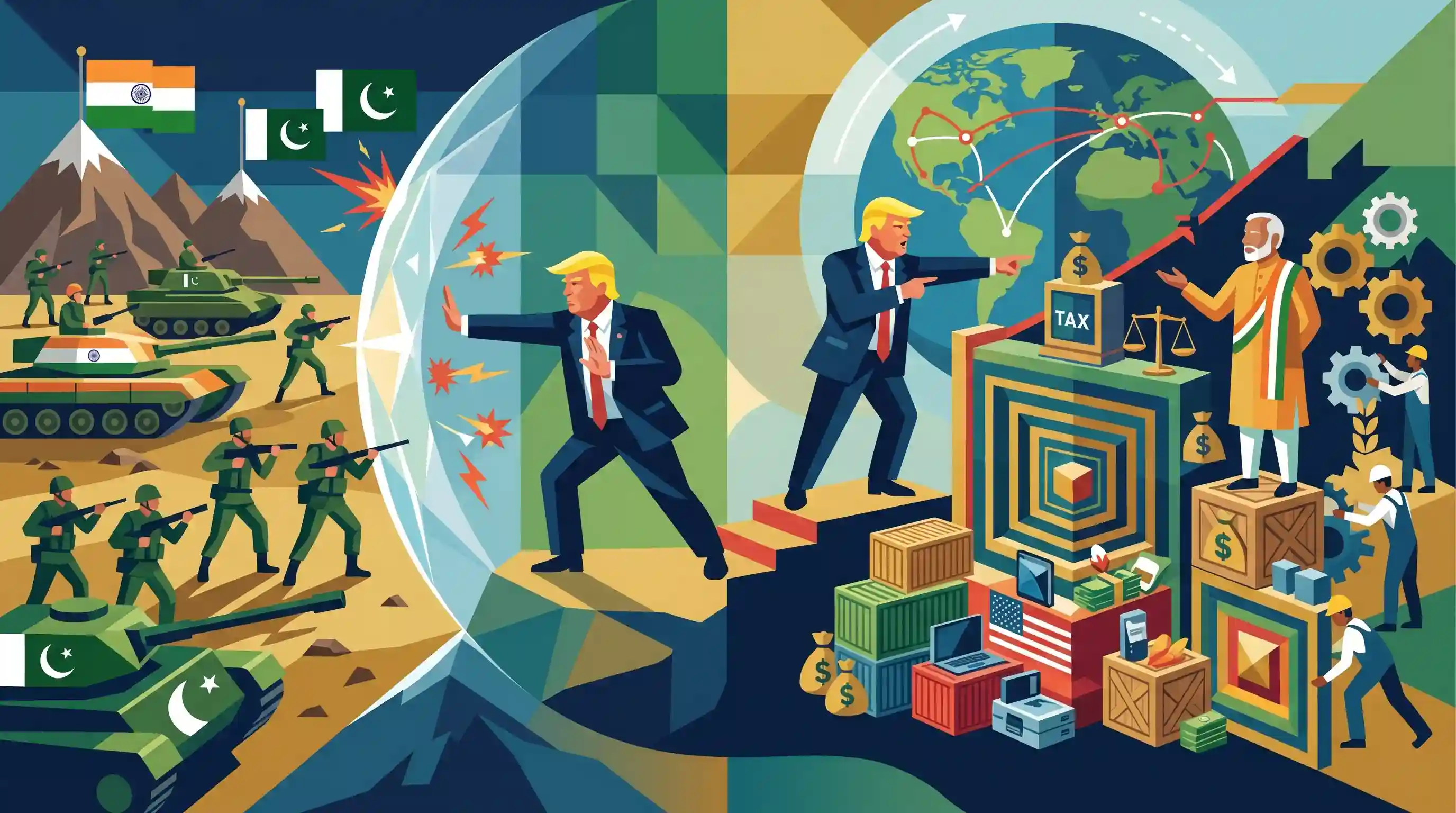
Former US President Donald Trump recently claimed that he successfully intervened to prevent a potential war between India and Pakistan by issuing a "three-word threat" to both nations, stating that both countries' leaderships were ready for conflict. Alongside these claims of diplomatic mediation, Trump also raised ongoing grievances regarding bilateral trade, specifically targeting India's tariff policies. The remarks highlight potential friction points in US-India relations, touching upon both strategic security dynamics in South Asia and bilateral economic negotiations.
Key Points
- Former US President Donald Trump claimed he averted a war between India and Pakistan by issuing a "three-word threat" to their leadership.
- Trump's remarks underscore his recurring assertions of having the ability to mediate complex geopolitical disputes.
- The statements also touched upon bilateral trade issues, with Trump reviving his criticism of India's tariff policies.
- India traditionally rejects third-party mediation in its disputes with Pakistan, maintaining that all issues must be resolved bilaterally as per the Shimla Agreement.
Prelims Trap
India allows US or UN diplomatic mediation in disputes with Pakistan on a case-by-case basis during military escalations.
India strictly rejects all third-party mediation (including by the US or UN) under the 1972 Shimla Agreement, mandating purely bilateral dispute resolution without exception.
Static Concepts Connected
What are the core tenets of the 1972 Shimla Agreement?
- Strict Bilateralism: All differences must be settled peacefully through bilateral negotiations, legally barring any third-party mediation or international intervention.
- Line of Control: Both nations committed to respect the Line of Control (LoC) resulting from the December 1971 ceasefire, without prejudice to either side's recognized position.
How do US tariff disputes with India operate under global trade rules?
- Bound vs Applied: The US frequently protests India's high applied tariffs, even though these tariffs generally remain legally permissible below India's committed WTO bound rates.
- Unilateral leverage: The US utilizes unilateral mechanisms like the Special 301 report or withdrawing Generalized System of Preferences (GSP) status to penalize perceived Indian protectionism.
Cross-Topic Patterns
Transactional trade vs strategic ties
The conflation of security interventions with tariff grievances highlights how transactional US domestic politics increasingly challenges India's strategic autonomy paradigm and traditional institutional diplomacy.
Nuclear thresholds and crisis management
Historically, US intervention in India-Pakistan skirmishes (like Kargil or Balakot) is primarily driven by fears of conventional conflicts rapidly breaching the subcontinent's nuclear threshold.

Expect a multi-statement prelims question testing the Shimla Agreement's bilateralism clause alongside WTO bound/applied tariff rates.
Linked PYQs · 2
Linked PYQs · 2
- 2019MainsGS2
‘What introduces friction into the ties between India and the United States is that Washington is still unable to find for India a position in its global strategy, which would satisfy India's national self-esteem and ambitions.’ Explain with suitable examples.
- 2012MainsGS2
Discuss the likely negative impact of the protectionist measures proposed by the US on India's software industry.
