India rejects US mediation claims on bilateral ties with Pakistan
Source:The Hindu ↗
Why It Matters
Highlights the intersection of trade diplomacy and strategic autonomy in India-US relations. It also tests candidates' awareness of India's consistent rejection of third-party mediation in its bilateral disputes, particularly regarding Pakistan and Kashmir.
Summary
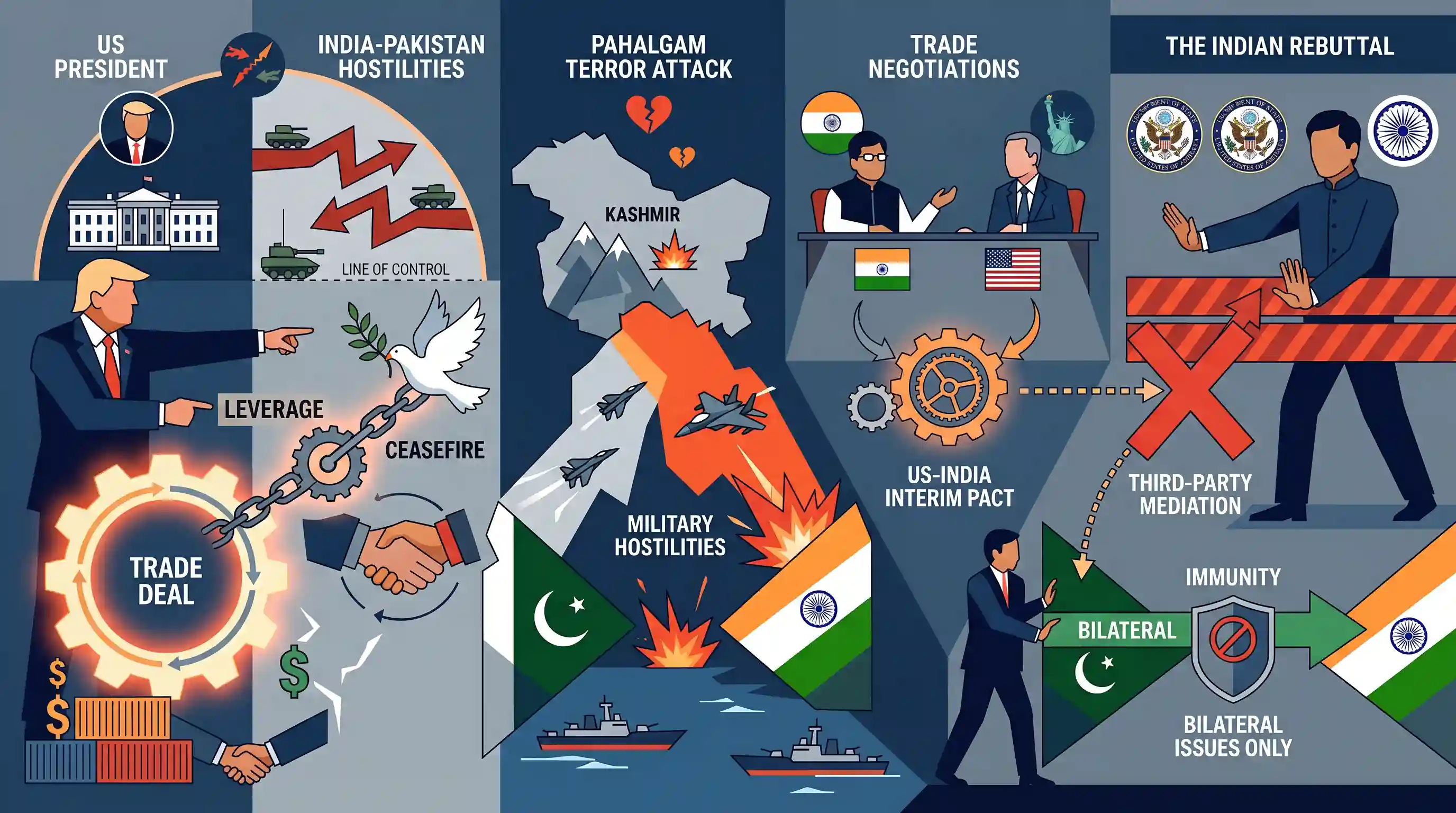
US President Donald Trump claimed credit for ending recent military hostilities between India and Pakistan following the April 22 terror incident in Pahalgam, suggesting his intervention was facilitated by an upcoming major US-India trade deal. As Indian Commerce Minister Piyush Goyal negotiates with US Commerce Secretary Howard Lutnick, Trump portrayed trade leverage as a tool for regional peacemaking. However, the Indian government quickly rebutted the assertion. Foreign Secretary Vikram Misri clarified that Washington was neither involved nor informed, firmly reiterating India's traditional stance that bilateral issues with Pakistan are strictly immune to third-party mediation.
Key Points
- US President Donald Trump claimed he helped de-escalate recent hostilities between India and Pakistan following the April 22 Pahalgam civilian killings.
- Trump implied that ongoing high-stakes US-India trade negotiations provided him the leverage to intervene.
- Indian Commerce Minister Piyush Goyal and US Commerce Secretary Howard Lutnick have been engaged in talks for a bilateral trade agreement.
- India's Foreign Secretary Vikram Misri categorically denied the claims, stating the US was "neither involved nor informed" about the cessation of hostilities.
- The episode reaffirms India's longstanding diplomatic policy of strictly rejecting any third-party mediation in its bilateral disputes with Pakistan.
Important Terms
Shimla Agreement (1972)

A 1972 peace treaty between India and Pakistan mandating the resolution of all disputes through bilateral negotiations. It serves as the legal basis for India’s rejection of third-party mediation in Kashmir.
UPSC context
GS Paper II: International Relations. It is the bedrock of Indo-Pak diplomacy and a frequent topic regarding regional stability.
Bilateralism
The diplomatic practice of conducting affairs between two sovereign states directly. India prioritizes this approach for neighborhood relations to prevent external interference in internal or sensitive matters like Kashmir.
UPSC context
GS Paper II: Neighborhood relations. Tests understanding of India’s strategic preference for direct dialogue over internationalization of disputes.
Third-party Mediation
Intervention by a neutral state or international body to resolve a dispute between two parties. While common in global conflicts, India considers it a violation of sovereignty regarding the Kashmir issue.
UPSC context
GS Paper II: Effect of policies of developed countries. Specifically tests India’s stance against US or UN involvement in Indo-Pak issues.
Foreign Secretary
The administrative head of the Ministry of External Affairs (MEA) and India's top career diplomat. This official advises the government on foreign policy and leads the Indian Foreign Service (IFS).
UPSC context
GS Paper II: Governance/Executive. Knowledge of key constitutional and administrative posts involved in shaping India’s global response.
Trade Diplomacy
The use of economic instruments, such as trade deals and market access, to achieve geopolitical goals. It reflects the shift from traditional security-led diplomacy to geo-economics.
UPSC context
GS Paper II & III: International Relations and Economy. Tests how economic leverage influences strategic partnerships (e.g., India-US ties).
Strategic Autonomy
A foreign policy framework where a state makes independent decisions based on national interest, avoiding being dictated by external powers or becoming part of rival blocs.
UPSC context
GS Paper II: Fundamental principles of India’s foreign policy. Evaluates India’s balancing act between major powers like the US and Russia.
Prelims Trap
India permitted limited US diplomatic mediation with Pakistan to secure a critical bilateral trade deal.
India categorically denied this. India's non-negotiable policy, rooted in the 1972 Simla Agreement, strictly rejects any third-party mediation with Pakistan, regardless of economic leverage.
Static Concepts Connected
What agreements form the basis of India's strict bilateralism policy with Pakistan?
- Simla Agreement 1972: Signed post-1971 war, it committed both nations to settle differences peacefully through bilateral negotiations, forming the bedrock of India's strict no-mediation policy.
- Lahore Declaration 1999: Reiterated the commitment to the Simla Agreement's bilateral framework, emphasizing confidence-building measures and peaceful dispute resolution under a newly nuclearized environment.
- Rejection of UN: India maintains that the Simla Agreement supersedes earlier UN resolutions, thereby nullifying any mandate for international or third-party mediation in Kashmir.
How is economic statecraft utilized in contemporary Indo-US relations?
- Transactional Leverage: The US increasingly uses trade negotiations, tariffs, or the withdrawal of trade privileges (like GSP) as bargaining chips to extract broader geopolitical concessions.
- Strategic Autonomy: India counterbalances this by insulating its core national security policies and territorial disputes from its economic and trade negotiations.
Cross-Topic Patterns
Trade Leverage vs. Strategic Autonomy
US attempts to tie bilateral trade deals to geopolitical mediation highlight the friction between transactional economic diplomacy and India's core doctrine of strategic autonomy.
Limited Conflict under Nuclear Overhang
India's retaliation (Operation Sindoor) reflects an evolving doctrine of punitive conventional strikes against terror infrastructure, carefully calibrated to stay below the nuclear threshold despite global alarm.

A 2026 Prelims question will likely test the exact provisions of the Simla Agreement against India's strict doctrine of bilateralism.
Linked PYQs · 2
Linked PYQs · 2
- 2015MainsGS2
Terrorist activities and mutual distrust have clouded India-Pakistan relations. To what extent the use of soft power like sports and cultural exchanges could help generate goodwill between the two countries? Discuss with suitable examples.
- 2020MainsGS2
What is the significance of Indo-US defence deals over Indo-Russian defence deals? Discuss with reference to stability in the Indo-Pacific region.
