US China Tariffs and Export Opportunities for India
Source:Indian Express ↗
Why It Matters
Global protectionism and the US-China trade war have direct implications for India's export sector and macroeconomic stability. Understanding how India can leverage these geopolitical tensions (e.g., via the 'China Plus One' strategy) is crucial for topics relating to export-led growth, manufacturing competitiveness, and global economic integration.
Summary
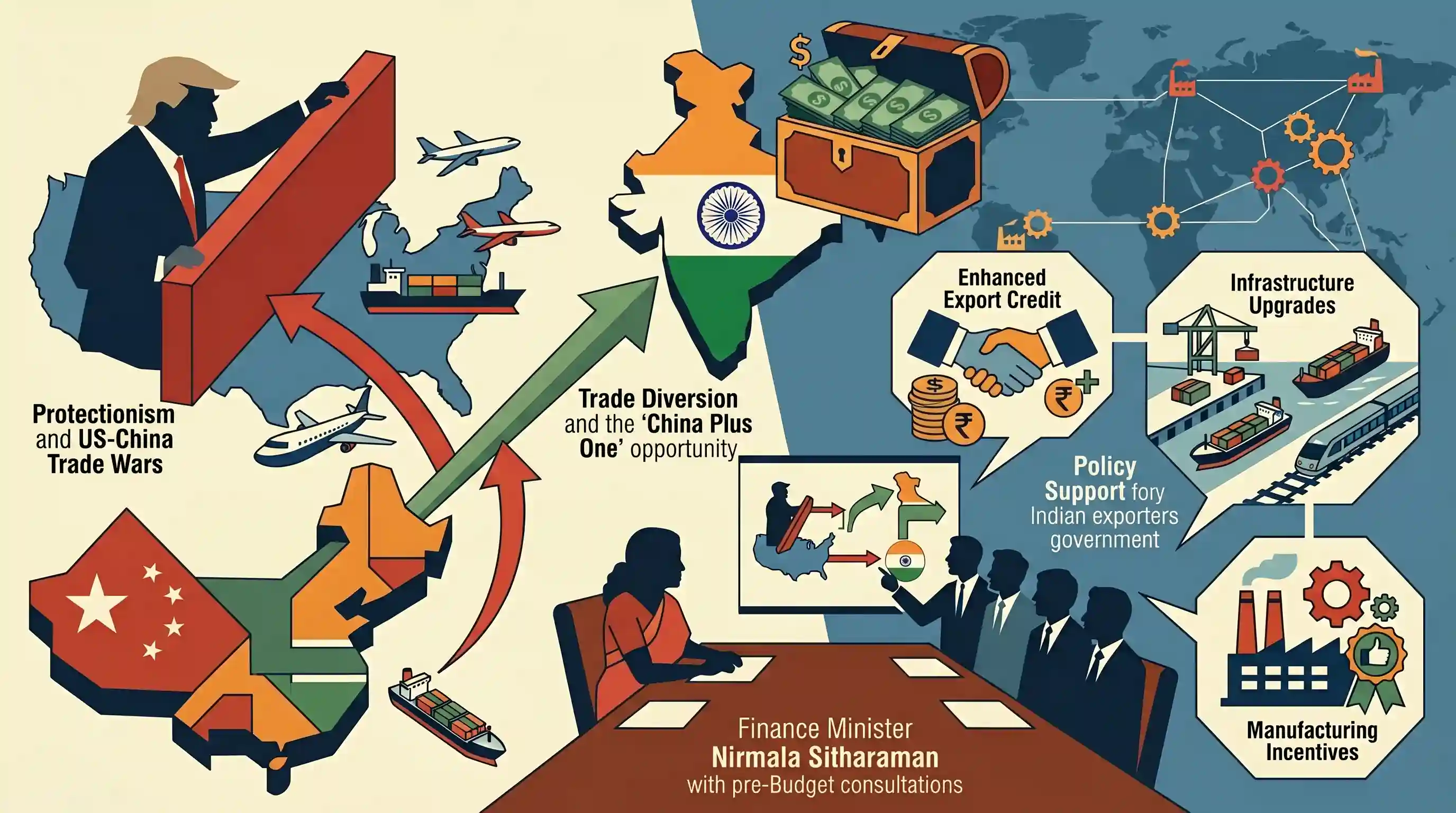
Indian exporters have informed Finance Minister Nirmala Sitharaman that proposed US tariffs on Chinese goods under Donald Trump's incoming administration could unlock a $25-billion export opportunity for India. During pre-Budget consultations, industry representatives urged the government to provide policy support—such as enhanced export credit, infrastructure upgrades, and manufacturing incentives—to help India capitalize on trade diversion and solidify its position in the 'China Plus One' global supply chain realignment.
Key Points
- Proposed tariffs by US President-elect Donald Trump on Chinese goods could create a massive trade diversion opportunity.
- Indian exporters estimate this shift could unlock up to a $25-billion export market for India in the US.
- Exporters raised these projections during pre-Budget consultations with Finance Minister Nirmala Sitharaman.
- Capitalizing on this opportunity will require targeted domestic policy support, including infrastructure development, addressing inverted duty structures, and competitive export credit.
- The geopolitical friction between the US and China accelerates the 'China Plus One' supply chain realignment, positioning India as a prime alternative manufacturing hub.
Important Terms
China Plus One Strategy

A global business strategy where companies diversify their manufacturing and supply chains by establishing production hubs outside of China to mitigate over-reliance and geopolitical risks.
UPSC context
GS Paper III (Economy/Industry); relevant for questions on global value chains, supply chain resilience, and India's manufacturing potential.
Trade Diversion
An economic phenomenon where trade shifts from a more efficient producer to a less efficient one due to preferential tariffs or trade barriers (like US-China tariffs).
UPSC context
GS Paper III (Economy/International Trade); tests understanding of how protectionism and trade wars impact global resource allocation.
Interest Equalisation Scheme (IES)
A government scheme providing interest subvention (subsidy) on pre- and post-shipment export credit, primarily to MSME manufacturers, to enhance their global cost-competitiveness.
UPSC context
GS Paper III (Indian Economy); critical for questions on export promotion, MSME support, and fiscal measures to boost trade.
Export Credit Guarantee Corporation (ECGC)
A government-owned enterprise under the Ministry of Commerce that provides credit insurance to exporters and banks to protect against payment risks from foreign buyers.
UPSC context
GS Paper III (Economy); relevant for topics on export financing, risk mitigation in international trade, and institutional support.
Federation of Indian Export Organisations (FIEO)
The apex body of Indian export promotion councils, acting as a crucial interface between the trading community and the government on trade policy and incentives.
UPSC context
GS Paper III (Economy); tests knowledge of institutional frameworks for trade promotion and industry-government stakeholders.
Pre-Budget Consultations
A series of formal meetings held by the Finance Ministry with various stakeholders (industry, unions, economists) to gather inputs before drafting the Union Budget.
UPSC context
GS Paper II (Polity/Governance) and III (Economy); focuses on the participatory nature of the budgetary process and fiscal policy-making.
Prelims Trap
"Inverted duty structure implies higher import tariffs on finished products compared to raw materials."
It is the exact opposite. An inverted duty structure means taxes/duties on raw materials are higher than on finished goods, which severely discourages domestic manufacturing and value-addition.
Static Concepts Connected
What is an Inverted Duty Structure and how does it impact the economy?
- Definition: A tax regime where import duties or GST on raw materials and intermediate inputs are higher than the taxes levied on finished goods.
- Manufacturing Impact: It makes domestic manufacturing uncompetitive by increasing input costs, while making imported finished goods comparatively cheaper for consumers.
- Working Capital: Exporters face blocked working capital due to the accumulation of unutilized Input Tax Credit (ITC), necessitating complex and delayed government refunds.
What is 'Trade Diversion' in the context of global economics?
- Core Mechanism: It occurs when trade shifts from a more efficient, lower-cost global supplier to a less efficient one, typically driven by protectionist tariffs, sanctions, or Free Trade Agreements.
- Current Context: Proposed US tariffs on China artificially increase the cost of Chinese goods, allowing countries like India to capture the US market despite potentially higher baseline production costs.
Cross-Topic Patterns
PLI Schemes + China Plus One
India's PLI schemes directly complement the 'China Plus One' geopolitical realignment by offering financial incentives to absorb global trade diversion in sectors like electronics, pharmaceuticals, and textiles.
Rules of Origin & Trade Wars
As US-China trade friction grows, enforcing Rules of Origin (like India's CAROTAR 2020) becomes vital to stop Chinese goods from being illegally routed through third countries to evade tariffs.

Expect a 2026 multi-statement Prelims question testing the interplay between Trade Diversion, Rules of Origin, and Inverted Duty.
Linked PYQs · 3
Linked PYQs · 3
- 2018MainsGS3
How would the recent phenomena of protectionism and currency manipulations in world trade affect macroeconomic stability of India?
- 2018MainsGS2
What are the key areas of reform if the WTO has to survive in the present context of "Trade War', especially keeping in mind the interest of India?
- 2012MainsGS2
Discuss the likely negative impact of the protectionist measures proposed by the US on India's software industry.
