US Protectionist Policies and Their Strategic Implications for China
Source:Indian Express ↗
Why It Matters
The ongoing strategic and economic competition between the US and China directly impacts global supply chains, inflation, and global governance. For India, a world shifting from free trade to protectionism presents both challenges (trade barriers) and opportunities (attracting supply chains moving away from China), necessitating a delicate recalibration of its foreign policy and economic strategy.
Summary
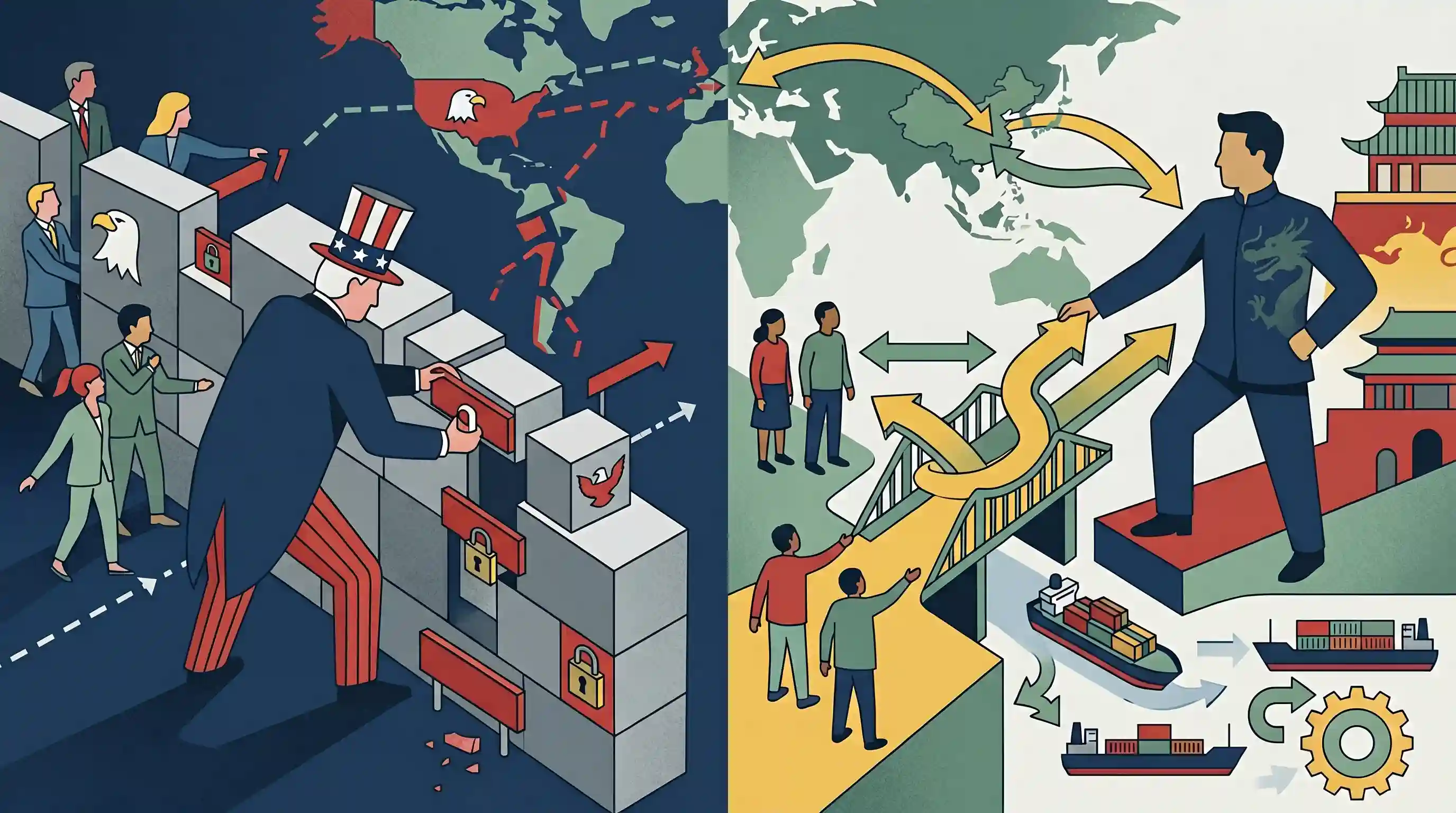
The article analyzes the unintended geopolitical consequences of Donald Trump's 'America First' protectionist trade policies. While the imposition of aggressive tariffs aims to penalize China and revitalize American manufacturing, it paradoxically creates opportunities for Beijing to enhance its global standing. As the U.S. retreats from multilateralism and alienates allies through trade barriers, China is positioning itself as a reliable champion of globalization and free trade, deepening its influence in the Global South. Consequently, Washington's isolationist approach is forcing a fundamental restructuring of global trade relationships, potentially empowering China in the broader strategic competition for global leadership.
Key Points
- Donald Trump's 'Make America Great Again' (MAGA) agenda relies heavily on trade protectionism, including aggressive tariffs targeting China and other nations.
- While aimed at reviving U.S. manufacturing, these isolationist policies often alienate allies and disrupt established global supply chains.
- China is capitalizing on the resulting vacuum by presenting itself as a champion of free trade and globalization, particularly strengthening its economic ties with the Global South.
- U.S. tariffs and trade barriers are forcing a fundamental restructuring of global trade dynamics, with countries seeking alternative partnerships and supply routes.
- The U.S. retreat from multilateralism paradoxically risks empowering China on the global stage, transforming the trade war into a broader realignment of global economic alliances.
Prelims Trap
"The United States actively uses the WTO dispute settlement mechanisms to counter China's unfair trade practices."
The US is actually bypassing the WTO and has crippled its Appellate Body by blocking judge appointments, preferring unilateral tariff actions (like Section 301) instead.
Static Concepts Connected
What is the WTO Appellate Body crisis?
- Two-tier system: The WTO's dispute settlement mechanism relies on a two-tier system: an initial panel and an Appellate Body.
- US blockade: The US has consistently blocked the appointment of new judges to the Appellate Body since 2019, rendering it non-functional.
- Multilateral failure: Without an apex dispute resolution body, unilateral tariffs (like the US-China trade war) escalate without enforceable multilateral checks.
What are the key Supply Chain Resilience strategies?
- China Plus One: A business strategy to diversify manufacturing and supply chains beyond China to mitigate over-reliance and geopolitical risks.
- Friend-shoring: Sourcing essential materials and manufacturing from allied nations that share similar geopolitical values and strategic interests.
- Near-shoring: Relocating production closer to the final consumer market to reduce freight costs and supply chain vulnerabilities.
Cross-Topic Patterns
WTO paralysis and the rise of Minilaterals
As the US stalls the WTO Appellate Body and imposes unilateral tariffs, trade governance is shifting toward regional blocs (RCEP, CPTPP) and minilateral economic frameworks like IPEF.
Global South and BRI expansion
China leverages the US trade vacuum to present its Belt and Road Initiative (BRI) as a 'free trade' lifeline to the Global South, masking potential debt-trap dependencies.

US protectionism + WTO paralysis + India's leadership in the Global South is a prime candidate for a 15-marker in GS-2 IR.
Linked PYQs · 2
Linked PYQs · 2
- 2021MainsGS2
“The USA is facing an existential threat in the form of a China, that is much more challenging than the erstwhile Soviet Union.” Explain.
- 2025MainsGS3
What are the challenges before the Indian economy when the world is moving away from free trade and multilateralism to protectionism and bilateralism? How can these challenges be met?
