US China Tariff Disputes and Geopolitical Trade Negotiations
Source:The Hindu ↗
Why It Matters
The ongoing US-China trade and technology war significantly impacts the global economy, semiconductor supply chains, and multilateral trade frameworks. It is essential for understanding contemporary geopolitics, shifting global alliances, and the structural challenges facing the WTO.
Summary
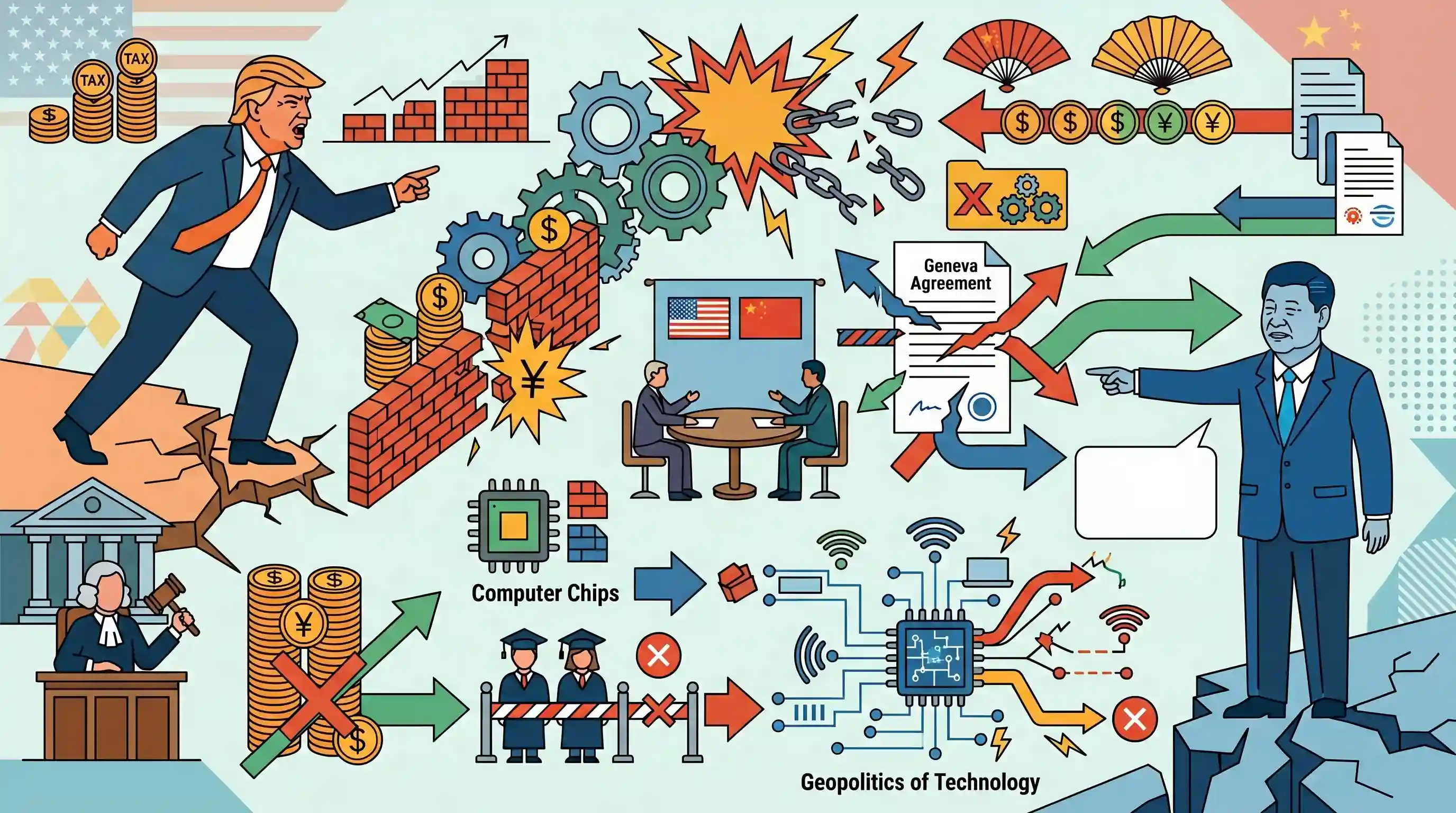
U.S. President Donald Trump has characterized Chinese President Xi Jinping as "extremely hard to make a deal with" as trade tensions between the two nations resurface. The U.S. has accused China of backtracking on an agreement to roll back tariffs, while China asserts that U.S. restrictions on computer chips and student visas violate their tariff truce. The two leaders are expected to hold talks to iron out differences over a recent Geneva tariff agreement. Meanwhile, U.S. domestic courts are battling over the legality of the tariffs imposed under emergency powers, with an appeals court temporarily reinstating them following an initial block.
Key Points
- U.S. President Donald Trump described Chinese President Xi Jinping as "tough" and "extremely hard to make a deal with" amid escalating trade tensions.
- The U.S. has accused China of violating an agreement aimed at rolling back tariffs and trade restrictions.
- The two leaders are scheduled to hold talks to resolve differences over a recent tariff agreement reached in Geneva.
- China claims that U.S. actions restricting computer chips and student visas seriously violate the established tariffs truce.
- A U.S. trade court initially ruled that Trump overstepped his authority in imposing tariffs under an emergency powers act, though a federal appeals court quickly reinstated them pending an appeal.
Important Terms
International Emergency Economic Powers Act (IEEPA)

A 1977 US law empowering the President to regulate international commerce and freeze assets after declaring a national emergency to address unusual and extraordinary threats.
UPSC context
GS Paper II: International Relations and Separation of Powers; tests executive authority in trade diplomacy and global sanctions.
Geneva Tariff Agreement (2025)
A May 2025 bilateral trade truce where the US and China agreed to slash tariffs (US to 30%, China to 10%) for a 90-day cooling-off period.
UPSC context
GS Paper II: Bilateral Relations; essential for understanding recent shifts in US-China trade dynamics and global market stability.
Tariff
A tax or duty imposed by a government on imported goods, intended to make foreign products less competitive and protect domestic industries.
UPSC context
GS Paper III: Economy; fundamental concept for trade policy, fiscal revenue, and domestic industrial protection debates.
Protectionism
An economic policy of shielding a country's domestic industries from foreign competition by taxing imports, often leading to reduced international trade and higher consumer prices.
UPSC context
GS Paper III: Economy; focuses on globalization challenges, trade barriers, and their impact on developing economies like India.
Trade War
An economic conflict where countries retaliate against each other by raising import duties or setting other trade barriers, disrupting global supply chains.
UPSC context
GS Paper II: International Relations; tests impacts of US-China rivalry on multilateralism and global economic governance.
U.S. Court of International Trade (CIT)
A specialized US federal court that hears civil cases related to trade laws, including challenges to the legality of tariffs and customs classifications.
UPSC context
GS Paper II: Comparative Constitutions; relevant for legal mechanisms and judicial review in international trade disputes.
Prelims Trap
The tariff agreements and trade truces between the US and China are formally enforced through the World Trade Organization (WTO) mechanisms.
The US-China trade war heavily relies on domestic laws (like Section 232/301) and bilateral truces, effectively bypassing the currently paralyzed WTO Dispute Settlement Body.
Static Concepts Connected
What is the 'National Security Exception' under WTO rules?
- GATT Article XXI: Allows WTO members to breach standard trade obligations to protect their essential security interests.
- Traffic in Arms: Includes actions related to the traffic of arms, ammunition, and dual-use implements of war.
- Emergency invocation: Can be invoked during times of war or other critical emergencies in international relations.
How are dual-use technologies globally and domestically regulated?
- Wassenaar Arrangement: A multilateral export control regime for conventional arms and dual-use goods/technologies. India is a participating state.
- Unilateral Export Controls: Nations use domestic legislation (like the US 'Entity List') to block rivals from accessing critical technologies like AI chips.
Cross-Topic Patterns
Chips, geopolitics, and PLI schemes
US restrictions on Chinese access to advanced computer chips directly mirror India's strategic push for semiconductor self-reliance through the India Semiconductor Mission and PLI schemes.
Securitization of human capital and visas
Restricting Chinese student visas reflects how human capital, research mobility, and STEM pipelines are now securitized as dual-use geopolitical assets in great power competition.

Expect a multi-statement Prelims question linking GATT Article XXI (National Security Exception), Wassenaar Arrangement, and semiconductors.
Linked PYQs · 4
Linked PYQs · 4
- 2025MainsGS2
"With the waning of globalization, post-Cold War world is becoming a site of sovereign nationalism.” Elucidate.
- 2021MainsGS2
“The USA is facing an existential threat in the form of a China, that is much more challenging than the erstwhile Soviet Union.” Explain.
- 2018MainsGS2
What are the key areas of reform if the WTO has to survive in the present context of "Trade War', especially keeping in mind the interest of India?
- 2025MainsGS3
India aims to become a semiconductor manufacturing hub. What are the challenges faced by the semiconductor industry in India? Mention the salient features of the India Semiconductor Mission.
