Shifting US Foreign Policy Requires Strategic Autonomy for India
Source:Indian Express ↗
Why It Matters
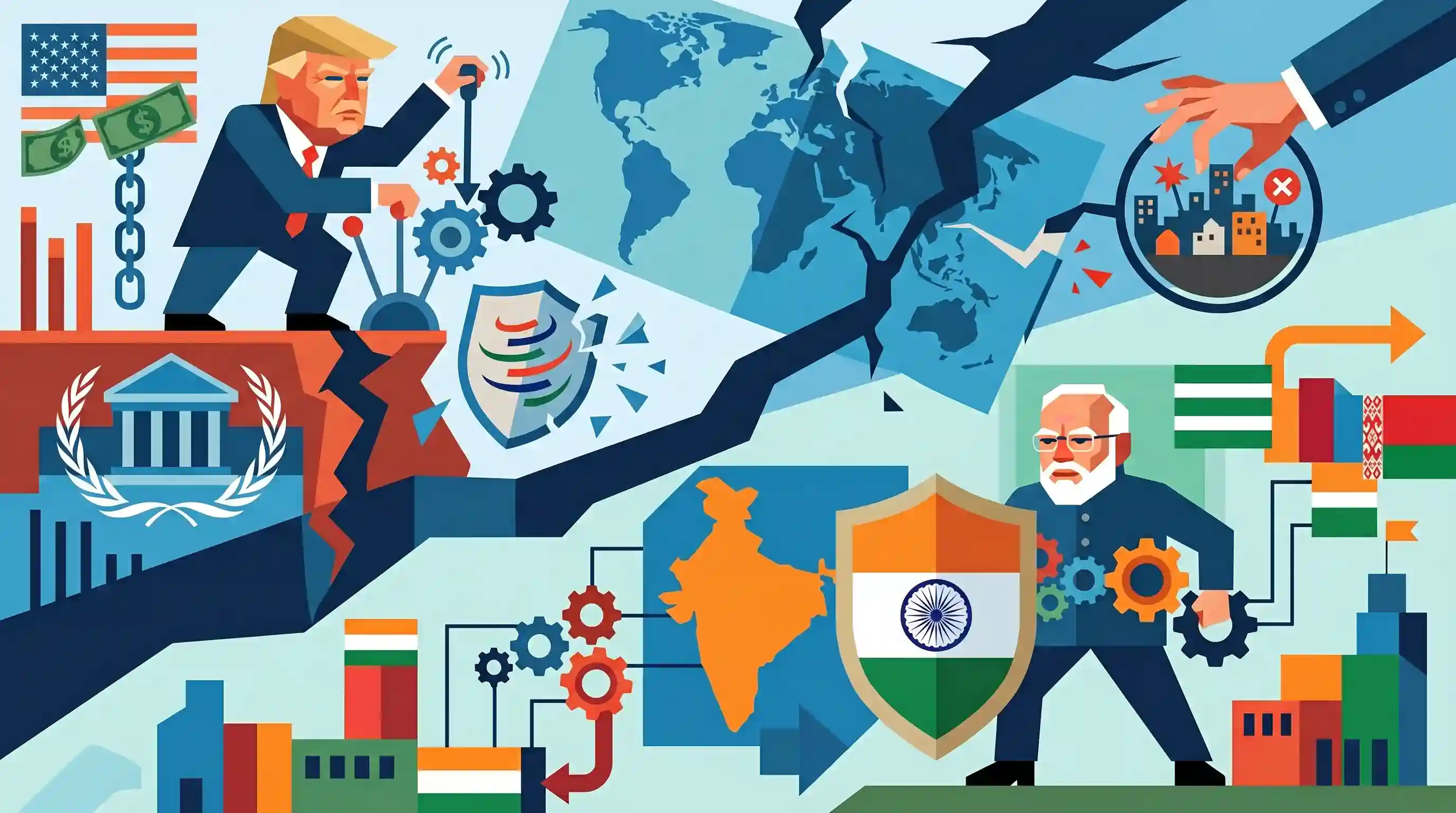
The potential weakening of NATO and disruption of the UN and WTO by US policy shifts directly affect India's strategic calculations, trade prospects, and diplomatic maneuvering, highlighting the evolving nature of global governance and the critical need for strategic autonomy.
Summary
The article examines the profound implications of Donald Trump's unconventional foreign policy, characterized by his proposed 'Board of Peace' and a dismissive stance toward traditional alliances like NATO. It outlines how this approach threatens the stability of established multilateral institutions, including the WTO and the UN Security Council, while introducing unpredictable elements into global flashpoints like Gaza. In response to this shifting and increasingly transactional US-led global order, the author argues that India, under PM Modi, must execute a strategic pivot. New Delhi is urged to bolster its strategic autonomy and proactively adapt its diplomatic posture to protect its interests in a rapidly transforming geopolitical landscape.
Key Points
- Donald Trump's proposed "Board of Peace" and disruptive foreign policy approach signal a potential dismantling of traditional US-led security architectures, notably NATO.
- The article highlights Trump's skepticism toward multilateral institutions, predicting significant impacts on the World Trade Organization (WTO) and the UN Security Council.
- Unconventional geopolitical maneuvers, such as interventions in Gaza and discussions about Greenland, underscore a shift toward highly transactional US diplomacy.
- For India, this unpredictable global environment necessitates a strategic pivot, demanding that New Delhi re-evaluate its foreign policy priorities to safeguard its national interests.
- The decline of the post-Cold War institutional framework compels India to reinforce its strategic autonomy and navigate a volatile, multipolar world order.
Important Terms
NATO (North Atlantic Treaty Organization)

An intergovernmental military alliance established in 1949, centered on the principle of collective defense where an attack on one member is an attack on all.
UPSC context
GS Paper 2/3: Tests understanding of global security architectures and India’s strategic distance from military blocs.
UN Security Council (UNSC)
A principal organ of the United Nations charged with maintaining international peace and security, consisting of five permanent members with veto power and ten non-permanent members.
UPSC context
GS Paper 2: Key to global governance topics and India’s long-standing demand for permanent membership (P5) reforms.
World Trade Organization (WTO)
The only global international organization dealing with the rules of trade between nations, established in 1995 to ensure trade flows as smoothly and predictably as possible.
UPSC context
GS Paper 2/3: Crucial for evaluating global trade rules, dispute settlement, and their impact on India’s economic interests.
Strategic Autonomy
A foreign policy posture where a state exercises independent decision-making based on national interest, resisting external pressure to join specific power blocs or alliances.
UPSC context
GS Paper 2: A core principle of Indian diplomacy, testing the transition from non-alignment to pragmatic multi-alignment.
Transactional Foreign Policy
A style of diplomacy focusing on immediate, self-interested gains and bilateral "deals" rather than long-term institutional commitments or shared ideological values.
UPSC context
GS Paper 2: Relevant for analyzing the effects of unpredictable U.S. policy shifts on India’s bilateral and multilateral interests.
Board of Peace
An unconventional international peacekeeping body proposed by Donald Trump, characterized by centralized leadership and a focus on reconstruction and stabilization in conflict zones like Gaza.
UPSC context
GS Paper 2: Evaluates the emergence of non-traditional diplomatic mechanisms and their challenge to the established UN-led world order.
Multilateralism
The practice of coordinating national policies in groups of three or more states through formal international institutions and rules-based frameworks.
UPSC context
GS Paper 2: Central to discussions regarding the "crisis of multilateralism" and the reform of the global rules-based order.
Prelims Trap
"The Board of Peace is a specialized agency of the United Nations established for Gaza reconstruction."
While initial legitimacy came via UNSC Res 2803, the Board of Peace is a US-led, parallel "pay-to-play" body outside traditional UN institutional frameworks.
Static Concepts Connected
What distinguishes India's Strategic Autonomy from traditional Non-Alignment?
- Non-Alignment: Historically meant maintaining strict distance from formal Cold War military and political blocs to ensure independence.
- Strategic Autonomy: Involves proactive, issue-based partnerships and multi-alignment driven by national interest, without binding alliance constraints.
- Practical Application: Allows India to engage in opposing groupings like the Quad and SCO simultaneously without losing independent decision-making.
What distinguishes Minilateralism from traditional Multilateralism in global governance?
- Multilateralism: Broad-based, consensus-driven forums involving a large number of states aiming for universal rules (e.g., UN, WTO).
- Minilateralism: Small, targeted coalitions of willing states focusing on specific shared interests, geography, or immediate crises.
- The Trade-off: Minilateral groupings prioritize speed, flexibility, and transactionality over the broad, democratic legitimacy of universal multilateral institutions.
Cross-Topic Patterns
Rise of transactional minilateralism
The shift from consensus-based UN frameworks to "pay-to-play" minilaterals parallels the systemic decline of the WTO's dispute settlement mechanism and the rise of selective economic groupings.
Diplomatic hedging via observer status
India's "wait and watch" observer approach to the Board of Peace mirrors its stance during the Ukraine crisis, prioritizing strategic autonomy and multi-alignment over Western alliance pressures.

UNSC Res 2803 and the "Board of Peace" will likely feature in a Prelims question contrasting UN agencies with US-led minilaterals.
Linked PYQs · 4
Linked PYQs · 4
- 2023MainsGS2
‘The expansion and strengthening of NATO and a stronger US-Europe strategic partnership works well for India.’ What is your opinion about this statement ? Give reasons and examples to support your answer.
- 2025MainsGS2
"With the waning of globalization, post-Cold War world is becoming a site of sovereign nationalism.” Elucidate.
- 2018MainsGS2
What are the key areas of reform if the WTO has to survive in the present context of "Trade War', especially keeping in mind the interest of India?
- 2025MainsGS2
"The reform process in the United Nations remains unresolved, because of the delicate imbalance of East and West and entanglement of the USA vs. Russo-Chinese alliance.” Examine and critically evaluate the East-West policy confrontations in this regard.
