US Government Shutdown Risks and Federal Workforce Downsizing
Source:Indian Express ↗
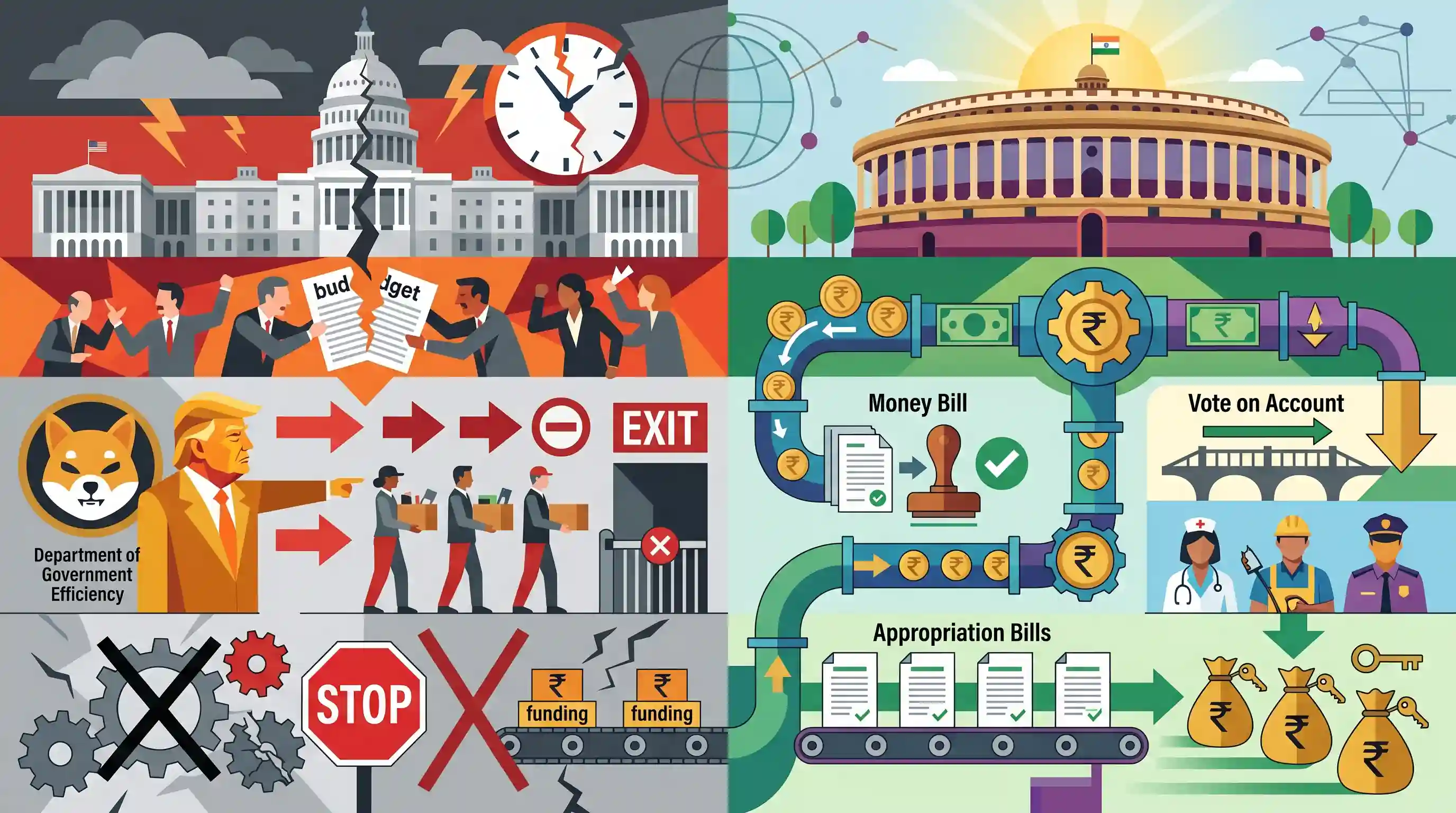
Why It Matters
The article provides a real-world example of the differences between the US Presidential system and the Indian Parliamentary system regarding financial legislation and budget approval. It also touches upon global trends in civil service reforms and bureaucracy downsizing, relevant for GS Paper 2 governance topics.
Summary
The United States is facing a potential partial government shutdown as lawmakers struggle to agree on discretionary funding. Incoming President Donald Trump has warned that agencies whose funding lapses will face mass layoffs, supporting the broader agenda of the new Department of Government Efficiency (DOGE) to significantly downsize the federal workforce. The crisis highlights a stark contrast with the Indian parliamentary system, where mechanisms like the 'Vote on Account' and strict procedures for Money and Appropriation Bills prevent such administrative paralysis.
Key Points
- A potential US government shutdown is looming due to a legislative deadlock between Democrats and Republicans over a short-term funding agreement.
- Incoming President Donald Trump warned of mass layoffs ("reduction in force") for federal programs whose funding lapses, aligning with the Department of Government Efficiency (DOGE) agenda to downsize the civil bureaucracy.
- The US system requires Congress to pass appropriation bills to fund operations; failure leads to government shutdowns.
- In contrast, the Indian parliamentary system ensures continuity of government functions through mechanisms like the 'Vote on Account', which provides advance grants pending the passage of the main Appropriation Bill.
Important Terms
Appropriation Bill

A Money Bill (Article 114) that provides legal authority to the government to withdraw funds from the Consolidated Fund of India to meet expenditures for a financial year.
UPSC context
GS Paper II (Parliament) and GS Paper III (Budgeting); essential for understanding legislative control over public finance and the 'No taxation without representation' principle.
Vote on Account
A grant in advance (Article 116) allowing the Lok Sabha to authorize government expenditure for a part of the year before the full budget and Appropriation Bill are passed.
UPSC context
GS Paper II and III; tests knowledge of financial procedures during election years or transitions to prevent administrative paralysis.
Department of Government Efficiency (DOGE)
An executive initiative led by Elon Musk aimed at streamlining the U.S. federal government, cutting 'bureaucratic waste,' and downsizing the workforce through reclassification and mass layoffs.
UPSC context
GS Paper II (Role of Civil Services in a Democracy); relevant for comparative analysis of civil service reforms and executive influence over the permanent bureaucracy.
Office of Management and Budget (OMB)
The largest office within the U.S. Executive Office of the President; it produces the President’s Budget, oversees agency performance, and ensures policy alignment across the executive branch.
UPSC context
GS Paper II (Comparative Constitution); used to compare the U.S. executive budget process with India’s Ministry of Finance and NITI Aayog functions.
Office of Personnel Management (OPM)
The independent human resources agency for the U.S. federal government, managing the civil service, merit system principles, and employee benefits.
UPSC context
GS Paper II (Comparative Constitution); comparable to India's Department of Personnel and Training (DoPT) and Union Public Service Commission (UPSC).
Prelims Trap
"The failure to pass an Appropriation Bill in the Lok Sabha leads to a temporary administrative shutdown."
In India's parliamentary system, defeating an Appropriation Bill indicates a loss of majority confidence. The Council of Ministers must resign; it does not result in a US-style temporary administrative shutdown.
Static Concepts Connected
What is the constitutional mechanism of a 'Vote on Account'?
- Constitutional Basis: Under Article 116, it allows the Lok Sabha to make advance grants from the Consolidated Fund of India to cover short-term expenditure.
- Scope and Duration: It generally covers one-sixth of the total estimated expenditure (for two months) while the main Appropriation Bill is being debated.
- Difference from Budget: Unlike an Interim Budget which details both receipts and expenditure, a Vote on Account deals exclusively with the expenditure side of the government's budget.
Why are US-style government shutdowns structurally impossible in India?
- Fused Powers: India features a parliamentary executive where the ruling government must command a majority in the Lok Sabha to survive.
- Confidence Vote Proxy: An Appropriation Bill acts as a Money Bill. Its defeat signifies a loss of confidence, forcing the government to resign immediately.
- Advance Grants: The Constitution provides tools like the 'Vote on Account' to bridge funding gaps seamlessly without halting administrative machinery.
Cross-Topic Patterns
Comparative Separation of Powers
US budget shutdowns stem from a strict separation of powers. India's fused executive-legislature means a budget defeat triggers government collapse rather than an administrative limbo.
DOGE vs. Article 311 protections
Trump's threat to arbitrarily slash the federal workforce contrasts with India's Article 311, which constitutionally shields civil servants from arbitrary dismissal or rank reduction without due inquiry.

Expect a 2026 Prelims question contrasting US budget deadlocks with India's Vote on Account and Appropriation Bill passage processes.
Linked PYQs · 4
Linked PYQs · 4
- 2020MainsGS2
Institutional quality is a crucial driver of economic performance". In this context suggest reforms in Civil Service for strengthening democracy.
- 2024PrelimsGS1
Which of the following statements are correct in respect of a Money Bill in the Parliament? 1. Article 109 mentions special procedure in respect of Money Bills. 2. A Money Bill shall not be introduced in the Council of States. 3. The Rajya Sabha can either approve the Bill or suggest changes but cannot reject it. 4. Amendments to a Money Bill suggested by the Rajya Sabha have to be accepted by the Lok Sabha. Select the answer using the code given below :
- 2023PrelimsGS1
With reference to Finance Bill and Money Bill in the Indian Parliament, consider the following statements: 1. When the Lok Sabha transmits Finance Bill to the Rajya Sabha, it can amend or reject the Bill. 2. When the Lok Sabha transmits Money Bill to the Rajya Sabha, it cannot amend or reject the Bill, it can only make recommendations. 3. In the case of disagreement between the Lok Sabha and the Rajya Sabha, there is no joint sitting for Money Bill, but a joint sitting becomes necessary for Finance Bill. How many of the above statements are correct?
- 2024MainsGS2
Discuss India as a secular state and compare with the secular principles of the US constitution.
