US Belarus Diplomatic Engagement Precedes High Stakes Alaska Summit
Source:Indian Express ↗
Why It Matters
The engagement between the US and Belarus right before a US-Russia summit illustrates the complex geopolitical maneuvering within the East-West paradigm. It underscores how major powers use diplomatic leverage over each other's allies to advance strategic and human rights agendas.
Summary
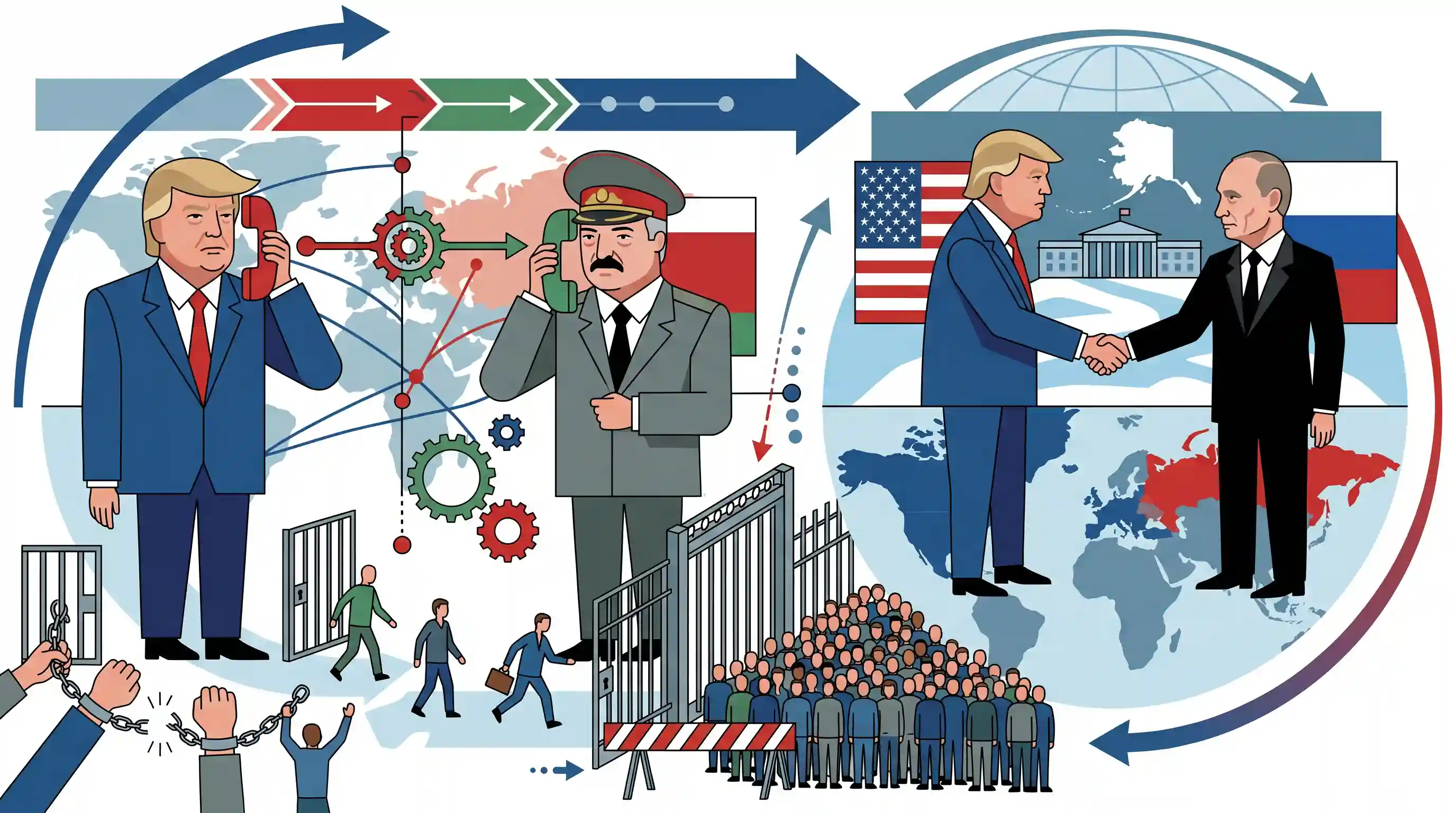
US President Donald Trump held a phone call with Belarusian President Alexander Lukashenko shortly before his planned summit with Russian President Vladimir Putin in Alaska. Trump's stated objective for the call was to address human rights, thanking Lukashenko for freeing 16 political prisoners and urging the release of 1,300 more. This engagement highlights broader East-West geopolitical maneuvers, as the US interacts with a close Russian ally while managing its direct relations with Moscow.
Key Points
- US President Donald Trump engaged in a phone call with Belarusian President Alexander Lukashenko ahead of a scheduled meeting with Russian President Vladimir Putin in Alaska.
- The conversation focused on political prisoners, with Trump thanking Lukashenko for releasing 16 individuals and pressing for the release of 1,300 more.
- Lukashenko is a close ally of Putin, making this diplomatic outreach significant in the context of US-Russia relations and East-West geopolitical dynamics.
Prelims Trap
Belarus is a coastal Eastern European nation bordered by the Baltic Sea.
Belarus is entirely landlocked. UPSC often tricks candidates by listing it alongside its Baltic neighbors (Lithuania, Latvia) to falsely imply it has coastal access to the Baltic Sea.
Static Concepts Connected
Which countries share land borders with Belarus?
- Russia: Shares the longest eastern and northeastern boundary; Russia's closest military and economic ally in the region.
- Ukraine: Borders the south, making Belarus a critical northern flank in the ongoing regional conflict.
- NATO Members: Poland (West), Lithuania (Northwest), and Latvia (North) form the western boundary, representing the immediate NATO frontier.
What is Triangular Diplomacy in International Relations?
- Definition: A tactic where a state engages a third party (often an adversary's ally) to exert leverage over its primary geopolitical rival.
- Historical Context: Famous during the Cold War when the US exploited the Sino-Soviet split to isolate the Soviet Union.
- Modern Application: The US engaging Belarus ahead of Putin talks to signal diplomatic reach into Russia's immediate sphere of influence.
Cross-Topic Patterns
Buffer States + Regional Balancing
The Belarus dynamic mirrors India's neighborhood challenges (e.g., Nepal or Bhutan balancing India and China), highlighting the strategic vulnerability and leverage of landlocked buffer states.
Human Rights as Diplomatic Leverage
Using political prisoner releases as summit leverage connects to Western diplomatic conditionality, frequently tested in the context of economic sanctions, FATF gray-listing, and CAATSA waivers.

A Prelims map question identifying landlocked Eastern European states (like Belarus) buffering Russia and NATO is highly probable in 2026.
Linked PYQs · 2
Linked PYQs · 2
- 2025MainsGS2
"The reform process in the United Nations remains unresolved, because of the delicate imbalance of East and West and entanglement of the USA vs. Russo-Chinese alliance.” Examine and critically evaluate the East-West policy confrontations in this regard.
- 2025MainsGS2
"With the waning of globalization, post-Cold War world is becoming a site of sovereign nationalism.” Elucidate.
