US-China Diplomatic Engagement and Rivalry Management
Source:Indian Express ↗
Why It Matters
The US-China strategic competition directly dictates the global economic and security architecture. For India, understanding this rivalry is critical for analyzing shifts in global supply chains (like the China+1 strategy), Indo-Pacific security dynamics, and India's own multi-aligned foreign policy.
Summary
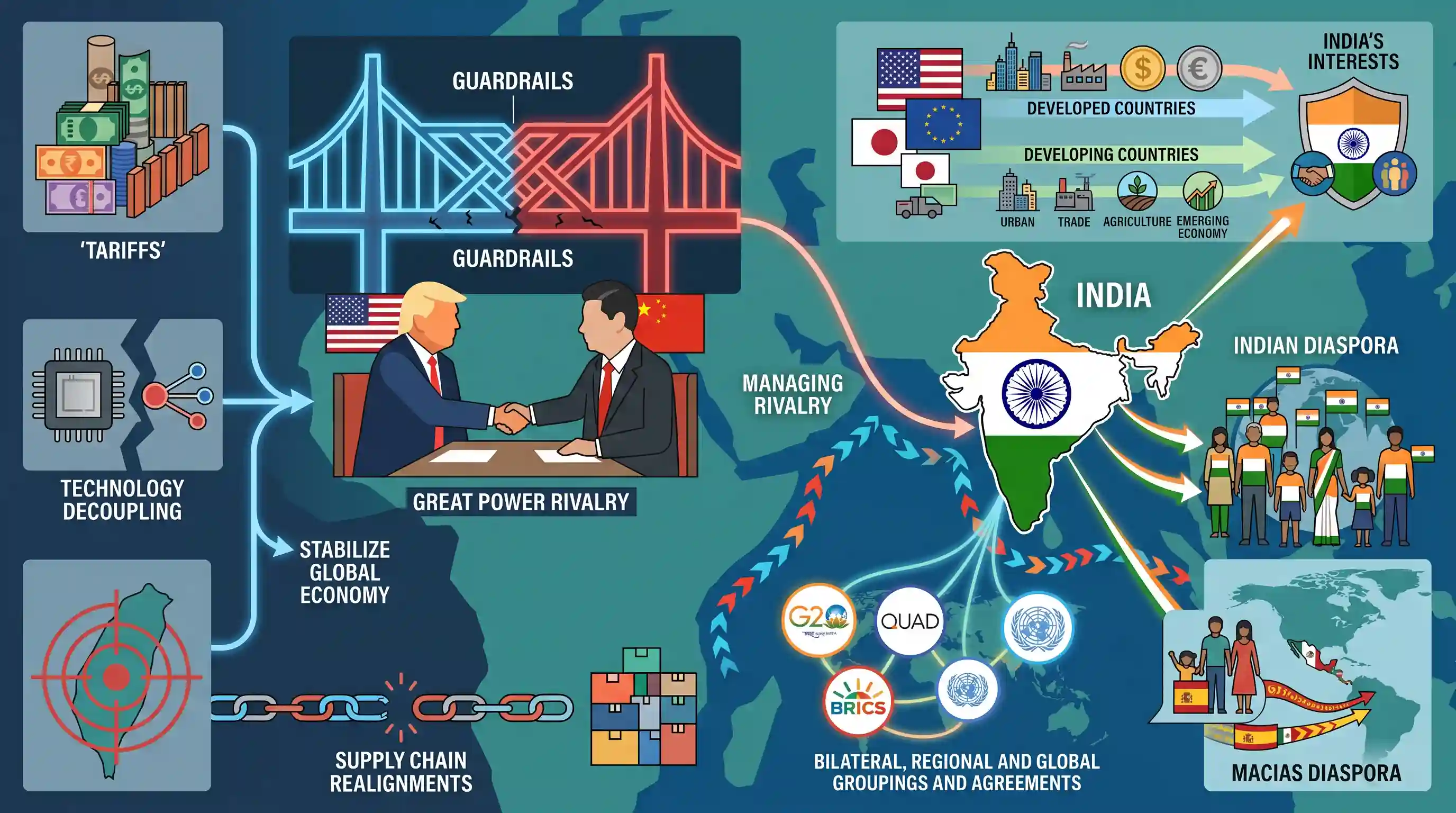
US President Donald Trump’s diplomatic visit to Beijing to meet Chinese President Xi Jinping highlights a pragmatic shift toward 'managing rivalry' in US-China relations. Acknowledging their deep-seated strategic competition, the leaders focused on establishing guardrails to prevent direct conflict while addressing contentious issues like trade tariffs, technology decoupling, and geopolitical flashpoints such as Taiwan. The engagement signals a stabilization effort in the world's most consequential bilateral relationship, carrying profound implications for the global economy, supply chain realignments, and India's strategic positioning in the Indo-Pacific.
Key Points
- US President Donald Trump's visit to Beijing underscores an effort to establish 'guardrails' and manage the intense superpower rivalry rather than attempting to fully restore trust.
- The bilateral discussions are heavily focused on economic frictions, particularly the threat of increased tariffs and the ongoing technological decoupling between the two nations.
- Geopolitical flashpoints such as Taiwan and the broader Indo-Pacific region remain central to the strategic competition, requiring direct communication to prevent unintended escalations.
- The pragmatic approach to 'managing rivalry' has significant implications for global supply chains, prompting countries like India to balance relations and capitalize on 'China Plus One' strategies.
Prelims Trap
"The US 'de-risking' strategy towards China mandates a complete decoupling of all bilateral trade and investments."
De-risking focuses strictly on reducing dependencies in critical supply chains (like semiconductors and rare earths) for national security, not halting all non-strategic economic trade.
Static Concepts Connected
What is the difference between economic 'decoupling' and 'de-risking'?
- Decoupling: A complete severing of economic, trade, and technological ties between two nations across all sectors.
- De-risking: Targeted reduction of reliance on a single country for critical supply chains to protect national security, without ending broader trade.
- China Plus One: A business strategy where multinational companies diversify their manufacturing investments away from China to alternative hubs.
How has India's foreign policy shifted from Non-Alignment to Multi-alignment?
- Non-Alignment (NAM): A Cold War-era strategy emphasizing distance and non-participation in formal military or ideological blocs led by the US or USSR.
- Multi-alignment: Pragmatic, concurrent engagement with competing global powers through issue-based coalitions (e.g., Quad, BRICS, SCO) to maximize national interests.
- Strategic Autonomy: Maintaining independent decision-making in foreign policy, avoiding over-dependence on any single power while leveraging diverse partnerships.
Cross-Topic Patterns
Tech-nationalism and Critical Minerals
As US-China tech decoupling accelerates, India's participation in the US-led Minerals Security Partnership (MSP) becomes vital to securing rare earths and bypassing Beijing's export controls.
China Plus One meets PLI Schemes
The geopolitical push to de-risk supply chains acts as a diplomatic catalyst for India's Production Linked Incentive (PLI) schemes, driving FDI into domestic semiconductor and electronics manufacturing.

Expect a 2026 Mains question linking US-China 'de-risking' to India's semiconductor mission and its 'multi-aligned' diplomatic strategy.
Linked PYQs · 3
Linked PYQs · 3
- 2021MainsGS2
“The USA is facing an existential threat in the form of a China, that is much more challenging than the erstwhile Soviet Union.” Explain.
- 2024MainsGS2
‘The West is fostering India as an alternative to reduce dependence on China's supply chain and as a strategic ally to counter China's political and economic dominance.’ Explain this statement with examples.
- 2025MainsGS2
"The reform process in the United Nations remains unresolved, because of the delicate imbalance of East and West and entanglement of the USA vs. Russo-Chinese alliance.” Examine and critically evaluate the East-West policy confrontations in this regard.
