US Administration Appeals Tariff Ruling to Supreme Court
Source:The Hindu ↗
Why It Matters
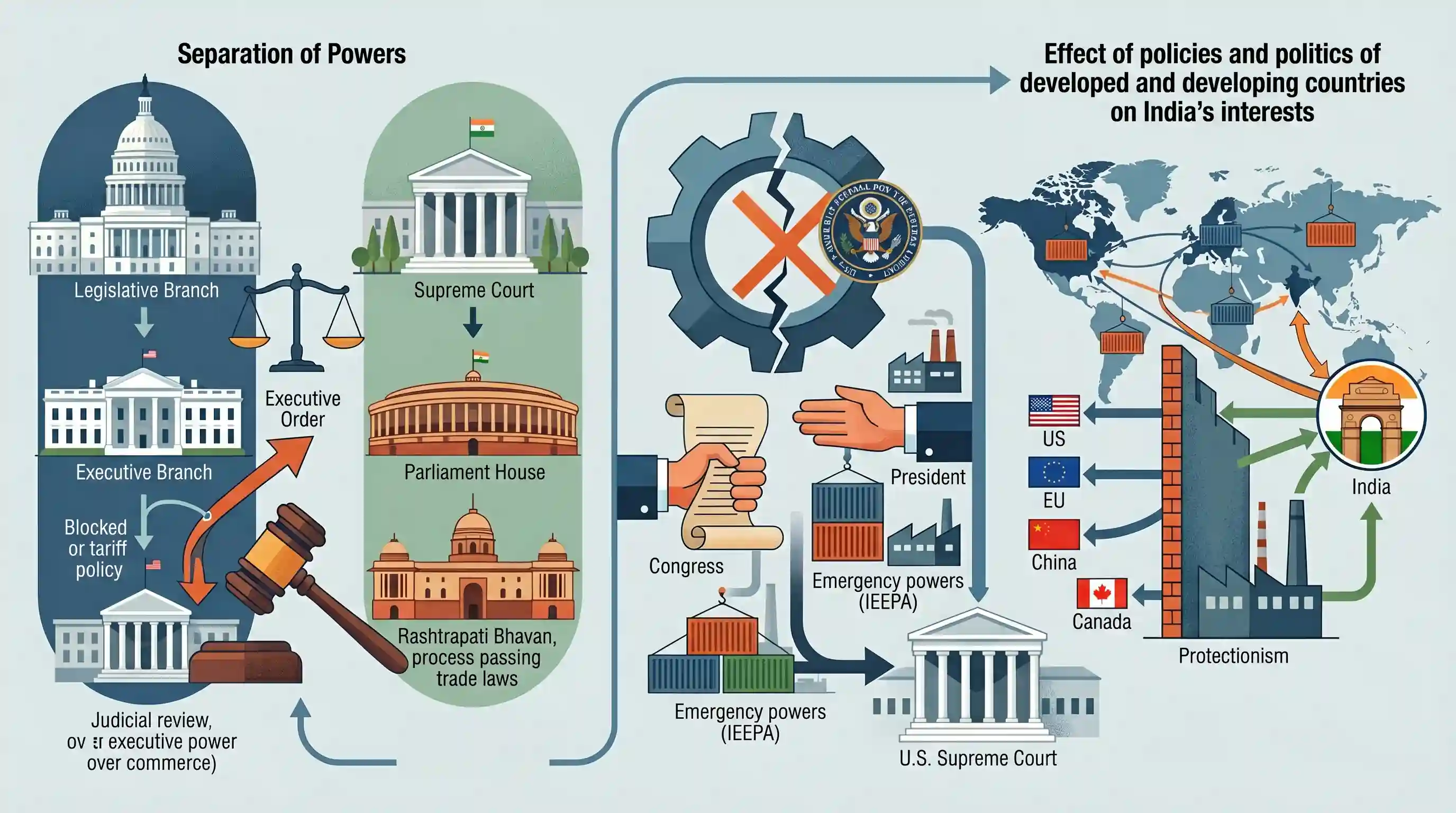
The legal battle provides a real-world case study on the separation of powers and the constitutional limits of executive authority, which is highly relevant for comparative constitution studies in GS2. Additionally, U.S. tariff policies represent a global shift towards protectionism, directly affecting the macroeconomic stability of emerging economies like India and shaping international relations.
Summary
The Trump administration has petitioned the U.S. Supreme Court to quickly review and reverse an appeals court ruling that invalidated sweeping import tariffs imposed by the President. The U.S. Court of Appeals for the Federal Circuit recently struck down the tariffs on the grounds that the President's use of the International Emergency Economic Powers Act (IEEPA) illegally bypassed Congress, which constitutionally holds exclusive authority over taxation and commerce. The Supreme Court's impending decision carries major implications for the separation of powers between the U.S. Executive and Legislative branches. Furthermore, the case impacts international trade dynamics, as the controversial tariffs were aimed at pressuring foreign trading partners like the EU, Canada, and China, sparking debates over global protectionism.
Key Points
- The Trump administration is appealing a U.S. Court of Appeals ruling that declared recent sweeping presidential import tariffs illegal.
- The appeals court ruled that the administration overstepped by invoking the 1977 International Emergency Economic Powers Act (IEEPA) to impose tariffs, effectively usurping congressional authority.
- Under the U.S. Constitution, Congress holds the sole power to levy taxes and tariffs, raising critical questions regarding the separation of powers.
- The tariffs were utilized by the administration to pressure international trading partners—such as the EU, Japan, Canada, and Mexico—into renegotiating trade deals, collecting over $159 billion in levies.
- The ongoing legal ambiguity over trade policy poses significant uncertainty for small businesses and introduces friction into global supply chains.
Important Terms
International Emergency Economic Powers Act (IEEPA)

A 1977 U.S. federal law allowing the President to regulate international commerce and freeze assets during declared national emergencies; often used for economic sanctions and trade-related executive actions.
UPSC context
GS Paper 2/3: Tests understanding of developed countries' policies on India and global trade dynamics.
Separation of Powers
The doctrine dividing government into independent branches—Legislature, Executive, and Judicial—to prevent concentrated power; characterized by a rigid model in the U.S. compared to India's parliamentary overlap.
UPSC context
GS Paper 2: Comparative Constitution; vital for questions on checks and balances.
Protectionism
Economic policies designed to shield domestic industries from foreign competition using trade barriers like tariffs, quotas, or subsidies; often leading to retaliatory trade wars and global market disruptions.
UPSC context
GS Paper 3: International trade; impacts on India’s exports and macroeconomic stability.
U.S. Supreme Court
The highest federal court in the United States, serving as the final interpreter of the Constitution and exercising judicial review within a dual (state/federal) judicial system.
UPSC context
GS Paper 2: Comparison of the Indian constitutional scheme with other countries.
Congress (U.S.)
The bicameral federal legislature of the United States (House and Senate) possessing constitutional authority over federal taxation, international commerce, and the power to declare war.
UPSC context
GS Paper 2: Comparison of legislatures and their authority relative to the executive.
European Union (EU)
A political and economic union of 27 European countries that operates as a single market and a major global trading bloc, frequently involved in trade disputes with the U.S.
UPSC context
GS Paper 2: Regional and global groupings affecting India’s strategic and economic interests.
Prelims Trap
The Indian Executive can unilaterally levy taxes or tariffs without legislative approval during a declared Financial Emergency.
Under Article 265, no tax can be levied except by authority of law. Even during emergencies, an executive order is insufficient; legislative enactment (or a formal Ordinance) is mandatory.
Static Concepts Connected
How does the Indian Constitution regulate the power to levy taxes?
- Article 265: Prohibits the levying or collection of any tax except by authority of law, ensuring strict parliamentary control over state revenue.
- Money Bills: Article 110 mandates that bills exclusively dealing with the imposition, abolition, or alteration of any tax are Money Bills, giving primacy to the Lok Sabha.
- Delegated Legislation: Parliament can delegate power to alter tariff rates (e.g., customs duties) within limits, but the essential legislative function of levying the tax itself cannot be delegated.
How does the Separation of Powers differ between the US and India?
- US Rigid Model: Based on a strict separation where the executive, legislative, and judicial branches are entirely distinct, with Congress holding exclusive constitutional authority over commerce and taxation.
- Indian Flexible Model: Features a functional overlap where the executive is drawn directly from and remains collectively accountable to the legislature, reflecting the Westminster system.
- Checks and Balances: Both democratic systems utilize robust checks and balances—such as judicial review by the Supreme Court—to prevent any single branch from usurping constitutional powers.
Cross-Topic Patterns
US Protectionism & India's CAD
Unilateral US tariffs threaten global value chains, potentially widening India's Current Account Deficit by making exports uncompetitive and inflating intermediate good costs.
Unilateral Tariffs vs WTO
The weaponization of executive trade powers to bypass legislative scrutiny marks a structural shift away from WTO-led multilateralism toward unilateral protectionism.

Comparative US-India constitutional limits on executive taxation powers, paired with WTO protectionism, is a high-probability GS2 Mains theme.
Linked PYQs · 4
Linked PYQs · 4
- 2025MainsGS2
Compare and contrast the President's power to pardon in India and in the USA. Are there any limits to it in both the countries? What are 'preemptive pardons'?
- 2025MainsGS3
What are the challenges before the Indian economy when the world is moving away from free trade and multilateralism to protectionism and bilateralism? How can these challenges be met?
- 2018MainsGS3
How would the recent phenomena of protectionism and currency manipulations in world trade affect macroeconomic stability of India?
- 2020MainsGS2
Judicial Legislation is antithetical to the doctrine of separation of powers as envisaged in the Indian Constitution. In this context justify the filing of large number of public interest petitions praying for issuing guidelines to executive authorities.
