US administration reinstates travel ban on multiple foreign countries
Source:The Hindu ↗
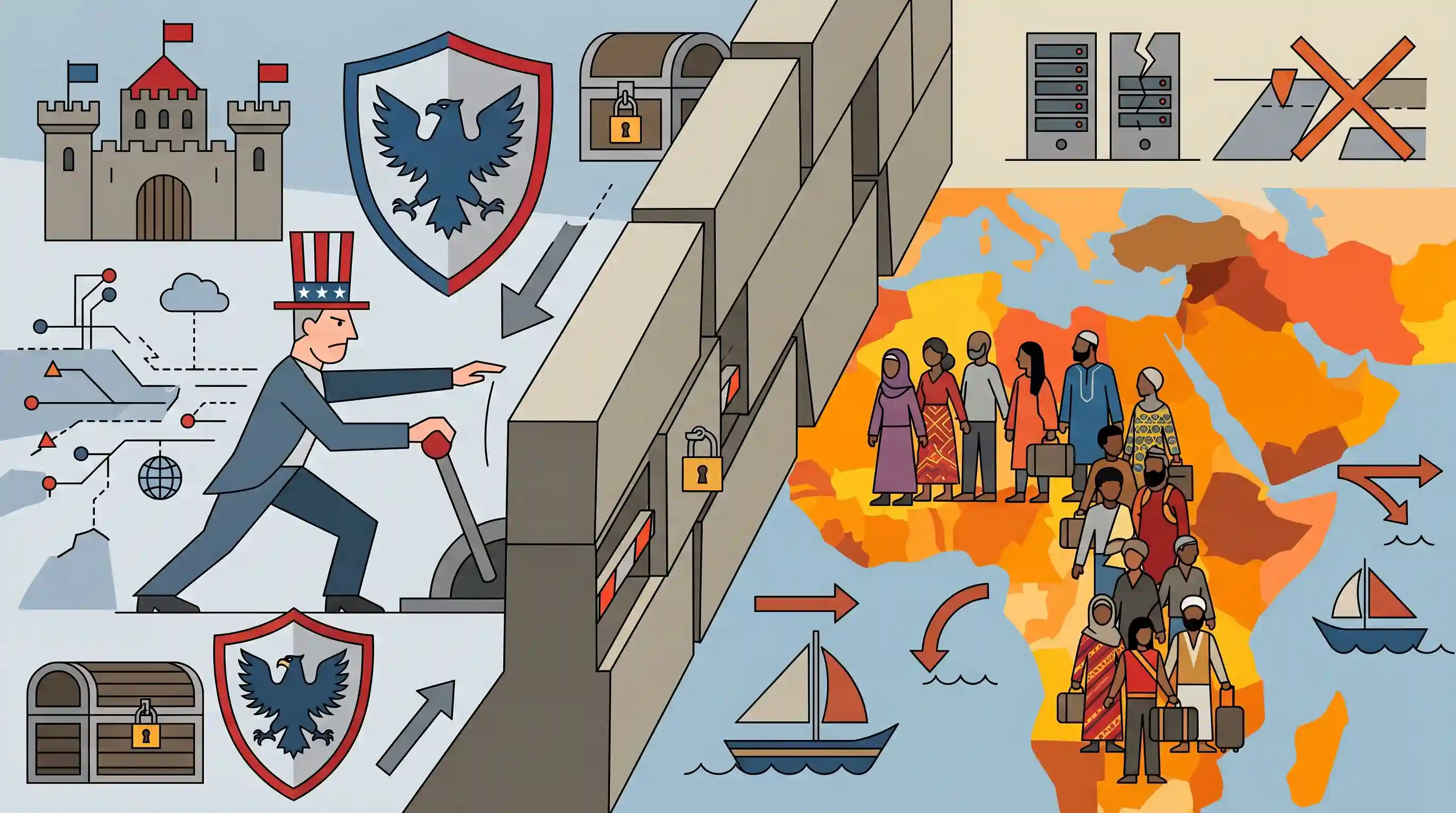
Why It Matters
The U.S. travel ban is a key example of the shift towards sovereign nationalism and restrictive immigration policies. For UPSC aspirants, understanding these protectionist measures is crucial for analyzing evolving global geopolitics, the waning of globalization, and their potential indirect impacts on global mobility, international relations, and diasporas.
Summary
U.S. President Donald Trump has reinstated and expanded a controversial travel ban, prohibiting entry from a dozen countries across the Middle East, Africa, and other regions. The ban, which mirrors a similar first-term policy, completely suspends immigration from nations including Afghanistan, Iran, Yemen, and Sudan, while imposing heightened restrictions on seven others. The U.S. administration cited national security, hostile attitudes toward the U.S., and systemic information-sharing failures by these governments as the primary drivers of the policy. The move highlights a renewed push toward restrictive immigration policies and sovereign nationalism in U.S. foreign policy.
Key Points
- U.S. President Donald Trump announced the reinstatement of a travel ban affecting a dozen countries, effectively suspending entry from these nations into the United States.
- The 12 banned nations include Afghanistan, Burma, Chad, Republic of Congo, Equatorial Guinea, Eritrea, Haiti, Iran, Libya, Somalia, Sudan, and Yemen.
- An additional seven countries (Burundi, Cuba, Laos, Sierra Leone, Togo, Turkmenistan, and Venezuela) face heightened visa and travel restrictions.
- The action mirrors Trump's first-term 2017 policy, widely termed the "Muslim ban", which initially targeted seven predominantly Muslim countries and was upheld by the U.S. Supreme Court in 2018.
- The administration cited national security concerns and "hostile attitudes" toward the United States as the primary reasons for enforcing these restrictive immigration measures.
Important Terms
Travel Ban

A U.S. federal policy restricting or prohibiting entry for nationals of specific countries, often citing national security or insufficient vetting. It involves suspending various visa categories to control immigration.
UPSC context
Relevant for GS Paper II: International Relations, specifically regarding global migration patterns and U.S. foreign policy impacts on the Global South.
Executive Order
A unilateral directive issued by the U.S. President that manages operations of the federal government and has the force of law, bypasssing the typical legislative process in Congress.
UPSC context
Tests GS Paper II topics on the Comparison of Constitutions, specifically executive powers and the checks-and-balances system.
Department of Homeland_Security (DHS)
The U.S. cabinet-level department responsible for public security, border control, and the enforcement of immigration laws. It is the primary agency executing domestic security and vetting policies.
UPSC context
Significant for GS Paper II (Institutional comparisons) and GS Paper III (Internal Security and Border Management).
Department of State (DoS)
The U.S. federal executive department responsible for international relations and diplomacy. It manages visa issuance and coordinates with the DHS on immigration and national security vetting.
UPSC context
Relevant for GS Paper II: International Relations and the role of diplomatic institutions in foreign policy execution.
Sovereign Nationalism
A political ideology where states prioritize national interests, strict border controls, and domestic autonomy over global cooperation, multilateralism, and the liberal international order.
UPSC context
Critical for GS Paper II: International Relations, examining the shift from globalization toward protectionism and nation-state primacy.
U.S. Supreme Court
The highest federal court in the United States, which holds the power of judicial review to determine the constitutionality of executive actions, such as immigration bans.
UPSC context
Important for GS Paper II: Comparison of Indian and U.S. judicial systems and the doctrine of separation of powers.
Prelims Trap
The US travel ban exclusively targets Islamic nations in the Middle East and Africa.
Aspirants may wrongly assume this is purely a "Muslim ban," but the expanded list includes nations from Latin America and Asia (Haiti, Cuba, Venezuela, Myanmar).
Static Concepts Connected
Which key geographical features surround Yemen, Sudan, Eritrea, and Somalia?
- Bab el-Mandeb: A critical maritime chokepoint connecting the Red Sea to the Gulf of Aden, bordered by Yemen on the Asian side, and Djibouti and Eritrea on the African side.
- Red Sea Littorals: The sea is bordered by Egypt, Sudan, Eritrea, and Djibouti on the west, and Saudi Arabia and Yemen on the east.
- Horn of Africa: The geopolitical peninsula comprising Somalia, Ethiopia, Eritrea, and Djibouti, strategically dominating the Gulf of Aden.
What is the principle of Non-Refoulement in international refugee law?
- Core Prohibition: Forbids a host country from returning asylum seekers to territories where they face a threat to their life, freedom, or human rights.
- Legal Framework: Enshrined in the 1951 Refugee Convention. Though India is not a signatory, it largely respects the principle under customary international law and Article 21.
Cross-Topic Patterns
Maritime Chokepoints + Regional Mapping
The heavy concentration of banned nations (Yemen, Sudan, Eritrea, Somalia) around the Bab el-Mandeb elevates the probability of Red Sea and Horn of Africa mapping questions in Prelims.
Sovereign Nationalism + Deglobalization
This immigration suspension acts as the demographic wing of the 'America First' doctrine, complementing trade tariffs and signaling a structural retreat from liberal globalization.

Expect a 2026 Prelims mapping question on the Red Sea/Horn of Africa nations, or a GS2 Mains question on Western sovereign nationalism.
Linked PYQs · 3
Linked PYQs · 3
- 2025MainsGS2
"With the waning of globalization, post-Cold War world is becoming a site of sovereign nationalism.” Elucidate.
- 2012MainsGS2
Discuss the likely negative impact of the protectionist measures proposed by the US on India's software industry.
- 2020MainsGS2
Indian diaspora has a decisive role to play in the politics and economy of America and European Countries'. Comment with examples.
