US Board of Peace Launched for Gaza Reconstruction and Relief
Source:The Hindu ↗
Why It Matters
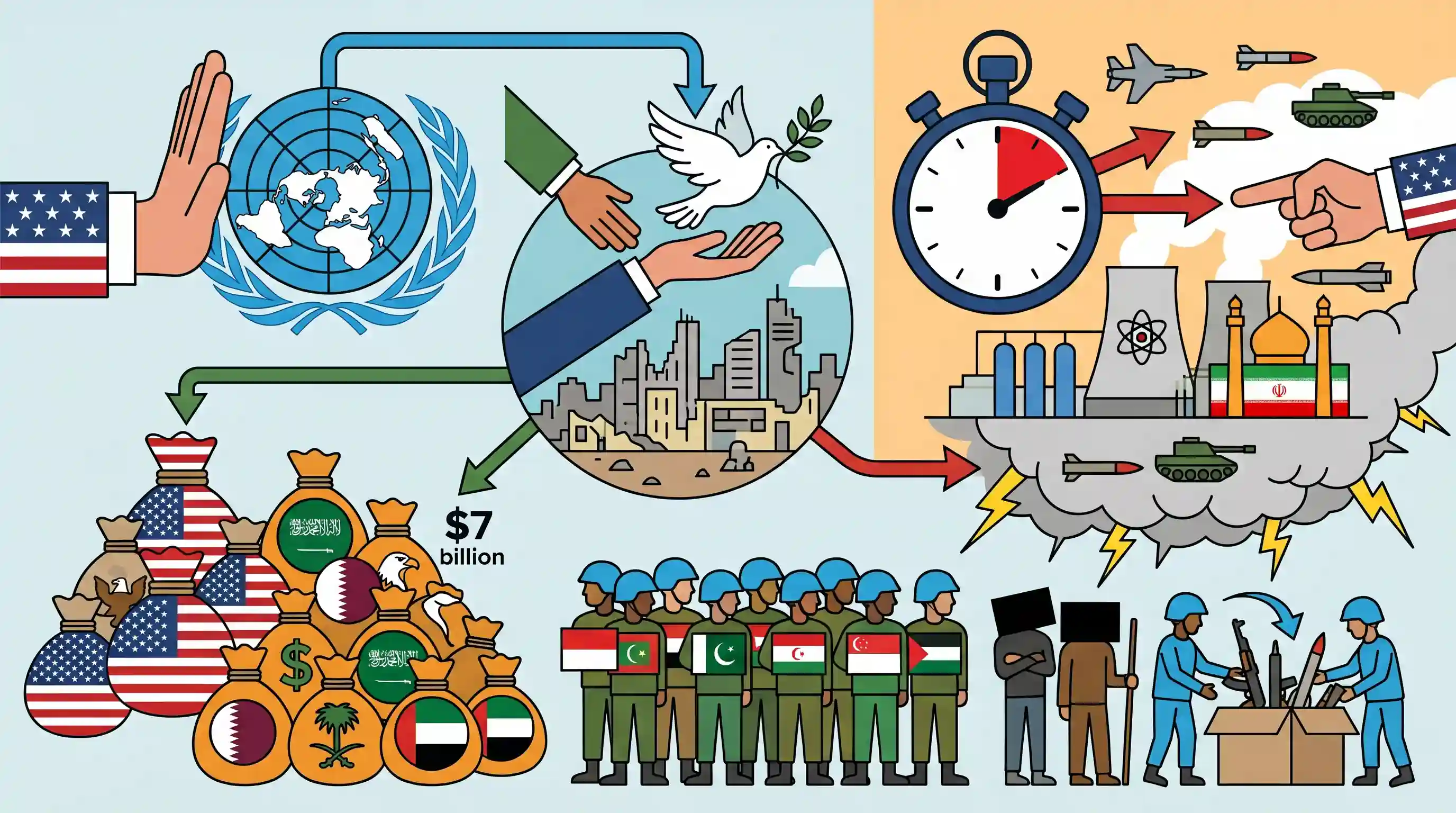
The creation of the 'Board of Peace' highlights an evolving trend in global governance where major powers bypass established multilateral institutions like the UN to form ad-hoc coalitions. For India, the unfolding dynamics in the Middle East—specifically the Israel-Palestine resolution efforts and the heightened US-Iran nuclear tensions—are critical as they directly impact regional stability, India's diaspora in the Gulf, and its vital energy security interests.
Summary
The United States has launched the "Board of Peace" to manage the ongoing crisis and reconstruction in Gaza, effectively bypassing traditional United Nations mechanisms. The initiative involves substantial financial pledges, including $10 billion from the US and $7 billion from nations like Qatar, Saudi Arabia, and the UAE, alongside military troop contributions from Muslim-majority countries such as Indonesia. The stabilization plan necessitates the disarmament of Hamas and deploys an international peacekeeping force. Concurrently, the US administration has escalated broader Middle Eastern tensions by issuing a strict 10-day ultimatum to Iran concerning its nuclear program, threatening military action if demands are not met.
Key Points
- US President Donald Trump inaugurated the 'Board of Peace', an ad-hoc grouping aimed at addressing the Gaza crisis, signalling a shift away from the United Nations.
- The initiative secured over $16.5 billion in total pledges, including $10 billion from the US and nearly $7 billion from Muslim-majority and Arab nations (Qatar, Saudi Arabia, UAE).
- The comprehensive plan demands the disarmament of Hamas and involves deploying international troops from nations like Indonesia, Albania, Kazakhstan, and Kosovo for Gaza's security.
- Simultaneously, the US issued a 10-day ultimatum to Iran regarding its nuclear program, warning of potential military strikes if major concessions are not made.
Important Terms
Board of Peace (BoP)

An international organization chaired by the U.S. to oversee Gaza's post-conflict reconstruction and security, functioning as an alternative to traditional United Nations-led humanitarian and administrative frameworks.
UPSC context
GS-II: Global Groupings; tests impact of alternative multilateral architectures on West Asian stability and India’s regional diplomatic interests.
International Stabilization Force (ISF)
A multinational peacekeeping contingent authorized by the Board of Peace to secure Gaza, oversee militant disarmament, and protect humanitarian efforts, with major troop contributions from countries like Indonesia.
UPSC context
GS-II: International Relations; tests knowledge of peacekeeping models and the role of regional powers in maintaining global security.
Hamas
A Palestinian militant and political organization; its total disarmament is a central requirement of the U.S.-led reconstruction plan to ensure long-term stability in the Gaza Strip.
UPSC context
GS-II: West Asia Geopolitics; tests understanding of non-state actors and their role in regional conflicts affecting India’s maritime security.
JCPOA (Joint Comprehensive Plan of Action)
The 2015 diplomatic agreement to limit Iran's nuclear program in exchange for sanctions relief; it is the primary focus of U.S. ultimatums regarding uranium enrichment and regional security.
UPSC context
GS-II: Global Agreements; tests impact of U.S.-Iran tensions on India’s strategic autonomy and West Asian energy security.
UNSC Resolution 2803
A 2025 United Nations measure that formally authorized the Board of Peace's mandate, empowering a U.S.-led body to manage Gaza's stabilization and redevelopment outside standard UN agencies.
UPSC context
GS-II: Important International Institutions; tests understanding of Security Council powers to delegate peacekeeping and administrative mandates to external coalitions.
Prelims Trap
"The 'Board of Peace' is a UN-mandated peacekeeping mission for Gaza."
The Board of Peace is explicitly a US-led, ad-hoc coalition designed to bypass the paralyzed United Nations Security Council mechanisms.
Static Concepts Connected
How do UN Peacekeeping operations differ from ad-hoc coalitions?
- UN Mandate: Traditional 'Blue Helmet' missions require a UN Security Council resolution and operate strictly under UN command structures.
- Ad-hoc Structure: Coalitions like the Board of Peace bypass the UN, relying on lead-nation (US) command, multilateral treaties, and voluntary sovereign pledges rather than assessed UN contributions.
What is the historical context of the US-Iran nuclear crisis?
- JCPOA (2015): The Joint Comprehensive Plan of Action (JCPOA) was a 2015 pact where Iran curbed nuclear enrichment in exchange for sanctions relief from the P5+1.
- Unilateral Exit: The US unilaterally withdrew in 2018 under the Trump administration, collapsing the deal, prompting unmonitored Iranian enrichment, and leading to today's military ultimatums.
Cross-Topic Patterns
Rise of West Asian Minilateralism
The 'Board of Peace' mirrors I2U2 and IMEEC—highlighting a structural shift in West Asia away from paralyzed universal UN bodies toward agile, interest-based coalitions.
Iran Ultimatum + Chabahar Port
The threat of US military strikes on Iran severely jeopardizes India's regional energy security and its strategic INSTC connectivity investments via the Chabahar Port.
Central Asian Republics expanding footprints
Kazakhstan's troop contribution marks a rare instance of Central Asian Republics (CARs) stepping beyond traditional Eurasian/Russian security umbrellas into broader Middle Eastern stabilization roles.

Expect a 2026 Prelims question contrasting traditional UN Peacekeeping mandates with ad-hoc minilateral coalitions like the Board of Peace.
Linked PYQs · 3
Linked PYQs · 3
- 2025MainsGS2
"The reform process in the United Nations remains unresolved, because of the delicate imbalance of East and West and entanglement of the USA vs. Russo-Chinese alliance.” Examine and critically evaluate the East-West policy confrontations in this regard.
- 2018MainsGS2
In what ways would the ongoing US-Iran Nuclear Pact Controversy affect the national interest of India? How should India respond to this situation?
- 2018MainsGS2
“India’s relations with Israel have, of late, acquired a depth and diversity, which cannot be rolled back.” Discuss.
