Bilateralism Reasserts Itself Against Third Party Mediation Claims
Source:The Hindu ↗
Why It Matters
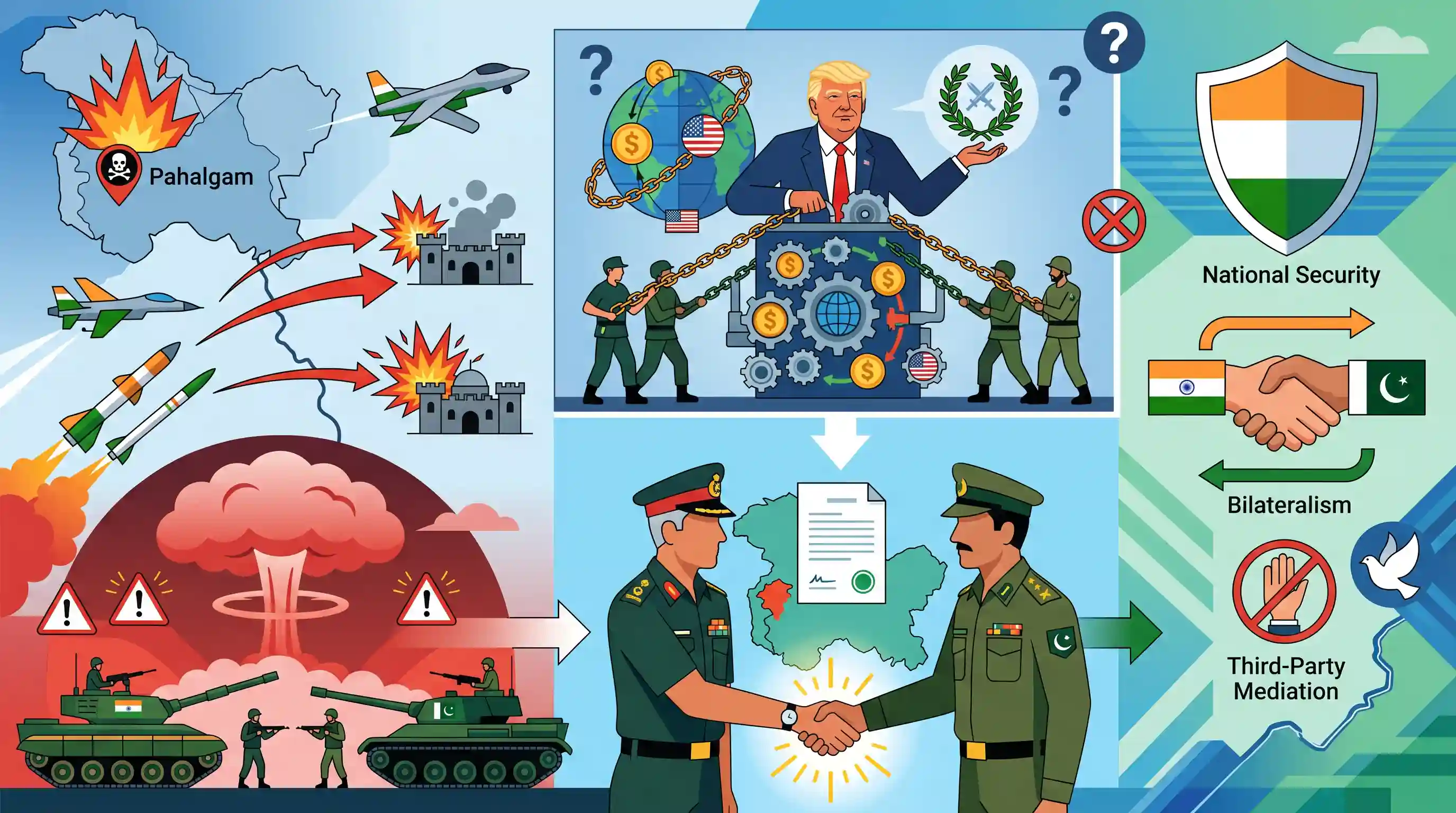
This highlights India's strict adherence to bilateralism in resolving disputes with Pakistan, rejecting third-party mediation. It also underscores India's active defense posture regarding cross-border terrorism, as seen in Operation Sindoor.
Summary
U.S. President Donald Trump claimed credit for averting a "potential nuclear war" between India and Pakistan by allegedly using trade leverage to enforce a ceasefire following military clashes. India rejected these claims of third-party mediation, maintaining that the May 10 ceasefire understanding was reached purely through bilateral dialogue between the Directors-General of Military Operations (DGMOs). The conflict originated from the April 22 Pahalgam terror attack, which prompted India to launch 'Operation Sindoor', conducting retaliatory drone and missile strikes against terror infrastructure in Pakistan and Pakistan-occupied Kashmir (PoK).
Key Points
- U.S. President Donald Trump claimed that threatening to cut off trade averted a potential nuclear conflict between India and Pakistan.
- India dismissed claims of third-party mediation, reiterating that the ceasefire was reached bilaterally through direct talks between the Directors-General of Military Operations (DGMOs).
- The recent conflict was triggered by the April 22 Pahalgam terror attack, which killed 26 civilians and led to India launching retaliatory strikes under Operation Sindoor.
- Operation Sindoor targeted terror infrastructure in Pakistan and Pakistan-occupied Kashmir (PoK) using drone and missile strikes.
Important Terms
Operation Sindoor

The 2025 Indian military response to the Pahalgam terror attack, involving precision strikes against terror infrastructure in Pakistan and Pakistan-occupied Kashmir (PoK).
UPSC context
GS Paper III: Security challenges and their management in border areas; tests understanding of India's retaliatory doctrine and counter-terrorism operations.
DGMO (Director General of Military Operations)
High-ranking military officers responsible for directing operations; the primary hotline for India and Pakistan to de-escalate border tensions and maintain ceasefire understandings.
UPSC context
GS Paper II/III: Internal Security and International Relations; tests knowledge of institutional mechanisms for conflict resolution and border management.
Bilateralism
India's foreign policy doctrine insisting that issues with Pakistan be resolved through direct mutual dialogue without third-party interference, rooted in the 1972 Simla Agreement.
UPSC context
GS Paper II: International Relations; tests understanding of India’s stance on foreign mediation and sovereignty in regional conflicts.
Pahalgam Terror Attack
A 2025 attack in Jammu & Kashmir that killed 26 people, primarily tourists, triggering a major military escalation between India and Pakistan.
UPSC context
GS Paper III: Role of external state and non-state actors in creating challenges to internal security.
Cross-border Terrorism
State-sponsored or supported terrorist activities originating across national borders; a central pillar of India's security challenges and diplomatic messaging against Pakistan.
UPSC context
GS Paper III: Linkages between developmental issues and spread of extremism; tests ability to analyze the impact of regional proxy wars.
Prelims Trap
India permits third-party mediation under UN auspices if a conflict breaches the nuclear threshold.
India strictly adheres to the 1972 Simla Agreement, categorically rejecting any third-party mediation—including by the UN or US—regardless of the threat level.
Static Concepts Connected
What legal framework governs India-Pakistan bilateral dispute resolution?
- Simla Agreement (1972): Established that all bilateral differences must be settled through peaceful bilateral negotiations, legally nullifying any scope for third-party mediation.
- Lahore Declaration (1999): Reaffirmed the strict bilateral framework, specifically emphasizing institutional Confidence Building Measures (CBMs) to avoid conflict post-nuclearization of the subcontinent.
What role does the DGMO hotline play in border management?
- Institutional CBM: Serves as a direct military-to-military communication channel to clarify troop movements, resolve localized disputes, and prevent tactical miscalculations along the LoC.
- Crisis De-escalation: Functions as the primary operational mechanism to independently negotiate local ceasefires, shielding tactical de-escalation from immediate political or diplomatic pressures.
Cross-Topic Patterns
Trade coercion vs Strategic Autonomy
The US linking trade penalties to military ceasefires highlights the growing weaponization of global trade. This tests India’s multi-alignment strategy and sovereign decision-making under its 'Strategic Autonomy' doctrine.
Evolution of Active Deterrence doctrine
'Operation Sindoor' continues the post-Uri/Balakot doctrine. India no longer absorbs sub-conventional terror attacks via 'strategic restraint', instead opting for retaliatory precision strikes against PoK terror infrastructure.

Expect a 2026 Mains question on India's shift to 'active deterrence' via precision strikes and its impact on the nuclear overhang.
Linked PYQs · 2
Linked PYQs · 2
- 2015MainsGS2
Terrorist activities and mutual distrust have clouded India-Pakistan relations. To what extent the use of soft power like sports and cultural exchanges could help generate goodwill between the two countries? Discuss with suitable examples.
- 2016MainsGS3
The terms 'Hot Pursuit' and 'Surgical Strikes' are often used in connection with armed action against terrorist attacks. Discuss the strategic impact of such actions.
