US Court Strikes Down Third Country Deportation Policy for Due Process
Source:The Hindu ↗
Why It Matters
This article serves as a practical, contemporary example of the 'Due Process of Law' (a recurring constitutional concept in UPSC) and its application in protecting human rights against arbitrary executive actions. It also touches upon the international principle of non-refoulement and the rights of asylum seekers.
Summary
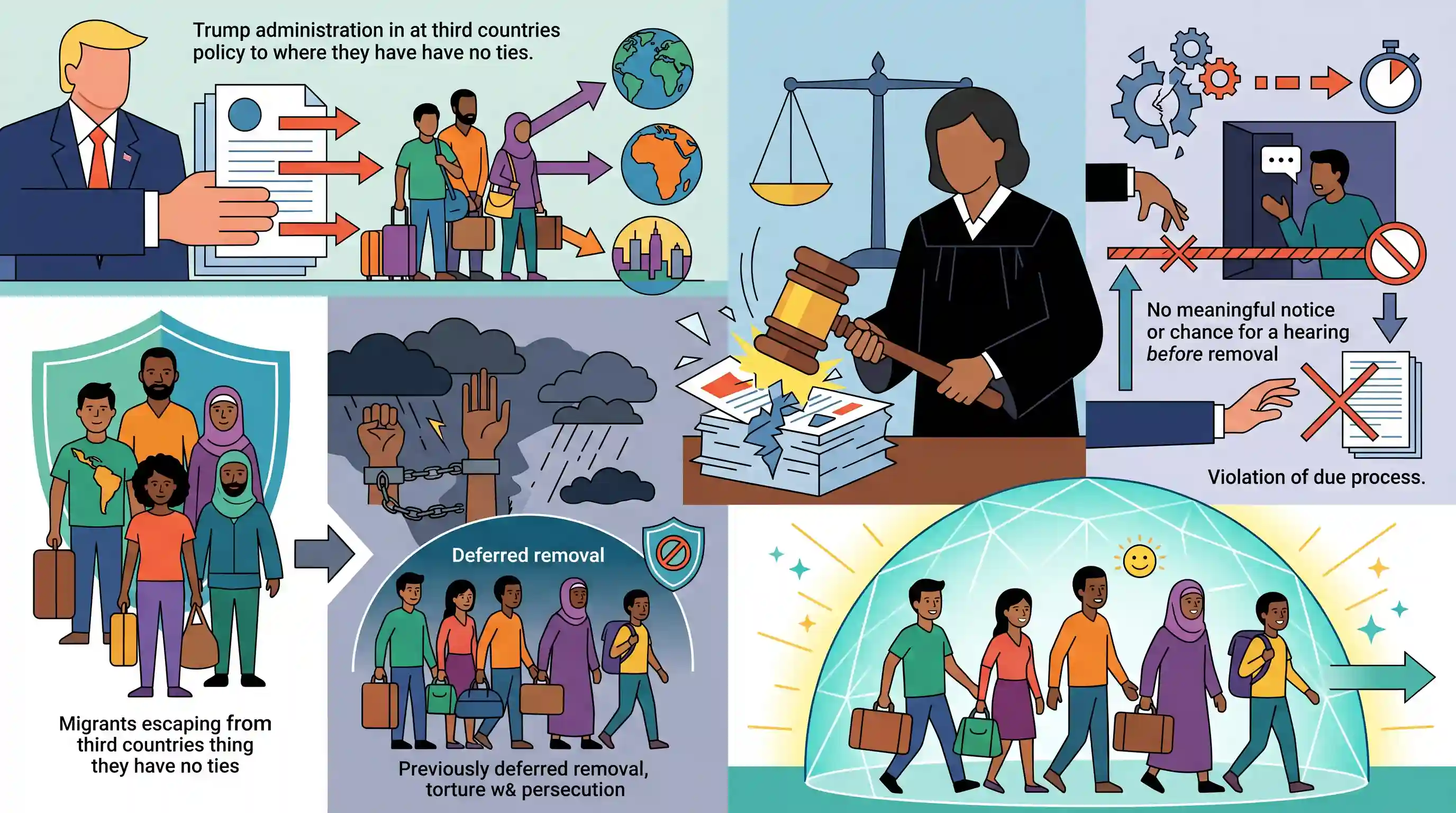
A U.S. federal judge has struck down a Trump administration policy that permitted the deportation of immigrants to "third countries" where they have no personal ties. The policy was specifically aimed at individuals whose removals to their home countries had been deferred because they faced a credible risk of torture or persecution. The judge ruled that the policy violated the constitutional guarantee of 'due process' by failing to provide these individuals with meaningful notice and an opportunity to contest their removal before it occurred, reinforcing legal protections for vulnerable migrant populations.
Key Points
- A U.S. federal judge ruled the Trump administration's policy of deporting immigrants to unrelated third countries is unlawful.
- The policy targeted individuals who had received protection from being sent to their native countries due to fears of torture or persecution.
- The ruling emphasized that the policy violated the fundamental principle of 'due process' by denying immigrants meaningful notice and an opportunity to object before removal.
- The case highlights the judicial checks on executive immigration policies and the application of due process rights to asylum seekers and migrants.
Important Terms
Convention Against Torture (CAT)

A 1984 UN treaty prohibiting torture and 'non-refoulement' (sending people back to places where they risk torture). It mandates that states take effective measures to prevent torture within their jurisdiction.
UPSC context
GS II (International Relations/Human Rights). Tests knowledge of global treaties and India's status (signed 1997, yet to ratify).
Due Process of Law
An American constitutional doctrine requiring that laws and legal procedures be fair, just, and reasonable, rather than merely following established technical rules.
UPSC context
GS II (Polity). Essential for comparing Article 21's 'Procedure Established by Law' with global standards after the Maneka Gandhi case.
Non-Refoulement
A fundamental principle of international law that forbids a country from returning asylum seekers to a country where they would face persecution, torture, or other serious harm.
UPSC context
GS II (International Relations). Core concept in migration and refugee studies; relevant to India's ad hoc refugee policies.
Third-Country Deportation Policy
A policy permitting the removal of migrants to nations other than their home country, often without personal ties, if the third country agrees to accept them.
UPSC context
GS II (International Relations). Relates to global migration management and executive authority over border control.
Department of Homeland Security (DHS)
The U.S. federal executive department responsible for public security, immigration, and border control; it oversees agencies like ICE (Immigration and Customs Enforcement).
UPSC context
GS II (Comparative Governance). Context for studying how different democracies structure internal security and immigration agencies.
Prelims Trap
The principle of non-refoulement does not apply in India because it is not a signatory to the 1951 Refugee Convention.
Though India hasn't signed the 1951 Convention, the Supreme Court ruled that non-refoulement is implicitly protected under Article 21, applying to all non-citizens.
Static Concepts Connected
How does 'Due Process' differ from 'Procedure Established by Law'?
- Procedure Established: Strictly checks if a law exists and was passed correctly by the legislature, without judging the law's inherent fairness (historically applied in India pre-1978).
- Due Process: Ensures the law itself is fair, just, and not arbitrary, protecting individuals against both executive and legislative overreach.
- Indian Evolution: In the Maneka Gandhi case (1978), the Supreme Court ruled that Article 21 implicitly encompasses the broader 'due process' principle.
Which Fundamental Rights apply to foreigners and asylum seekers in India?
- Applicable Rights: Article 14 (Equality before law) and Article 21 (Protection of life and personal liberty) apply to all persons, citizens or not.
- Exclusive to Citizens: Articles 15, 16, 19, 29, and 30 are strictly reserved for Indian citizens and do not apply to refugees or migrants.
Cross-Topic Patterns
Domestic deportation vs. non-refoulement
India lacks a formal refugee law and relies on the Foreigners Act, 1946, creating tension between domestic deportation drives (like those involving Rohingyas) and the international norm of non-refoulement.
Deportation vs. Extradition frameworks
Deportation (executive expulsion of an alien) often gets confused with Extradition (surrender of a fugitive based on bilateral treaties and dual criminality). Both touch upon Article 21 rights.

Expect a Prelims statement linking Article 21's implicit 'due process' to the rights of non-citizens and the principle of non-refoulement.
Linked PYQs · 1
Linked PYQs · 1
- 2023PrelimsGS1
In essence, what does 'Due Process of Law' mean?
