US Launches Strategic Reserve for Rare Earth Elements
Source:The Hindu ↗
Why It Matters
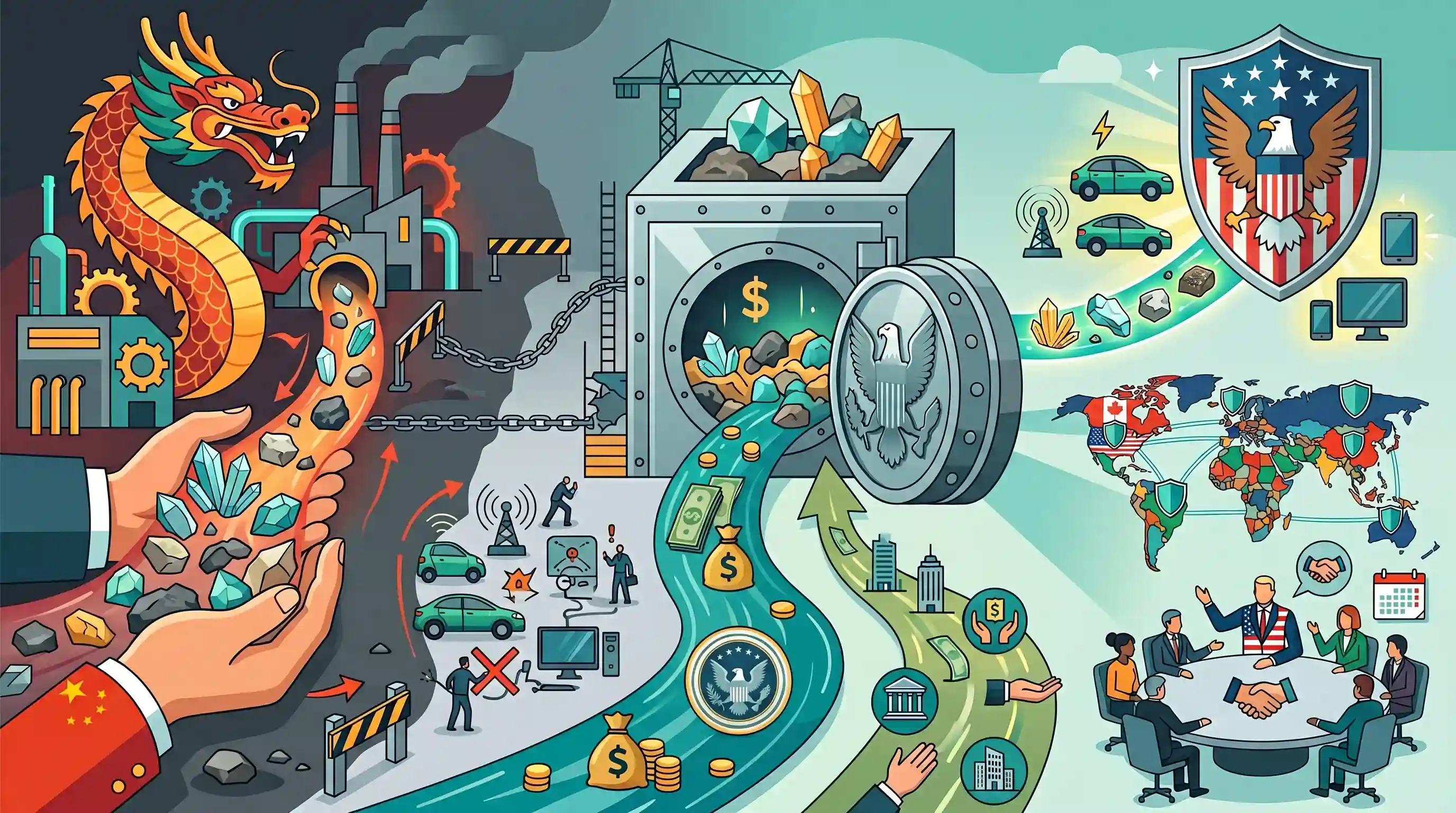
Rare earth elements are indispensable for modern technology, green energy, and defense systems. China's near-monopoly on processing gives it immense geopolitical leverage. The U.S. move to create a strategic reserve and coordinate with global partners reflects the broader 'China-plus-one' and de-risking strategies. For India, which is also seeking to secure critical minerals through frameworks like the Minerals Security Partnership (MSP), this global realignment offers opportunities for strategic cooperation, technology transfer, and supply-chain integration independent of China.
Summary
The Trump administration is launching "Project Vault," a nearly $12 billion initiative to create a strategic reserve of rare earth elements, aiming to drastically reduce the U.S.'s supply-chain reliance on China. Seeded by a $10 billion loan from the U.S. Export-Import Bank and $1.67 billion in private capital, the reserve is designed to protect American manufacturers in critical industries—such as electric vehicles, radar systems, and consumer electronics—from sudden supply disruptions. With China currently controlling 70% of global rare earth mining and 90% of processing, Beijing has previously leveraged this dominance by restricting exports during trade disputes. The strategic reserve aligns with a broader push for global supply chain resilience, highlighted by an upcoming U.S.-led ministerial meeting to coordinate critical mineral logistics among allied nations.
Key Points
- The U.S. has announced "Project Vault," a nearly $12 billion strategic reserve for rare earth elements designed to break China's monopoly.
- China currently controls approximately 70% of global rare earth mining and 90% of processing.
- The reserve aims to shield U.S. manufacturers in critical sectors (autos, electronics, defense) from supply chain shocks and export curbs.
- The project is primarily funded by a 15-year, $10 billion loan from the U.S. Export-Import Bank, supplemented by $1.67 billion in private capital.
- The initiative will anchor an upcoming State Department ministerial meeting involving European, African, and Asian nations to coordinate global supply chain logistics and reduce dependence on Beijing.
Important Terms
Project Vault

A $12 billion U.S. initiative to establish a Strategic Critical Minerals Reserve, aimed at reducing supply-chain reliance on China for refined materials essential to defense and high-tech industries.
UPSC context
GS Paper II & III: Geopolitical competition over resources, strategic autonomy, and shielding domestic industry from foreign supply shocks.
U.S. Export-Import Bank (EXIM)
The official export credit agency of the U.S. federal government, providing $10 billion in loans to seed the strategic rare earth reserve under Project Vault.
UPSC context
GS Paper III: Role of specialized financial institutions in infrastructure, strategic manufacturing, and counter-cyclical economic policy.
Rare Earth Elements (REEs)
A group of 17 chemically similar metallic elements (e.g., neodymium, dysprosium) vital for manufacturing permanent magnets, electronics, and advanced defense systems.
UPSC context
GS Paper I & III: Distribution of key natural resources; technology-led industrial growth and environmental impacts of processing.
MP Materials
Operator of the Mountain Pass mine, the only scaled U.S. rare earth facility; it serves as a 'national champion' for domestic mineral security.
UPSC context
GS Paper III: Public-private partnerships and domestic industrial capacity in strategic sectors like electronics and defense.
USA Rare Earth
A U.S. company developing heavy rare earth projects (Round Top Mountain) and magnet manufacturing, receiving significant federal equity investment to de-risk heavy REE supply.
UPSC context
GS Paper III: Diversification of mineral supply chains and government intervention in high-entry-barrier strategic markets.
Supply Chain Resilience
The ability of a supply chain to anticipate, resist, and recover from disruptions; here, achieved through stockpiling and diversifying sourcing away from concentrated suppliers.
UPSC context
GS Paper II: International trade relations and the 'China Plus One' strategy for global manufacturing stability.
Critical Minerals
Minerals essential for economic/national security with high supply-disruption risk; includes lithium, cobalt, and rare earths needed for the green energy transition.
UPSC context
GS Paper III: Energy security, net-zero commitments, and the National Critical Mineral Mission (India context).
Prelims Trap
India completely lacks natural reserves of Rare Earth Elements and relies entirely on imports.
India actually possesses the world's 5th largest REE reserves (coastal monazite sands). The dependency on China is for processing and finished compounds, not raw reserves.
Static Concepts Connected
What constitute Rare Earth Elements (REEs) and where are they found in India?
- Chemical composition: A group of 17 metals encompassing 15 lanthanides on the periodic table, plus Scandium and Yttrium.
- Indian reserves: India holds the 5th largest reserves globally, primarily occurring as light REEs in coastal placer sands containing monazite and ilmenite.
- Industrial applications: Crucial for permanent magnets, EV motors, wind turbines, radar systems, and consumer electronics due to unique magnetic and luminescent properties.
What is the Minerals Security Partnership (MSP)?
- US-led framework: A US-led multilateral initiative comprising 14 countries and the EU, designed to build resilient, non-Chinese supply chains for critical minerals.
- India's membership: India joined the grouping in 2023 to secure strategic minerals (Lithium, Cobalt, REEs) essential for its clean energy transition.
- Investment focus: It focuses on catalyzing public and private investment across the entire value chain—from mining to processing and recycling.
Cross-Topic Patterns
Critical Minerals + India's Green Energy targets
Global initiatives like Project Vault and the Minerals Security Partnership directly underwrite India's National Green Hydrogen Mission and EV targets by de-risking supply chains from Chinese control.
Rare Earths + Atomic Minerals mining laws
India's REEs are largely found in monazite sands, which also contain Thorium. Consequently, they are classified as atomic minerals, strictly regulating private sector mining and stifling domestic processing capacity.

Expect a 2026 prelims multi-statement question linking global critical mineral groupings (MSP) with India's monazite sand regulations.
Linked PYQs · 3
Linked PYQs · 3
- 2025PrelimsGS1
Consider the following statements : Statement I: Some rare earth elements are used in the manufacture of flat television screens and computer monitors. Statement II : Some rare earth elements have phosphorescent properties. Which one of the following is correct in respect of the above statements?
- 2025PrelimsGS1
Consider the following statements : I. India has joined the Minerals Security Partnership as a member. II. India is a resource-rich country in all the 30 critical minerals that it has identified. III. The Parliament in 2023 has amended the Mines and Minerals (Development and Regulation) Act, 1957 empowering the Central Government to exclusively auction mining lease and composite license for certain critical minerals. Which of the statements given above are correct?
- 2024MainsGS2
‘The West is fostering India as an alternative to reduce dependence on China's supply chain and as a strategic ally to counter China's political and economic dominance.’ Explain this statement with examples.
