US Strategic Reserve for Rare Earth Elements and Supply Security
Source:The Hindu ↗
Why It Matters
The global scramble for critical minerals directly impacts India's own strategic interests in securing resources for its energy transition and high-tech manufacturing. The US's attempt to decouple from China's supply chains presents geopolitical opportunities for India to position itself as a reliable partner in alternative global supply networks.
Summary
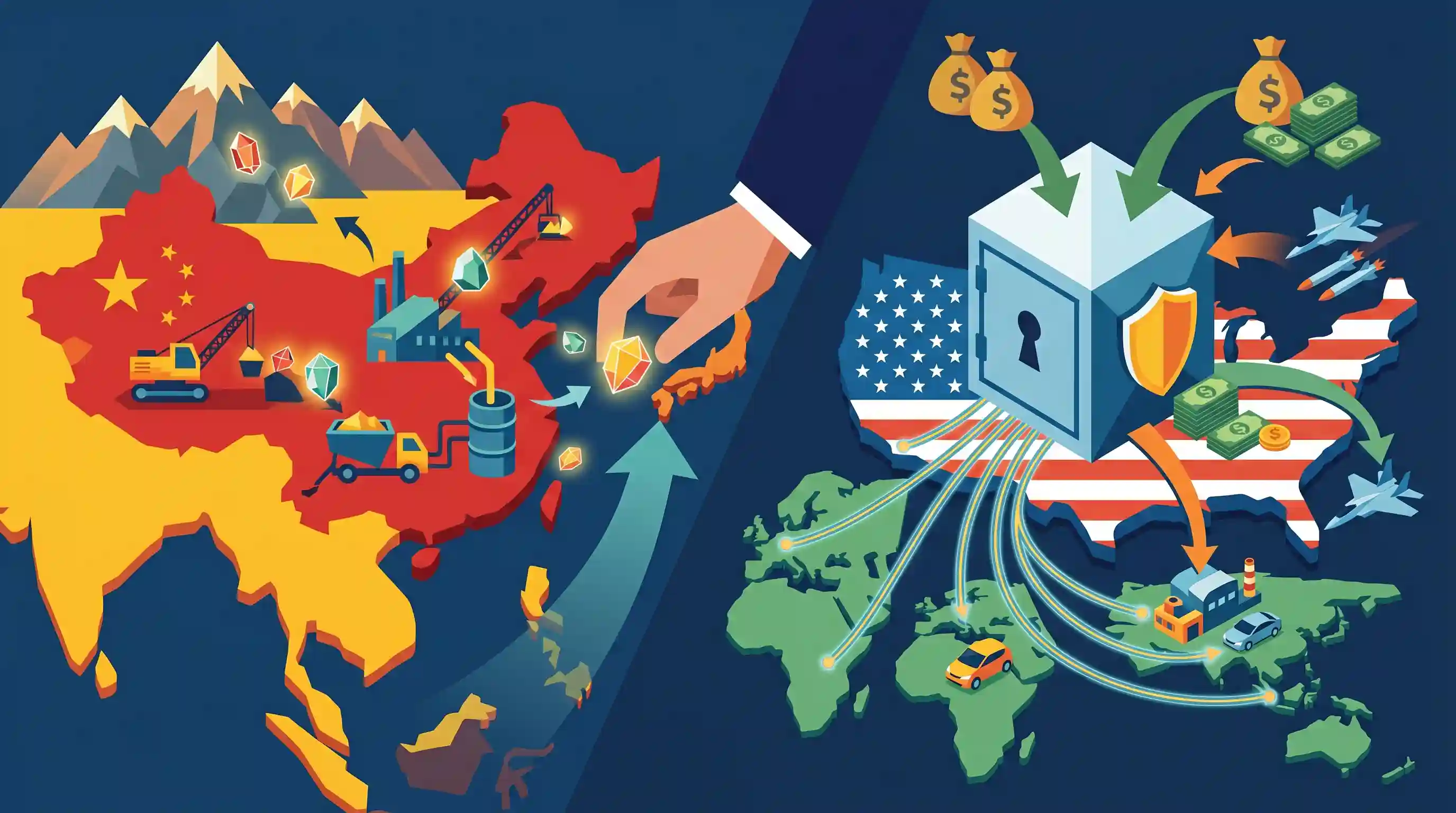
The Trump administration has launched 'Project Vault' to establish a strategic U.S. reserve of rare earth elements, utilizing a $10 billion loan from the U.S. Export-Import Bank alongside private capital. The initiative aims to counter China's near-monopoly over the mining and processing of these critical minerals, which are essential for manufacturing high-tech goods, electric vehicles, and defense equipment. By coordinating with global allies across Europe, Africa, and Asia, the U.S. seeks to build resilient supply chains and reduce its strategic vulnerability to Beijing's potential export controls.
Key Points
- The Trump administration announced 'Project Vault,' a plan backed by a $10 billion U.S. Export-Import Bank loan to create a strategic reserve of rare earth elements (REEs).
- The move is designed to break China's dominance over critical minerals, as China currently controls approximately 70% of global REE mining and 90% of processing.
- Establishing this reserve aims to insulate key U.S. industries—including automakers, electronics manufacturers, and defense contractors (jet engines, precision munitions)—from supply chain disruptions.
- U.S. Secretary of State Marco Rubio is coordinating with European, African, and Asian nations to build resilient, alternative critical mineral supply chains outside of China's sphere of influence.
Important Terms
Project Vault

A $12 billion U.S. initiative to establish a strategic reserve of 60 critical minerals for civilian industry, aimed at reducing dependence on China and securing high-tech supply chains.
UPSC context
Relevant for GS Paper II (International Relations) regarding US-China geoeconomics and GS Paper III (Economy) for global supply chain resilience.
U.S. Export-Import Bank
The official export credit agency of the United States, providing financing to support the export of American goods and services to international markets while countering foreign subsidies.
UPSC context
Relevant for GS Paper III (Economy) under mobilization of resources and international trade financing mechanisms.
Rare Earth Elements (REEs)
A group of 17 metallic elements essential for manufacturing high-tech products like smartphones, electric vehicle motors, wind turbines, and advanced defense equipment due to their unique magnetic and conductive properties.
UPSC context
Crucial for GS Paper III (Science & Technology and Economy) regarding self-reliance in high-tech manufacturing and energy transition.
Critical Minerals
Minerals vital for a country's economic and national security, whose supply is at high risk of disruption, including lithium, cobalt, and rare earth elements used in green energy and defense.
UPSC context
Important for GS Paper I (Geography of resources) and GS Paper III (Economic Development and Security).
Strategic Reserve
A government-controlled stockpile of essential raw materials maintained to ensure industrial continuity and national security during emergencies, supply chain disruptions, or geopolitical conflicts.
UPSC context
Relevant for GS Paper III (Security and Economy) concerning resource nationalism and domestic manufacturing buffers.
National Critical Mineral Mission
A seven-year Indian government initiative (FY 2024-25 to 2030-31) with a ₹16,300 crore budget to secure supply chains, build domestic capacity, and establish strategic reserves for critical minerals.
UPSC context
Key for GS Paper III (Indian Economy) and Government Policies for achieving self-reliance (Atmanirbharta).
Prelims Trap
"Rare Earth Elements are extremely scarce and rarely found in the Earth's crust."
REEs are relatively abundant in the Earth's crust (e.g., cerium is as abundant as copper). They are called "rare" because they are dispersed and rarely found in concentrated ores.
Static Concepts Connected
What are Rare Earth Elements (REEs) and their significance?
- Chemical Definition: A group of 17 metallic elements comprising 15 lanthanides on the periodic table, plus scandium and yttrium.
- Strategic Applications: Crucial for manufacturing permanent magnets, EV motors, wind turbines, aerospace components, and precision guided munitions.
- India's Position: India has the 5th largest reserves (largely in beach placer monazite sand) but heavily imports processed REEs due to weak domestic processing capabilities.
How is India geopolitically securing its critical mineral supply?
- Minerals Security Partnership: India joined this US-led 14-nation alliance in 2023 to catalyze public and private investment in critical mineral supply chains globally.
- KABIL (Khanij Bidesh): A joint venture company set up by the Ministry of Mines to identify and acquire overseas strategic mineral assets (e.g., lithium in Argentina).
Cross-Topic Patterns
Resource Nationalism vs Climate Goals
Export curbs on critical minerals by dominant players (like China's gallium/germanium curbs) directly threaten the affordability and timeline of global green transitions and net-zero targets.
Deep Sea Mining as a strategic hedge
As terrestrial REE monopolies tighten, India's Deep Ocean Mission and exploration of the Central Indian Ocean Basin for polymetallic nodules gain massive geoeconomic urgency.

Expect a paired question linking global critical mineral supply chains (REEs/Lithium) with India's Mines & Minerals Amendment Act 2023.
Linked PYQs · 3
Linked PYQs · 3
- 2012PrelimsGS1
Recently, there has been a concern over the short supply of a group of elements called 'rare earth metals'. Why? 1. China, which is the largest producer of these elements, has imposed some restrictions on their export. 2. Other than China, Australia, Canada and Chile, these elements are not found in any country. 3. Rare earth metals are essential for the manufacture of various kinds of electronic items and there is a growing demand for these elements. Which of the statements given above is/are correct?
- 2025PrelimsGS1
Consider the following statements : Statement I: Some rare earth elements are used in the manufacture of flat television screens and computer monitors. Statement II : Some rare earth elements have phosphorescent properties. Which one of the following is correct in respect of the above statements?
- 2024MainsGS2
‘The West is fostering India as an alternative to reduce dependence on China's supply chain and as a strategic ally to counter China's political and economic dominance.’ Explain this statement with examples.
