US Taiwan Trade Deal and Semiconductor Supply Chain Shifts
Source:Indian Express ↗
Why It Matters
The US-Taiwan agreement illustrates the deep intersection between geopolitics and critical technologies like semiconductors. For UPSC aspirants, it provides a contemporary case study of the global shift from multilateral free trade towards bilateralism and strategic reshoring (affecting GS3 Economy). It also reshapes the balance of power in the Indo-Pacific, which holds significant implications for India's strategic posture and its own ambitions under the India Semiconductor Mission.
Summary
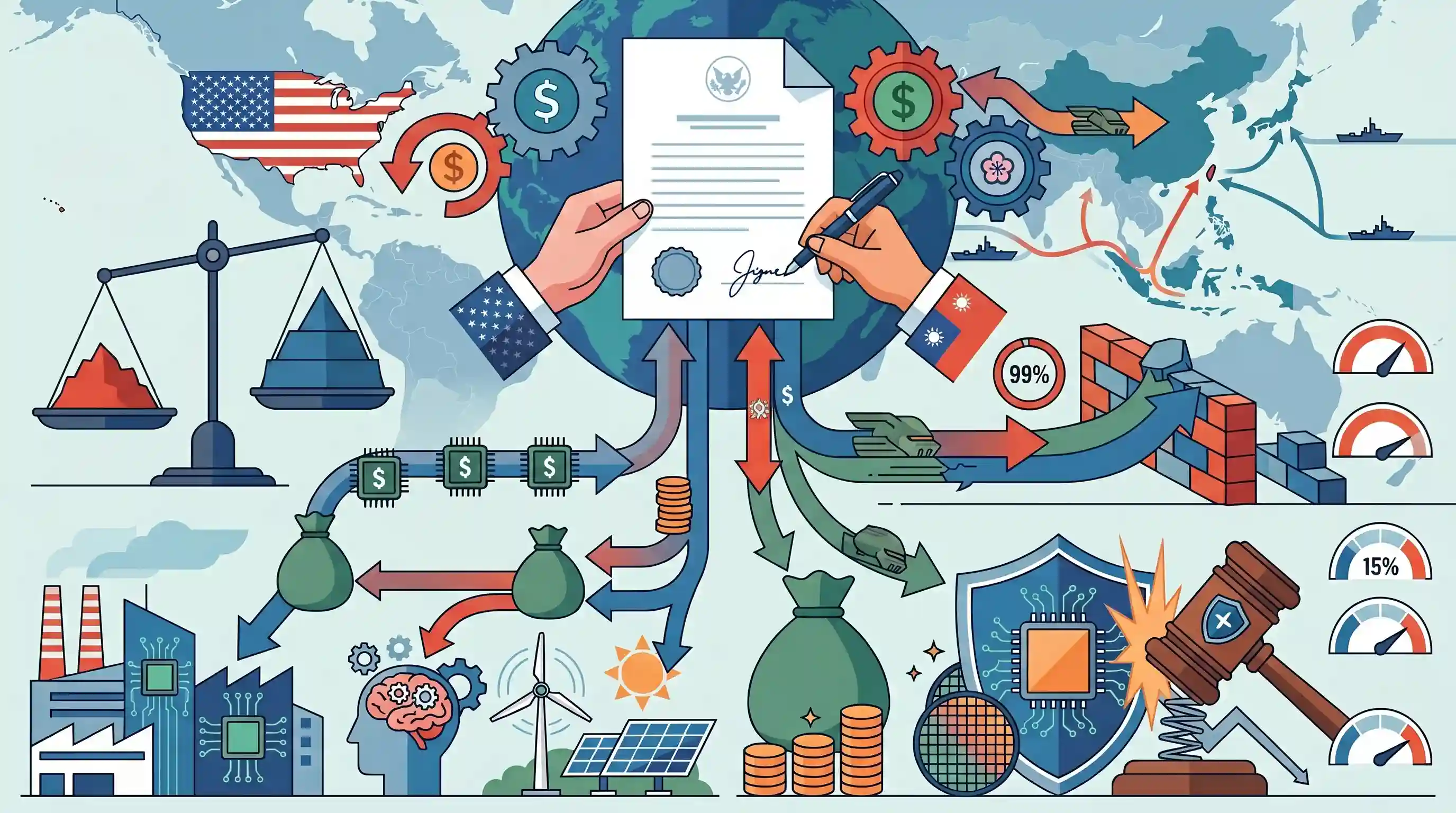
The Trump administration has signed a major trade and technology agreement with Taiwan aimed at reducing a $127 billion trade deficit and securing critical supply chains. Taiwan will remove 99% of its tariff barriers and invest $250 billion in US sectors such as semiconductors, AI, and energy, with TSMC alone committing $165 billion to US-based facilities. In return, the US will cap tariffs on Taiwanese imports at 15% (matching rates for Japan and South Korea) and exempt Taiwan from potential Section 232 national security tariffs on computer chips. The deal reflects the increasing weaponization of trade policy and underscores the geopolitical importance of semiconductor supply chains in the Indo-Pacific.
Key Points
- Taiwan agreed to remove 99% of its tariff barriers to help address a $127 billion trade imbalance with the United States.
- Taiwanese imports to the US will face a maximum tariff of 15% (or the US MFN rate), placing Taiwan on par with key regional allies like Japan and South Korea.
- The US will grant Taiwan preferential treatment, shielding it from potential tariffs resulting from a Section 232 national security investigation into computer chip imports.
- Taiwan committed to $250 billion in direct investments in US industries like semiconductors, AI, and energy, plus an additional $250 billion in credit guarantees for smaller businesses.
- Taiwan Semiconductor Manufacturing Co. (TSMC) committed $165 billion for establishing US-based fabrication plants and an R&D center, boosting American domestic tech manufacturing.
- The deal highlights a global shift towards bilateralism, protectionism, and the strategic reshoring of critical technology supply chains.
Important Terms
Section 232

A provision of the US Trade Expansion Act of 1962 allowing the President to impose tariffs on imports deemed a threat to national security.
UPSC context
Relevant for GS Paper II (International Relations) and GS Paper III (Economy) regarding trade wars and protectionist policies.
TSMC
The world's largest dedicated semiconductor foundry, based in Taiwan, which produces the majority of the world's most advanced logic chips.
UPSC context
Important for GS Paper III (Science & Tech and Economy) concerning strategic industries and global value chains.
American Institute in Taiwan (AIT)
A nonprofit corporation established under the 1979 Taiwan Relations Act to handle unofficial US-Taiwan diplomatic, commercial, and cultural relations.
UPSC context
Crucial for GS Paper II (International Relations) to understand the 'One China Policy' and de facto diplomacy.
Semiconductor Supply Chain
The complex network of design, fabrication, and assembly for computer chips, currently centralized in East Asia and a focus for global diversification.
UPSC context
Key for GS Paper III (Economy/S&T) regarding 'Strategic Autonomy' and 'Supply Chain Resilience' initiatives like the India Semiconductor Mission.
Indo-Pacific
The geopolitical and economic region spanning the Indian and Pacific Oceans, viewed as the primary theater for US-China strategic competition.
UPSC context
Core topic for GS Paper II (International Relations) involving regional security, the Quad, and India’s 'Act East' policy.
Trade Deficit
An economic condition where a country's total value of imports exceeds its exports; a primary driver of current trade protectionism.
UPSC context
Relevant for GS Paper III (Economy) concerning balance of payments and bilateral trade negotiations.
Prelims Trap
"Most Favoured Nation (MFN) status grants a trading partner exclusive, preferential tariff rates lower than all other countries."
MFN actually mandates equal treatment among all WTO members. The MFN rate is the standard tariff applied to all, not a special discount. Special lower rates require formal Free Trade Agreements.
Static Concepts Connected
What is the Most-Favoured-Nation (MFN) principle under the WTO?
- Non-discrimination principle: Article I of GATT mandates that any trade advantage, favor, or tariff cut granted to one nation must be immediately extended to all other WTO members.
- Allowed Exceptions: Members can bypass MFN for regional Free Trade Agreements (FTAs) or to give special market access to developing nations under the Generalized System of Preferences (GSP).
How do trade rules address "National Security" tariffs?
- GATT Article XXI: Article XXI of GATT allows WTO members to breach standard trade obligations to protect essential security interests. It is increasingly invoked in modern trade wars.
- US Section 232: A US domestic law (Trade Expansion Act of 1962) allowing the President to impose tariffs on specific imports deemed a threat to national security, such as chips or steel.
Cross-Topic Patterns
Friend-shoring + Supply Chain Resilience
Taiwan’s shift of TSMC capacity to the US exemplifies "friend-shoring." This connects directly to the Quad's Supply Chain Resilience Initiative (SCRI) and India’s domestic semiconductor PLI push.
Geoeconomics + Indo-Pacific Strategy
Securing chip supply chains is now a primary geopolitical weapon. US trade exemptions for Taiwan blend economic policy with Indo-Pacific deterrence against Chinese technological dominance.

Semiconductor friend-shoring, US Section 232 tariffs, and WTO MFN exceptions are highly likely to form a combined Prelims question.
Linked PYQs · 3
Linked PYQs · 3
- 2025MainsGS3
India aims to become a semiconductor manufacturing hub. What are the challenges faced by the semiconductor industry in India? Mention the salient features of the India Semiconductor Mission.
- 2025MainsGS3
What are the challenges before the Indian economy when the world is moving away from free trade and multilateralism to protectionism and bilateralism? How can these challenges be met?
- 2021MainsGS2
The newly tri-nation partnership AUKUS is aimed at countering China's ambitions in the Indo-Pacific region. Is it going to supersede the existing partnerships in the region? Discuss the strength and impact of AUKUS in the present scenario.
