अमेरिकी राष्ट्रपति ने घरेलू महंगाई और आप्रवासन चिंताओं पर संबोधन दिया
स्रोत:द हिंदू ↗
क्यों मायने रखता है
Shifts in U.S. domestic priorities toward protectionism and sovereign nationalism to appease domestic voters have profound implications for global trade, inflation dynamics, and the trajectory of international conflicts.
सारांश
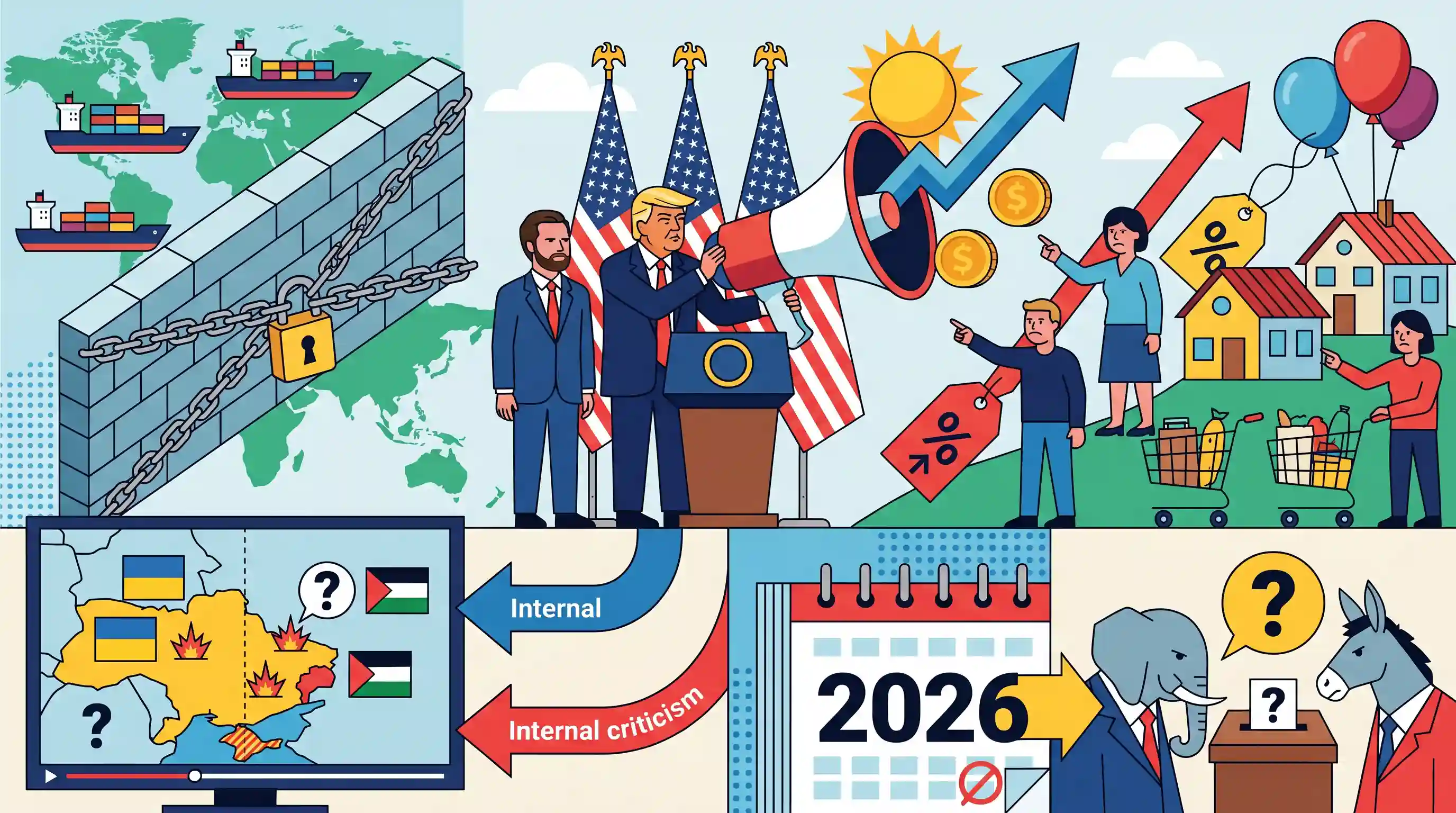
U.S. President Donald Trump is scheduled to deliver a national address focusing on his administration's domestic accomplishments, specifically regarding inflation and immigration. Despite his claims of a new 'golden age,' Trump faces mounting voter frustration over the high cost of living—exacerbated by his protectionist tariff policies. Facing internal criticism for prioritizing foreign policy initiatives in Ukraine and Gaza over domestic issues, Trump and officials like Vice President J.D. Vance are shifting their messaging to focus on the domestic economy. This pivot, encapsulated by the promise to 'make America affordable again,' comes as Republicans navigate recent electoral setbacks ahead of the 2026 midterm elections.
मुख्य बिंदु
- अमेरिकी राष्ट्रपति डोनाल्ड ट्रंप राष्ट्र के नाम एक संबोधन में मुद्रास्फीति और आप्रवासन पर अपने प्रशासन के प्रयासों को रेखांकित करने की योजना बना रहे हैं।
- Voter dissatisfaction is rising over the high cost of living, which experts suggest is partly fueled by the administration\'s protectionist tariff policies.
- Facing criticism for prioritizing foreign peace deals (Ukraine, Gaza) over domestic concerns, Trump\'s team is pivoting its focus to the domestic economy ahead of the 2026 midterm elections.
- The administration is adopting the slogan \'Make America affordable again\' as recent Republican electoral losses signal potential vulnerabilities.
महत्वपूर्ण शब्द
Protectionism

Economic policy of restricting imports from other countries through methods such as tariffs on imported goods, restrictive quotas, and a variety of other government regulations.
UPSC context
GS पेपर III (अर्थव्यवस्था); व्यापार बाधाओं, वैश्वीकरण पर उनके प्रभाव और भारत की निर्यात प्रतिस्पर्धात्मकता की समझ का परीक्षण करता है।
Tariffs
आयातित वस्तुओं पर सरकार द्वारा लगाए गए कर, जिनका उपयोग घरेलू उद्योगों की रक्षा करने, राजस्व प्राप्त करने, या व्यापार वार्ताओं और विवादों में एक उपकरण के रूप में किया जाता है।
UPSC context
GS Paper II/III; relevant for International Relations (trade wars) and Economy (impact on inflation and global supply chains).
MAGA movement
A populist political movement led by Donald Trump, advocating for 'America First' policies, economic protectionism, and restrictive immigration to restore perceived lost national greatness.
UPSC context
GS Paper II; tests impact of developed countries' internal politics on global order and India-US strategic ties.
US Congress
The bicameral legislature of the U.S. federal government, consisting of the House of Representatives and the Senate, with powers over trade, war, and funding.
UPSC context
GS Paper II; important for comparative politics and understanding the legislative role in shaping foreign policy and sanctions.
Republican Party
One of the two major U.S. political parties, generally characterized by conservative ideologies, 'America First' nationalism, and a preference for unilateral foreign policy.
UPSC context
GS Paper II; relevant for studying international relations and how partisan shifts in major powers affect global stability.
Democratic Party
One of the two major U.S. political parties, typically supporting liberal social policies, multilateral diplomacy, international cooperation, and global climate agreements.
UPSC context
GS Paper II; essential for analyzing shifts in U.S. foreign policy regarding human rights, climate, and international organizations.
प्रारंभिक ट्रैप
High inflation in the US economy leads to increased Foreign Portfolio Investment (FPI) inflows into developing markets like India.
Aspirants often think US inflation drives money to emerging markets. In reality, US inflation forces Federal Reserve rate hikes, triggering FPI outflows and depreciating the Rupee.
संबंधित अवधारणाएँ
How do US Federal Reserve interest rate hikes impact the Indian economy?
- Capital Outflow: Higher US yields attract foreign investors, leading to capital flight (FPI outflows) from Indian equities and bonds.
- मुद्रा का मूल्यह्रास: The outflow of dollars weakens the Indian Rupee against the USD, leading to costlier imports and imported inflation.
- Costlier Borrowing: Indian corporates raising funds abroad face higher interest burdens on External Commercial Borrowings (ECBs).
What WTO mechanisms are challenged by unilateral protectionist tariffs?
- National Security Exception: Countries increasingly invoke Article XXI to impose tariffs, claiming national security exemptions rather than economic protectionism.
- Dispute Settlement Crisis: Unilateral tariff impositions bypass the WTO's formal dispute settlement mechanism, whose Appellate Body remains paralyzed by US blockages.
- Breach of Bound Rates: Unilateral duties violate the Most-Favoured-Nation (MFN) principle and bound tariff commitments without utilizing authorized anti-dumping or countervailing measures.
अंतर-विषय पैटर्न
Protectionism & Sovereign Nationalism
The shift towards 'Make America affordable' reflects a broader deglobalization trend, moving away from multilateral trade frameworks (WTO) to unilateral, inward-looking economic policies.
US Immigration & India's Knowledge Economy
अमेरिका की सख्त आप्रवासन नीतियों का सीधा संबंध भारत के सेवा निर्यात प्रभुत्व, IT क्षेत्र की गतिशीलता और भारतीय प्रवासियों द्वारा संचालित विशाल रेमिटेंस अर्थव्यवस्था से है।

US protectionism + Fed rate hikes + RBI policy response will likely form a complex multi-statement macroeconomic question in Prelims 2026.
संबद्ध PYQ · 4
संबद्ध PYQ · 4
- 2025MainsGS2
"With the waning of globalization, post-Cold War world is becoming a site of sovereign nationalism.” Elucidate.
- 2018MainsGS2
What are the key areas of reform if the WTO has to survive in the present context of "Trade War', especially keeping in mind the interest of India?
- 2012MainsGS2
Discuss the likely negative impact of the protectionist measures proposed by the US on India's software industry.
- 2024MainsGS3
What are the causes of persistent high food inflation in India? Comment on the effectiveness of the monetary policy of the RBI to control this type of inflation.
