U.S. tariffs on Indian goods and implications for bilateral trade
Source:The Hindu ↗
Why It Matters
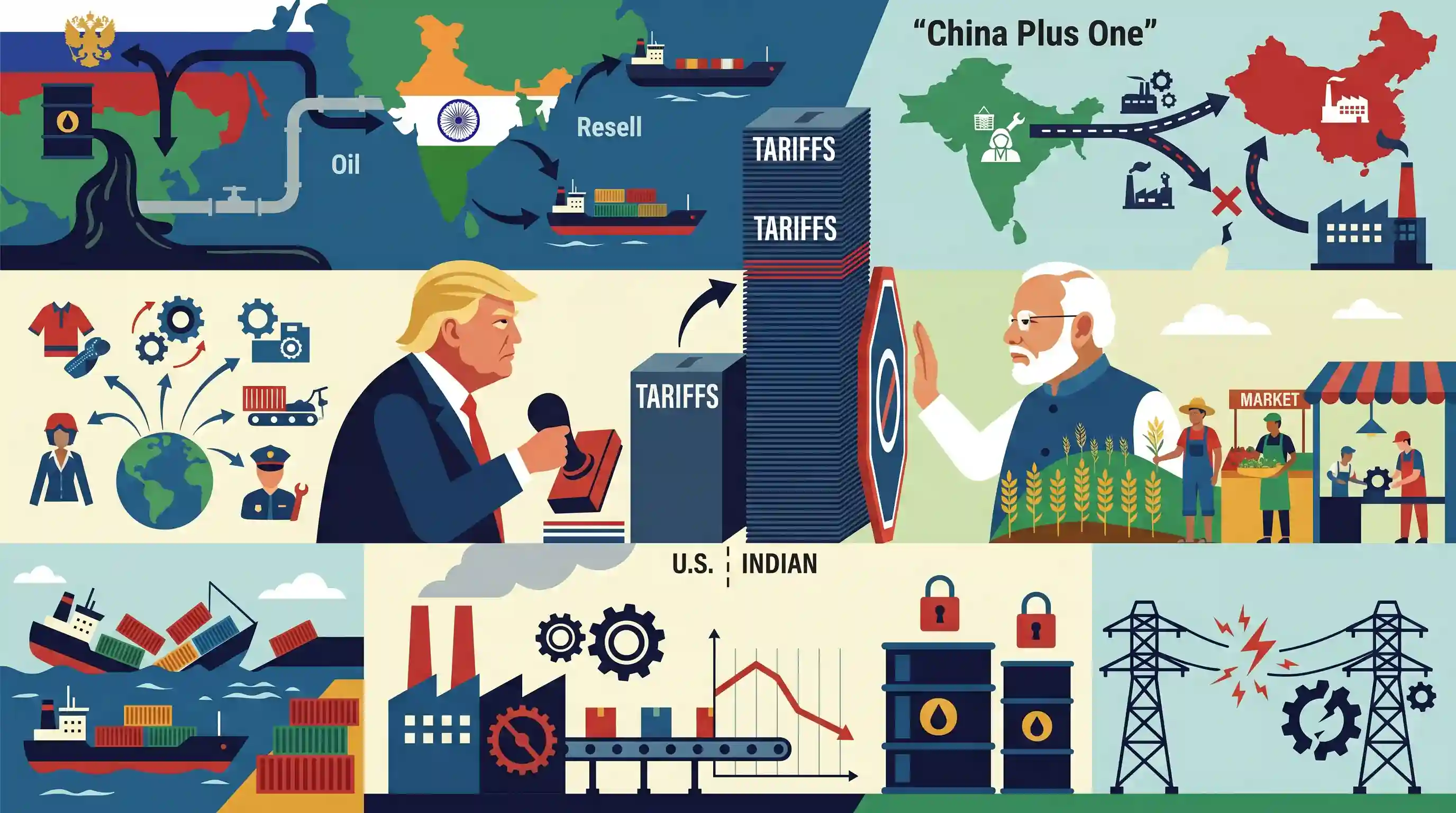
Highlights the complex geopolitical intersection between India's energy diplomacy (accessing discounted Russian oil) and U.S. trade protectionism, while demonstrating the vulnerability of India's export-driven manufacturing goals to external tariff shocks.
Summary
U.S. President Donald Trump has implemented an additional 25% tariff on Indian imports, raising the total levy to 50% in response to India's purchase and resale of Russian crude oil. The move has escalated trade friction, with the U.S. Treasury accusing India of "profiteering," while India terms the action unjustified. Prime Minister Modi has vowed to protect domestic farmers and small industries. Trade analysts suggest this protectionist measure will undermine the "China Plus One" strategy, potentially disrupting global supply chains and impeding India's manufacturing-led economic growth.
Key Points
- An additional 25% tariff on Indian imports by the U.S. has come into effect, largely in retaliation for India's continued purchase and resale of Russian crude oil.
- U.S. Treasury Secretary Scott Bessent accused India of profiteering from U.S.-led sanctions on Russia, while India maintains the tariffs are "unjustified".
- Prime Minister Narendra Modi emphasized India's commitment to defending the economic interests of its farmers and small industries amidst the dispute.
- Analysts warn the tariffs may derail the "China Plus One" supply chain diversification strategy, harming India's manufacturing sector and making export-driven growth more challenging.
Important Terms
China Plus One strategy

A global business strategy where companies diversify their supply chains by expanding manufacturing to other countries (like India or Vietnam) to reduce over-reliance on China.
UPSC context
GS3 Economy/GS2 IR; tests India's manufacturing competitiveness and its role in resilient global supply chains.
Trade Protectionism
Economic policy of restricting imports through tariffs or quotas to shield domestic industries and workers from foreign competition.
UPSC context
GS3 Economy; tests understanding of globalization, trade wars, and impacts on India's export-led growth strategy.
U.S. Department of the Treasury
The executive department responsible for managing U.S. finances, implementing sanctions (via OFAC), and overseeing international financial policy and trade enforcement.
UPSC context
GS2 IR; relevant for understanding the institutional mechanisms of global sanctions and economic statecraft.
Geopolitics of Energy
The intersection of energy security, resource management, and international politics, particularly how nations navigate global conflicts to secure fuel supplies.
UPSC context
GS2 IR/GS3 Energy; tests India's strategic autonomy and its ability to balance foreign policy with domestic energy needs.
The Asia Group
A strategic advisory firm that provides analysis on the intersection of public policy, geopolitics, and corporate strategy in the Indo-Pacific region.
UPSC context
GS2 IR; example of Track-II diplomacy and the role of private strategic analysis in bilateral trade negotiations.
Prelims Trap
"India's purchase of Russian crude oil violates global sanctions."
Sanctions on Russia are unilateral (US/EU), not UN-mandated. India only recognizes multilateral sanctions authorized by the UN Security Council, making its oil imports strictly legal.
Static Concepts Connected
How do unilateral US tariffs interact with WTO rules?
- MFN Principle: WTO members must apply the same tariff rates equally to all other members under GATT Article I.
- Security Exception: GATT Article XXI allows nations to bypass MFN obligations if they claim it is necessary for their "essential security interests."
- Unilateral Action: The US often invokes domestic trade laws to unilaterally impose tariffs on trade partners, bypassing standard WTO dispute resolution mechanisms.
What is the difference between primary and secondary sanctions?
- Primary Sanctions: These bar citizens and companies of the sanctioning country from engaging in trade or financial relations with the targeted nation.
- Secondary Sanctions: Extraterritorial measures targeting third-party countries (like India) with economic penalties if they continue trading with the sanctioned entity.
- UN Recognition: The UN does not recognize unilateral secondary sanctions; India officially adheres only to sanctions mandated by the UN Security Council.
Cross-Topic Patterns
Secondary sanctions + Strategic Autonomy
US tariffs illustrate the friction between Western extraterritorial economic coercion and India's pursuit of independent energy security via discounted Russian crude.
China Plus One + Trade Protectionism
US protectionism ironically weakens the 'China Plus One' strategy by penalizing alternative manufacturing hubs like India, hindering global supply chain resilience initiatives.

Expect a 2026 Prelims question linking WTO's Article XXI (Security Exception) with the legality of unilateral US secondary sanctions.
Linked PYQs · 3
Linked PYQs · 3
- 2012MainsGS2
Discuss the likely negative impact of the protectionist measures proposed by the US on India's software industry.
- 2025MainsGS2
"Energy security constitutes the dominant kingpin of India's foreign policy, and is linked with India's overarching influence in Middle Eastern countries.” How would you integrate energy security with India's foreign policy trajectories in the coming years?
- 2023MainsGS3
Faster economic growth requires increased share of the manufacturing sector in GDP, particularly of MSMEs. Comment on the present policies of the Government in this regard.
