Truecaller Criticizes TRAI Move on App Regulation
Source:The Hindu ↗
Why It Matters
This development is highly relevant for understanding the governance of the digital economy in India, specifically the jurisdictional friction between statutory regulators (TRAI, DoT) and administrative ministries (MeitY) over digital applications. It also highlights the challenges of balancing consumer protection, financial fraud prevention, and unsolicited commercial communications (UCC) regulation with private technology innovation and user experience.
Summary
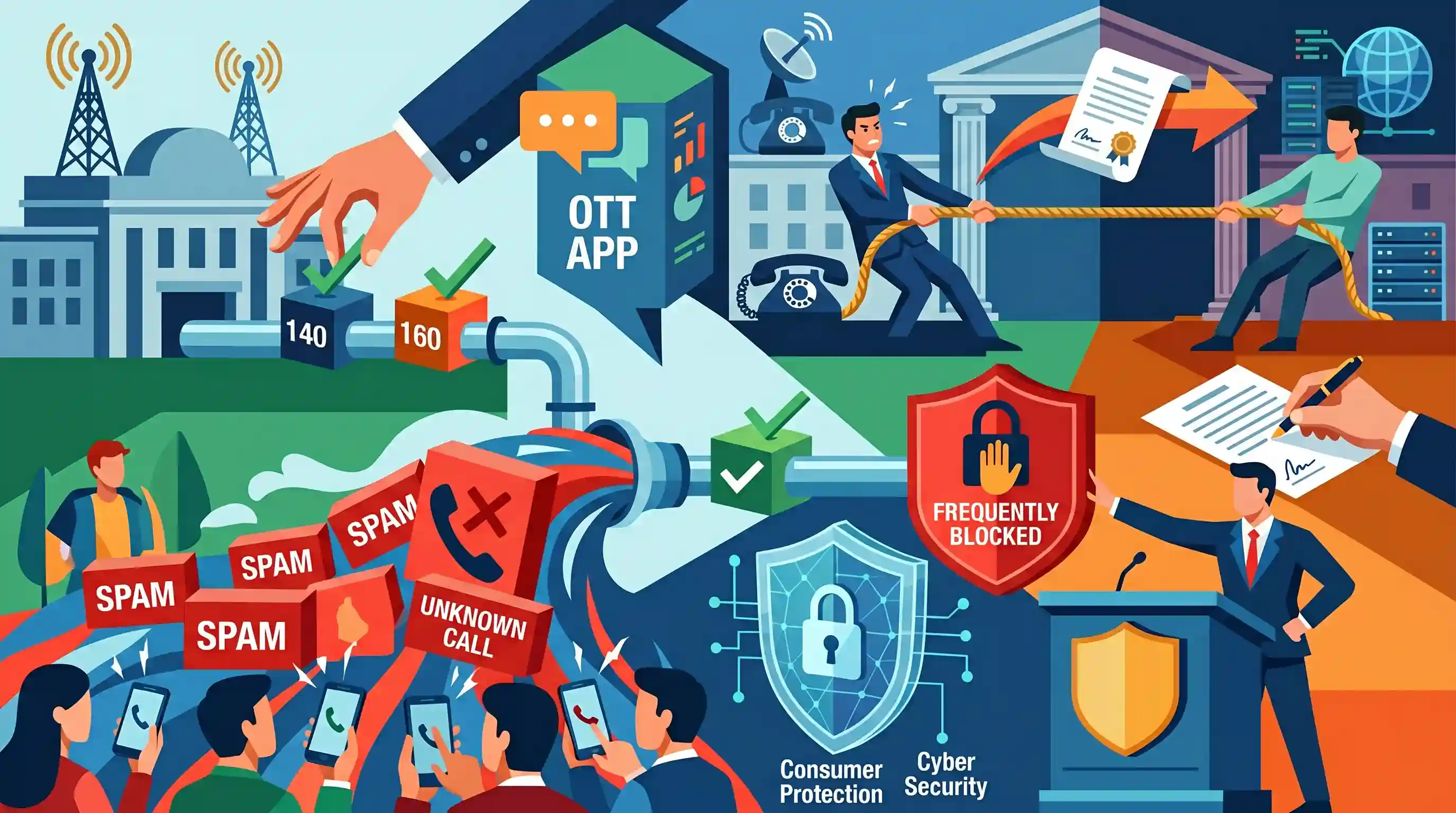
Truecaller CEO Rishit Jhunjhunwala has strongly criticized attempts by the Telecom Regulatory Authority of India (TRAI) to bring caller ID applications under its regulatory purview. The dispute stems from TRAI's mandate that apps whitelist 140-series (promotional) and 160-series (banking) numbers, which Truecaller claims triggered a massive spike in unanswered spam calls (over 51 million daily). Truecaller's introduction of a 'Frequently Blocked' warning on these whitelisted numbers led TRAI to write to the Ministry of Electronics and Information Technology (MeitY) to seek authority to regulate such apps. This clash highlights a growing jurisdictional conflict between traditional telecom authorities (DoT and TRAI) and IT ministries (MeitY) over the administration of Over-The-Top (OTT) communication tools and app designs.
Key Points
- Truecaller CEO Rishit Jhunjhunwala criticized the Telecom Regulatory Authority of India (TRAI) for seeking Ministry of Electronics and Information Technology (MeitY) clearance to regulate caller ID applications.
- The conflict arose over TRAI's mandate to whitelist 140-series (promotional) and 160-series (banking) phone numbers from spam warnings, which Truecaller claims led to an immediate surge in spam calls (resulting in over 51 million unanswered calls daily).
- In response to user feedback, Truecaller circumvented the whitelisting by implementing a 'Frequently Blocked' badge, drawing complaints from banks and prompting TRAI to seek regulatory control over caller ID apps from MeitY.
- The dispute underscores a broader trend of regulatory and jurisdictional overlap in India's digital ecosystem, involving the Department of Telecommunications (DoT), MeitY, and TRAI over OTT communication platforms and online services.
- Examples of this overlap include the DoT directing WhatsApp to only operate when the registered SIM card is inside the phone, and MeitY requesting WhatsApp to pause its privacy-oriented username feature.
- TRAI's regulatory efforts, such as the Telecom Commercial Communications Customer Preference (Second Amendment) Regulations, 2025, aim to curb Unsolicited Commercial Communications (UCC) but face execution challenges when targeting private, app-based ecosystem solutions.
Important Terms
Telecom Commercial Communications Customer Preference (Second Amendment) Regulations, 2025

TRAI regulations designed to curb spam by mandating registered headers, assigning 140-series numbers for promotional calls, and 160-series numbers for transactional/service calls.
UPSC context
GS Paper II & III: Government policies, consumer protection, and the regulation of unsolicited commercial communications.
Calling Name Presentation
A telecom supplementary service recommended by TRAI that displays a caller's registered, KYC-verified name on the receiver's screen to combat spam and fraud.
UPSC context
GS Paper III: Science and Technology, digital infrastructure, and consumer data privacy.
Telecom Regulatory Authority of India
The statutory regulator of the telecommunications sector in India, established under the TRAI Act, 1997, to protect consumer interests and ensure orderly sector growth.
UPSC context
GS Paper II: Statutory, regulatory, and quasi-judicial bodies and their mandates.
Ministry of Electronics and Information Technology
The Union ministry responsible for executive policy-making in information technology, electronics manufacturing, cybersecurity, and the regulation of digital platforms under the IT Act.
UPSC context
GS Paper II: Executive structure, Union Ministries, and cyber governance.
Department of Telecommunications
A department under the Ministry of Communications, Government of India, that licenses telecom operators, administers telecom policies, and manages national spectrum allocation.
UPSC context
GS Paper II & III: Regulatory policy and infrastructure development in communications.
Truecaller
A third-party digital call-management application providing crowdsourced caller identification, spam detection, and call-tagging services to mobile users globally.
UPSC context
GS Paper III: Cybersecurity, intermediary liability, and data protection regimes in India.
A prominent over-the-top (OTT) communication application regulated under IT laws that has occasionally clashed with telecom policies over registration and user verification.
UPSC context
GS Paper III: Intermediary compliance, OTT vs. telecom operator regulatory parity, and digital security.
Prelims Trap
TRAI holds direct licensing and regulatory jurisdiction over Over-The-Top (OTT) communication and caller-ID applications in India.
These apps are classified as intermediaries under the IT Act, 2000, placing them under MeitY's jurisdiction, not TRAI's direct telecom licensing framework.
Static Concepts Connected
What is the functional division between TRAI and TDSAT?
- TRAI Mandate: Established under the TRAI Act, 1997 to recommend licensing conditions, set tariffs, and monitor Quality of Service (QoS) for telecom.
- TDSAT Role: Created via a 2000 amendment to divest TRAI of judicial powers; adjudicates disputes between licensors, licensees, and consumers.
What is the regulatory status of OTT communication players in India?
- Nodal Ministry: Governed by MeitY primarily under the Information Technology Act, 2000, rather than DoT's telecom laws.
- Intermediary Status: Classified as intermediaries, granting them safe-harbor protections under Section 79, unlike licensed telecom service providers.
Cross-Topic Patterns
Regulatory Convergence vs Governance Silos
Technological convergence blurs lines between telecom and internet services, testing the limits of siloed ministries (DoT, MeitY, MIB) and demanding a unified digital regulator.
E-Governance vs Private App Design
State measures to curb unsolicited communications (like TRAI's whitelisting) clash with private algorithms designed for user-centric spam blocking, creating friction in digital public goods.

GS-2/3 will likely test jurisdictional boundaries between TRAI (telecom) and MeitY (IT) regarding OTT and digital intermediary regulation.
Linked PYQs · 2
Linked PYQs · 2
- 2015MainsGS2
For achieving the desired objectives, it is necessary to ensure that the regulatory institutions remain independent and autonomous. Discuss in the light of the experiences in recent past.
- 2020MainsGS3
Discuss different types of cyber crimes and measures required to be taken to fight the menace.
