Foreign Contribution Regulation Amendment Bill Raises Concerns
Source:The Hindu ↗
Why It Matters
Understanding the FCRA and its subsequent amendments is essential for analyzing the evolving relationship between the State and Civil Society Organizations in India. This topic directly relates to GS Paper 2 (Governance) regarding the regulatory ecosystem for NGOs, the balance between national security and freedom of association, and the protection of minority rights in institutional operations.
Summary
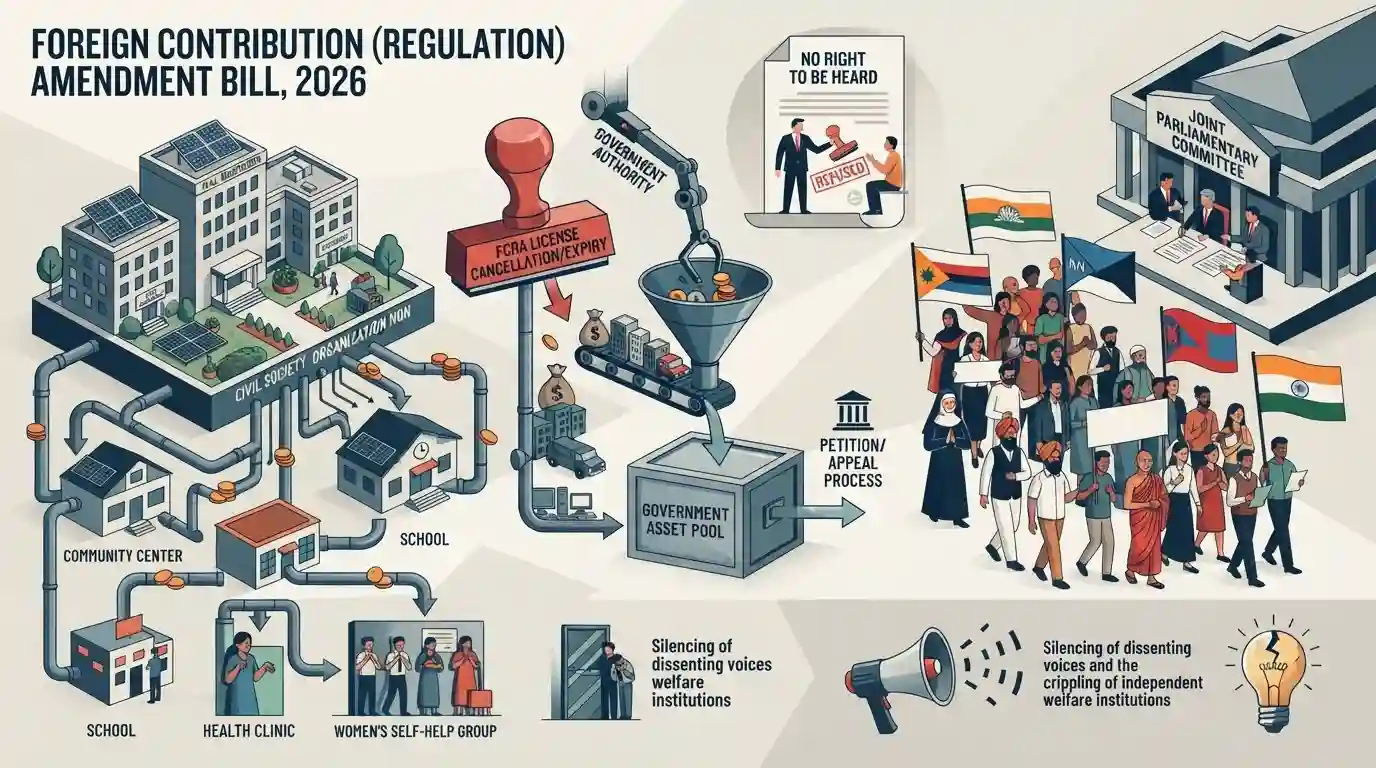
The Foreign Contribution (Regulation) Amendment Bill, 2026 introduces draconian measures that further tighten government control over civil society organizations (CSOs). The most controversial provision mandates the automatic transfer of foreign funds and assets built with them to a government authority if an NGO loses its FCRA registration due to cancellation, non-renewal, or expiry. Even assets built partly with foreign funds can be entirely seized, forcing NGOs to petition for their domestic share. The bill lacks basic tenets of natural justice, offering no right to be heard before a license renewal is refused. Due to widespread protests, particularly from minority religious institutions and states like Kerala, Mizoram, Nagaland, and Tamil Nadu, the legislation has been referred to a Joint Parliamentary Committee (JPC). The proposed amendments threaten to effectively cripple dissenting voices and independent welfare institutions in India.
Key Points
- The Foreign Contribution (Regulation) Amendment Bill, 2026 seeks to further restrict civil society organizations by tightening regulations on foreign funding.
- Under the proposed law, unutilized foreign funds and any assets created using them will automatically pass to a government-designated authority if an NGO's FCRA registration is cancelled, not renewed, or allowed to expire.
- In cases where assets are built with mixed funds (partly foreign, partly domestic), the government authority will take over the entire asset, requiring the NGO to submit an application to reclaim its domestic share.
- The bill has been heavily criticized for violating principles of natural justice, as it denies NGOs a right to be heard before a renewal is refused and limits appeals to post-takeover asset disputes.
- Following strong objections from minority religious institutions (especially Christian organizations running schools and hospitals) and multiple State governments, the bill has been referred to a Joint Parliamentary Committee (JPC).
Important Terms
Foreign Contribution (Regulation) Amendment Bill, 2026

A proposed legislation creating a 'Designated Authority' to provisionally seize and manage foreign-funded assets of NGOs if their FCRA registration is cancelled, surrendered, or ceases due to non-renewal.
UPSC context
GS Paper 2 (Governance). Tests understanding of state control mechanisms over civil society and debates on fundamental rights vs. regulation.
Foreign Contribution (Regulation) Act (FCRA)
An Indian law regulating the acceptance and utilization of foreign donations by individuals and NGOs to ensure such funding does not adversely affect national security, sovereignty, or public order.
UPSC context
GS Papers 2 & 3. Highly relevant for topics covering internal security, NGO regulation, and the impact of government policies.
Joint Parliamentary Committee (JPC)
An ad-hoc, temporary legislative body composed of members from both the Lok Sabha and Rajya Sabha. It is constituted to conduct detailed investigations into complex bills, scams, or issues of public importance.
UPSC context
GS Paper 2 (Parliament). Essential for understanding parliamentary committees, legislative scrutiny, and mechanisms holding the executive accountable.
Civil Society Organisations (CSOs)
Voluntary, non-profit citizen groups operating independently of the state and commercial sectors. They advocate for public interests, welfare, and policy changes but face strict compliance regimes regarding their funding.
UPSC context
GS Paper 2 (Development Processes). Critical for analyzing the role of NGOs, SHGs, and civic groups in grassroots development and democracy.
Prelims Trap
Upon registration cancellation, assets built with mixed funding are automatically split between the government and the NGO based on contribution ratios.
Incorrect. The government-designated authority takes over the entire asset, shifting the burden on the NGO to apply and prove its domestic share.
Static Concepts Connected
What is the FCRA's core regulatory structure and administrative authority?
- Nodal Ministry: Administered strictly by the Ministry of Home Affairs (MHA) to safeguard internal security.
- SBI Bank Mandate: All foreign contributions must be received exclusively in a designated State Bank of India branch in New Delhi.
- Validity Period: FCRA registration is valid for five years and requires active renewal before expiry.
What is a Joint Parliamentary Committee (JPC) and its key features?
- Ad-hoc Nature: A JPC is a temporary, non-standing committee set up for a specific inquiry and dissolved after submitting its report.
- Composition Ratio: Members are drawn from both Houses, traditionally maintaining a 2:1 ratio between Lok Sabha and Rajya Sabha.
- Advisory Status: Its recommendations are not binding on the government, though they carry significant persuasive and legislative weight.
Cross-Topic Patterns
Foreign Funding vs. Freedom of Religion
FCRA curbs on minority-run schools and hospitals directly intersect with constitutional protections under Articles 25, 26, and 30.
Civil Society vs. Internal Security
Tighter NGO regulations reflect the constitutional tension between preserving state security and upholding the freedom of association under Article 19(1)(c).

FCRA administrative mechanics, MHA powers, and mixed-fund asset seizure provisions are highly likely to be tested in Prelims 2026.
Linked PYQs · 3
Linked PYQs · 3
- 2015MainsGS2
Examine critically the recent changes in the rules governing foreign funding of NGOs under the Foreign Contribution (Regulation) Act (FCRA), 1976.
- 2024MainsGS2
Public charitable trusts have the potential to make India's development more inclusive as they relate to certain vital public issues. Comment.
- 2018MainsGS2
Whether National Commission for Scheduled Castes (NCSC) can enforce the implementation of constitutional reservation for the Scheduled Castes in the religious minority institutions? Examine.
