Great Nicobar Project Faces Ecological and Tribal Rights Concerns
Source:The Hindu ↗
Why It Matters
The Great Nicobar Island project is a classic 'Development vs Environment' case study. It directly pits India's strategic and infrastructure goals in the Indian Ocean against severe ecological costs and the rights of Particularly Vulnerable Tribal Groups (PVTGs) like the Shompen. It is highly relevant for GS3 (Environment/EIA/Infrastructure) and GS2 (Vulnerable Sections/Tribal Rights).
Summary
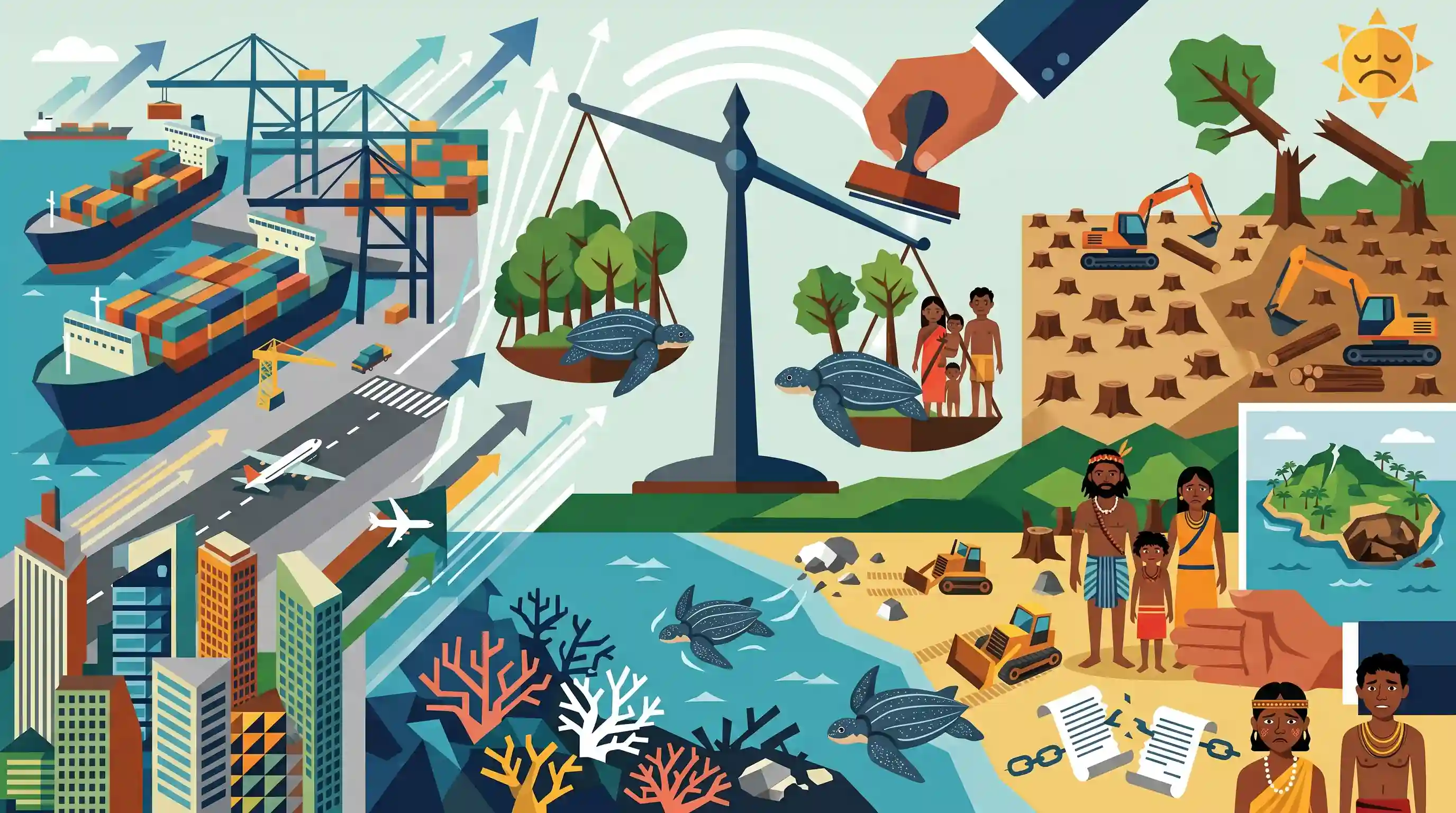
The editorial critiques the National Green Tribunal's endorsement of the Great Nicobar Island Project (GNIP), a massive strategic infrastructure initiative involving a trans-shipment port, airport, and township. While the project is hailed for its strategic utility, it poses severe environmental threats, including the felling of nearly 9 lakh trees and the disruption of coral reefs and leatherback turtle habitats. Furthermore, it threatens the survival and rights of indigenous tribes like the Shompen and Nicobarese, raising concerns over coercive land acquisition practices that bypass the Forest Rights Act. The article warns against repeating the historical displacement seen in Pacific islands like Banaba, urging a fair balance between strategic development and ecological preservation.
Key Points
- The National Green Tribunal (NGT) approved the Great Nicobar Island Project (GNIP), validating its strategic utility but failing to independently appraise significant ecological and tribal concerns.
- The mega-project envisions a trans-shipment port, international airport, township, and power plant, which will require the felling of approximately 9 lakh trees across 130 sq.km of pristine tropical forest.
- Environmental experts warn of massive biodiversity loss, including severe disruption to coral reefs and leatherback turtle nesting grounds.
- The project threatens the community rights of the Shompen (a PVTG) and Nicobarese tribes under the Forest Rights Act, amid allegations of coerced land surrender certificates.
- Drawing a historical parallel to the environmental devastation and tribal displacement caused by phosphate mining in Nauru and Banaba, the editorial argues that economic logic alone should not dictate actions in ecologically fragile remote territories.
Important Terms
Great Nicobar Island Project (GNIP)

A ₹72,000-crore strategic initiative involving an international transshipment port, greenfield airport, township, and power plant at the southern tip of the Andaman and Nicobar Islands to enhance maritime security.
UPSC context
GS Paper III (Infrastructure, Environment). Tests understanding of the trade-off between strategic maritime security and ecological/tribal preservation.
National Green Tribunal (NGT)
A statutory judicial body established under the NGT Act (2010) for the expeditious disposal of cases involving environmental protection and forest conservation, applying the 'Polluter Pays' and 'Precautionary' principles.
UPSC context
GS Paper II & III (Statutory Bodies, Environment). Evaluates the role of specialized tribunals in upholding environmental justice and sustainable development.
Forest Rights Act (FRA), 2006
Legislation that recognizes the land and usufruct rights of forest-dwelling communities, requiring Gram Sabha consent for forest land diversion and protecting traditional livelihoods from arbitrary displacement.
UPSC context
GS Paper II (Social Justice, Governance). Tests knowledge of legal safeguards for tribal rights and the mandatory role of Gram Sabhas.
Shompen
One of India's most isolated Particularly Vulnerable Tribal Groups (PVTGs), the Shompen are semi-nomadic hunter-gatherers of Mongoloid descent residing in the interior rainforests of Great Nicobar Island.
UPSC context
GS Paper I & II (Geography, Social Justice). Focuses on vulnerable indigenous populations, their unique socio-cultural identity, and threats from large-scale development.
Particularly Vulnerable Tribal Groups (PVTGs)
A government sub-classification of Scheduled Tribes characterized by pre-agricultural technology, stagnant or declining populations, extremely low literacy, and economic backwardness; there are 75 recognized PVTGs in India.
UPSC context
GS Paper II (Social Justice). Crucial for understanding specific administrative measures and welfare schemes targeting the most marginalized tribal communities.
Environmental Impact Assessment (EIA)
A statutory process under the Environment (Protection) Act, 1986, that identifies and evaluates the potential environmental, social, and economic impacts of a proposed project before granting development clearance.
UPSC context
GS Paper III (Environment). Tests knowledge of regulatory frameworks for balancing industrial/infrastructure growth with ecological stability.
Tribal Council
A representative indigenous body in the Andaman and Nicobar Islands that safeguards tribal interests and provides or withholds consent for projects affecting traditional tribal lands and reserves.
UPSC context
GS Paper II (Governance, Tribes). Highlights the institutional mechanisms of tribal self-governance and their authority in land acquisition disputes.
Prelims Trap
"The Giant Leatherback Turtle is endemic to the Andaman and Nicobar Islands."
Leatherbacks have a global oceanic distribution. While Galathea Bay in Great Nicobar is a vital nesting site, the species is completely migratory, not endemic to India.
Static Concepts Connected
What defines a Particularly Vulnerable Tribal Group (PVTG) in India?
- Population status: A stagnant or declining population size compared to other tribal groups.
- Pre-agricultural technology: The practice of hunting, gathering, or other pre-agricultural forms of livelihood.
- Low literacy: Extremely low levels of educational attainment and literacy.
- Economic backwardness: Geographical isolation combined with severe economic backwardness.
How does the Forest Rights Act (FRA), 2006 protect vulnerable tribes like the Shompen?
- Habitat rights: Section 3(1)(e) explicitly recognizes and vests the rights to community tenures of habitat and habitation for PVTGs and pre-agricultural communities.
- Gram Sabha authority: Empowers the Gram Sabha as the supreme statutory authority to initiate the process of determining individual or community forest rights.
- Protection from eviction: Mandates that forest dwellers cannot be displaced for projects or conservation without free, prior, and informed consent (FPIC).
Cross-Topic Patterns
Strategic infrastructure vs. Island ecology
The GNIP mirrors debates around the Lakshadweep development plans, linking maritime security strategies (proximity to the Malacca Strait) with the dilution of Island Coastal Regulation Zone (ICRZ) norms.
NGT jurisprudence on strategic mega-projects
The NGT's deference to 'strategic utility' over strict ecological appraisal reflects a broader trend where defense/strategic exemptions in EIA norms face scrutiny regarding executive overreach in fragile zones.

Expect a 2026 multi-statement Prelims question linking PVTG habitat rights (Shompen), key species (Leatherbacks) and Nicobar's geography.
Linked PYQs · 5
Linked PYQs · 5
- 2021PrelimsGS1
At the national level, which ministry is the nodal agency to ensure effective implementation of the Scheduled Tribes and Other Traditional Forest Dwellers (Recognition of Forest Rights) Act, 2006?
- 2019PrelimsGS1
Consider the following statements: 1. As per recent amendment to the Indian Forest Act, 1927, forest dwellers have the right to fell the bamboos grown on forest areas. 2. As per the Scheduled Tribes and Other Traditional Forest Dwellers (Recognition of Forest Rights) Act, 2006, bamboo is a minor forest produce. 3. The Scheduled Tribes and Other Traditional Forest Dwellers (Recognition of Forest Rights) Act, 2006 allows ownership of minor forest produce to forest dwellers. Which of the statements given above is/are correct?
- 2018PrelimsGS1
Consider the following statements: 1. The definition of "Critical Wildlife Habitat" is incorporated in the Forest Rights Act, 2006. 2. For the first time in India, Baigas have been given Habitat Rights. 3. Union Ministry of Environment, Forest and Climate Change officially decides and declares Habitat Rights for Primitive and Vulnerable Tribal Groups in any part of India. Which of the statements given above is/are correct?
- 2013PrelimsGS1
Under the Scheduled Tribes and Other Traditional Forest Dwellers (Recognition of Forest Rights) Act, 2006, who shall be the authority to initiate the process for determining the nature and extent of individual or community forest rights or both?
- 2019MainsGS3
Define the concept of carrying capacity of an ecosystem as relevant to an environment. Explain how understanding this concept is vital while planning for sustainable development of a region.
