Addressing Internal Security Vulnerabilities in India
Source:The Hindu ↗
Why It Matters
Understanding the intricate nexus between internal developmental deficits and security challenges (like Naxalism and radicalization) is crucial for formulating effective governance and internal security policies. This forms a core component of the GS3 Internal Security syllabus.
Summary
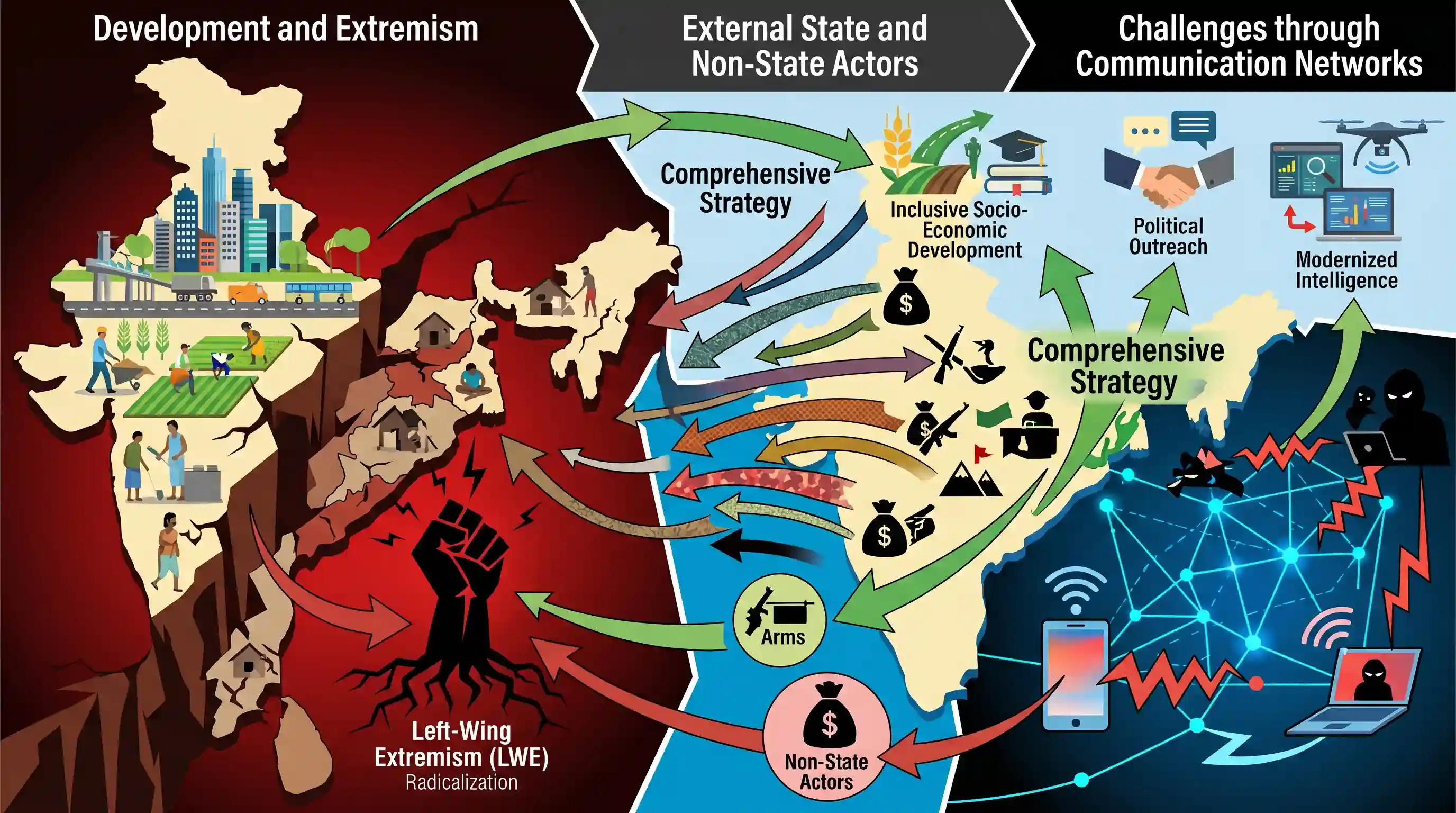
The article critically examines India's internal security landscape, emphasizing that domestic vulnerabilities—often stemming from socio-economic disparities, marginalization, and developmental deficits—pose a profound threat to national stability. It highlights how Left-Wing Extremism (LWE) and domestic radicalization represent a "trouble from within" that non-state actors exploit to undermine state authority. The author advocates for a paradigm shift from purely militaristic responses to a comprehensive, multi-layered strategy that integrates inclusive socio-economic development, political outreach, and modernized intelligence to effectively neutralize these internal threats at their roots.
Key Points
- The article highlights that internal fault lines—such as socio-economic disparities and developmental deficits—are increasingly exploited to create domestic instability.
- Left-Wing Extremism (LWE) and domestic radicalization remain persistent threats that cannot be resolved through kinetic/military means alone.
- Non-state actors are increasingly utilizing digital platforms to exploit domestic vulnerabilities, worsening the 'trouble from within'.
- A multi-layered strategy focusing on inclusive development, political engagement, and robust intelligence is necessary to address root causes.
Important Terms
SAMADHAN doctrine

The Indian government's 2017 multi-pronged strategy to combat Naxalism, standing for Smart leadership, Aggressive strategy, Motivation/training, Actionable intelligence, Dashboard-based KPIs, Harnessing technology, Action plans, and No access to financing.
UPSC context
GS Paper 3 (Internal Security); crucial for questions on counter-insurgency frameworks and the evolution of India's anti-Naxal policy.
Left-Wing Extremism (LWE)
A Maoist-inspired armed insurgency in India, primarily active in the 'Red Corridor,' that rejects parliamentary democracy and exploits socio-economic grievances to attempt to overthrow the state through violent revolution.
UPSC context
GS Paper 3 (Internal Security); central to topics regarding the linkages between development deficits and the spread of extremism.
Non-state actors
Individuals or groups (e.g., terrorist outfits, insurgent groups, or NGOs) that operate independently of any sovereign state but possess significant power to influence security, often exploiting socio-political fault lines.
UPSC context
GS Paper 3 (Internal Security); tests knowledge on asymmetric threats and the role of external/internal entities in destabilizing national security.
Ministry of Home Affairs (MHA)
India's primary nodal ministry for internal security, border management, and center-state relations; it exercises administrative and policy control over central police forces and intelligence agencies.
UPSC context
GS Paper 2 (Governance) and GS 3 (Security); relevant for understanding the executive structure managing domestic peace and federal security.
Central Armed Police Forces (CAPF)
A collective of seven specialized central security organizations (including CRPF, BSF, and CISF) under the MHA, tasked with border guarding, counter-insurgency, and assisting state police in maintaining law and order.
UPSC context
GS Paper 3 (Various Security Forces and their Mandate); essential for identifying the roles of different agencies in India's security architecture.
Red Corridor
The region in central, eastern, and southern India (covering states like Chhattisgarh, Jharkhand, and Odisha) characterized by significant Naxalite-Maoist influence and high levels of developmental deficits.
UPSC context
GS Paper 3 (Internal Security); used to geographically define the primary theatre of internal conflict involving LWE.
Prelims Trap
"The SAMADHAN doctrine is an exclusively militaristic and security-centric framework to eradicate Left-Wing Extremism."
SAMADHAN is actually a holistic approach encompassing technology, intelligence, cutting off terror financing, and development tracking, not just kinetic military operations.
Static Concepts Connected
What are the key pillars of the SAMADHAN doctrine?
- S-A-M-A: Smart Leadership, Aggressive Strategy, Motivation & Training, and Actionable Intelligence form the operational core.
- D-H-A-N: Dashboard-based KPIs, Harnessing Technology, Action plan for each Theatre, and No access to Financing address the systemic and logistical challenges.
How does the State address the "development deficit" in LWE-affected areas?
- Infrastructure: Road Connectivity Project for LWE Areas (RCPLWEA) and widespread Mobile Tower Projects bridge physical and digital isolation.
- Socio-economic: The Aspirational Districts Programme specifically targets backward LWE districts to improve health, education, and financial inclusion parameters.
- Security & Relief: The Security Related Expenditure (SRE) scheme assists affected states with capacity building and the rehabilitation of surrendered Maoists.
Cross-Topic Patterns
LWE + Tribal Forest Governance
Non-implementation or dilution of PESA (1996) and the Forest Rights Act (2006) directly correlates with the entrenchment of extremism due to tribal alienation and land displacement.
Cyber + Domestic Radicalization
Traditional geographic 'Red Corridors' are being mirrored by ideological digital echo chambers, merging GS3 Cyber Security with conventional internal security paradigms like radicalization.

Expect a GS3 Mains question in 2026 linking digital communication networks to the amplification of traditional socio-economic fault lines.
Linked PYQs · 3
Linked PYQs · 3
- 2022MainsGS3
Naxalism is a social, economic and developmental issue manifesting as a violent internal security threat. In this context, discuss the emerging issues and suggest a multilayered strategy to tackle the menace of Naxalism.
- 2021MainsGS3
Analyse the multidimensional challenges posed by external state and non-state actors, to the internal security of India. Also discuss measures required to be taken to combat these threats.
- 2016MainsGS3
Use of Internet and social media by non-state actors for subversive activities is a major security concern. How have these been misused in the recent past? Suggest effective guidelines to curb the above threat.
