Study Shows Light Tropical Rain Destabilises Upper Ocean Layers
Source:The Hindu ↗
Why It Matters
Ocean-atmosphere coupling governs major weather systems like the Indian Monsoon and tropical cyclones. Understanding how rainfall intensity alters ocean stratification and Sea Surface Temperature (SST) is vital for Geography (Oceanography/Climatology) and for assessing the impacts of shifting precipitation patterns due to climate change.
Summary
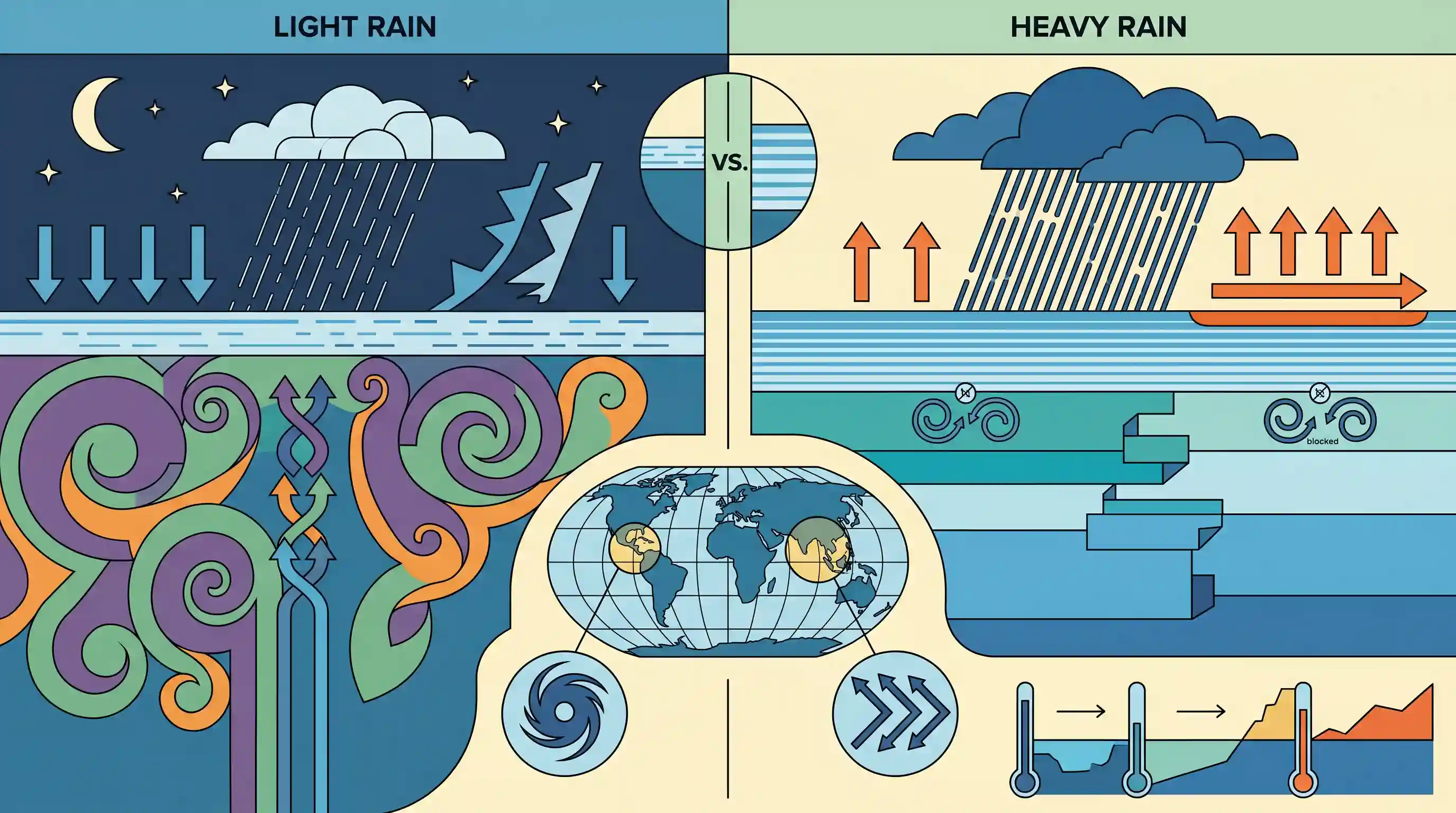
A recent study has uncovered a counter-intuitive mechanism in ocean-atmosphere interactions, revealing that tropical rainfall destabilises the upper ocean only when it falls lightly. While it is generally understood that freshwater from rain reduces surface density and stabilizes the ocean (creating stratification), light rain creates only a weak salinity gradient. This thin layer is highly susceptible to nighttime cooling, which makes the surface denser and triggers convective mixing (destabilization). Heavy rain, however, creates a strong buoyancy barrier that persists and suppresses mixing. These findings are crucial for understanding Sea Surface Temperature (SST) variations and improving climate models that predict tropical cyclones and monsoon dynamics.
Key Points
- Rainfall traditionally promotes ocean stratification by adding less dense freshwater to the surface, forming a buoyant layer that inhibits vertical mixing.
- The recent study reveals a counter-intuitive dynamic: light tropical rainfall actually destabilizes the upper ocean. The mild freshening creates a shallow layer that is easily cooled by nighttime heat loss, triggering convective overturn and deep mixing.
- Conversely, heavy tropical rainfall creates a thick, robust freshwater lens with a strong halocline (salinity gradient). This strong buoyancy barrier resists cooling-induced convection, maintaining ocean stability and trapping heat.
- This differential mixing profoundly impacts Sea Surface Temperature (SST), as destabilization brings cooler sub-surface waters to the top, while stabilization keeps the surface warm.
- The findings suggest that climate models need to accurately distinguish between light and heavy rainfall impacts on ocean stratification to better predict tropical weather systems, cyclones, and monsoon behaviour.
Prelims Trap
All freshwater addition through tropical rainfall increases ocean stratification and invariably stabilizes the sea surface.
While heavy rain creates a buoyancy barrier (stratification), light rain forms a weak layer prone to nighttime cooling. This cooling increases density, triggering vertical mixing (destabilization).
Static Concepts Connected
What factors control ocean surface density and vertical mixing?
- Evaporation vs Precipitation: Evaporation removes water and increases salinity/density, while precipitation adds freshwater, lowering density and promoting stratification.
- Temperature Changes: Warmer surface water is less dense. Nighttime or seasonal cooling increases surface density, causing water to sink and trigger convective mixing.
- The Halocline: A vertical zone in the oceanic water column where salinity changes rapidly with depth, acting as a barrier to mixing.
How does ocean stratification influence Tropical Cyclone genesis?
- Heat Trapping: Strong stratification (like a thick freshwater lens) prevents cooler, deeper waters from mixing upwards, maintaining high Sea Surface Temperatures (SST >26.5°C).
- Latent Heat Fuel: Consistently high SSTs provide the continuous latent heat of condensation required to fuel and intensify tropical cyclones.
Cross-Topic Patterns
Ocean mixing and monsoon modeling
Refined Sea Surface Temperature (SST) predictions from rainfall-mixing data directly impact the accuracy of dynamic monsoon models tracking the Indian Ocean Dipole (IOD) and ENSO.
Ocean stratification and Marine Heatwaves
Heavy rainfall creates a robust buoyancy barrier that prevents vertical mixing. This trapping of surface heat is a key driver that can exacerbate localized marine heatwaves.

Expect a statement-based Geography question contrasting how heavy vs light precipitation impacts the ocean halocline and cyclone genesis.
Linked PYQs · 3
Linked PYQs · 3
- 2017MainsGS1
Account for variations in oceanic salinity and discuss its multi-dimensional effects.
- 2024MainsGS1
What is sea surface temperature rise? How does it affect the formation of tropical cyclones?
- 2015MainsGS1
How far do you agree that the behaviour of the Indian monsoon has been changing due to humanizing landscapes? Discuss.
