Tropical Cyclone Gezani Impact on Madagascar Disaster Resilience
Source:The Hindu ↗
Why It Matters
Highlights the devastating socio-economic costs of climate-induced disasters on developing coastal nations. It provides a real-world case study for concepts of disaster vulnerability, hazard impact, and the critical need for global disaster resilience frameworks (like the Sendai Framework), which are frequently tested in GS1 Geography and GS3 Disaster Management.
Summary
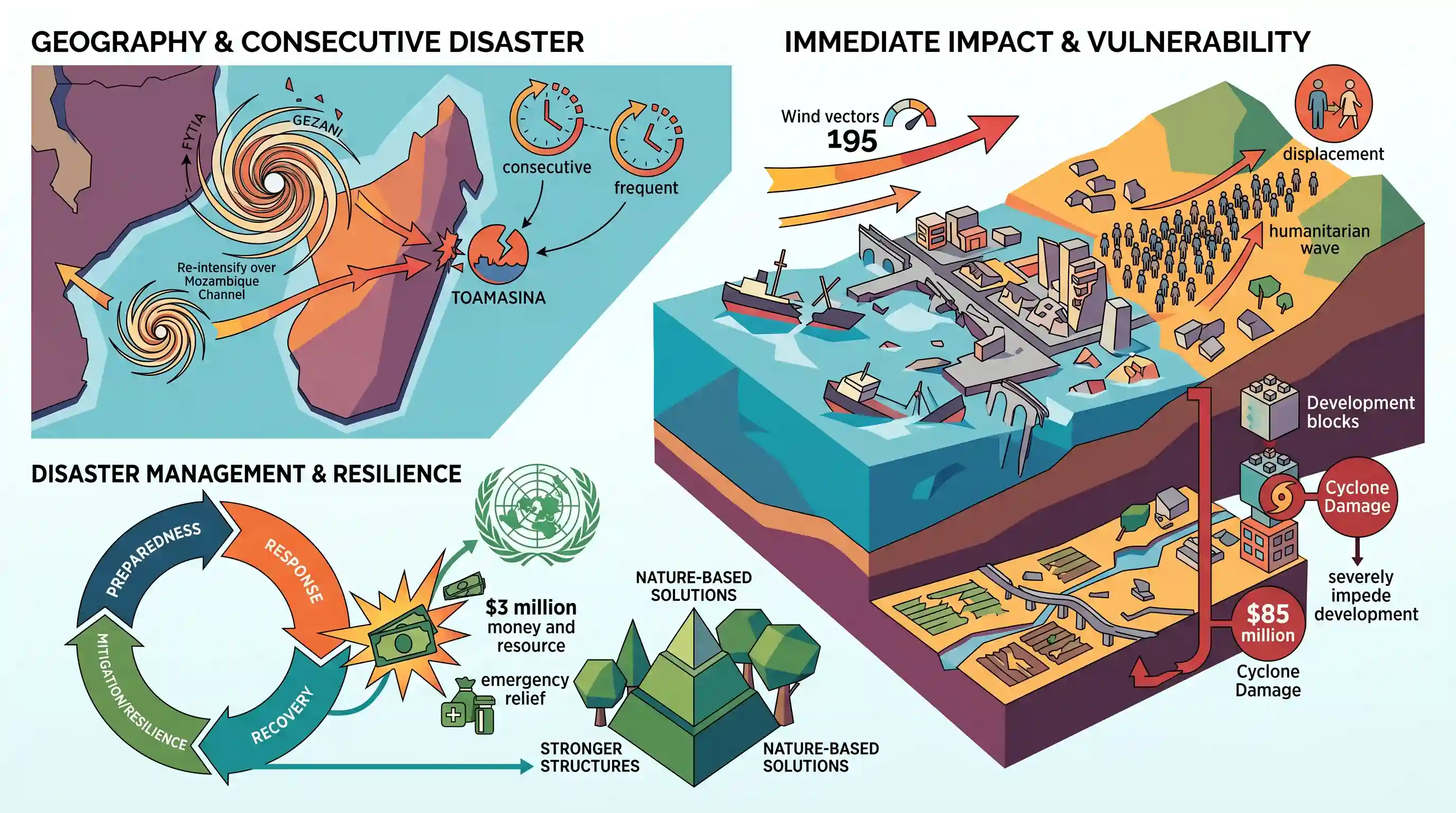
Tropical Cyclone Gezani struck Madagascar with devastating force, claiming at least 31 lives and causing catastrophic infrastructure damage, especially in the port city of Toamasina. The severe storm brought winds exceeding 195 km/h, leading to collapsed buildings, widespread flooding, and the displacement of thousands. Highly vulnerable to Indian Ocean cyclones, Madagascar faces consecutive disasters, having been hit by Cyclone Fytia just weeks prior. The United Nations Office for Disaster Risk Reduction (UNDRR) underscores that frequent extreme weather events severely impede the island nation's development, costing an estimated $85 million annually in structural damages. The UN has allocated $3 million for emergency relief as the storm threatens to re-intensify in the Mozambique channel.
Key Points
- Tropical Cyclone Gezani severely impacted Madagascar, resulting in at least 31 fatalities and the displacement of over 6,000 people.
- The critical port city of Toamasina experienced winds exceeding 195 km/h, which damaged an estimated 75% of its infrastructure and caused widespread flooding and power outages.
- Madagascar faces compounding climate vulnerabilities, having been struck by Cyclone Fytia less than two weeks prior to Gezani.
- The UNDRR estimates that frequent tropical storms cost Madagascar roughly $85 million annually in infrastructure damage, significantly stunting its economic development.
- The United Nations allocated $3 million from its emergency response fund for immediate relief operations.
- The storm is projected to move into the Mozambique channel, where it could re-intensify and threaten Mozambique.
Important Terms
Sendai Framework for Disaster Risk Reduction

A global, non-binding 15-year (2015–2030) agreement aimed at reducing disaster risk and losses. It emphasizes proactive risk management over reactive disaster response.
UPSC context
GS Paper 3: Disaster Management. Tests knowledge of international protocols, India's National Disaster Management Plan alignment, and global DRR targets.
United_Nations Office for Disaster Risk Reduction (UNDRR)
The UN focal point for coordinating disaster risk reduction. It oversees the implementation of the Sendai Framework and supports countries in building resilience against climate-related hazards.
UPSC context
GS Paper 2/3: International Institutions and Disaster Management. Important for understanding global governance of climate vulnerability and humanitarian coordination.
Central Emergency Response Fund (CERF)
A humanitarian fund established by the UN to provide rapid initial funding for life-saving assistance at the onset of emergencies or for underfunded crises.
UPSC context
GS Paper 2: Important International Institutions. Relevant for humanitarian aid mechanisms and the UN's role in global disaster response.
National Office for Risk and Disaster Management (BNGRC)
Madagascar’s national authority (BNGRC) responsible for coordinating, monitoring, and managing all disaster risk reduction and emergency response activities across the island nation.
UPSC context
GS Paper 3: Disaster Management. Case study for national-level institutional frameworks in highly vulnerable Least Developed Countries (LDCs).
Multi-Hazard Early Warning Systems (MHEWS)
Integrated systems that provide early warnings for multiple hazards, allowing individuals and communities to act timely to reduce the risk of harm or loss.
UPSC context
GS Paper 3: Disaster Management. Key technical component of the Sendai Framework and India's 'Early Warning for All' initiative.
Prelims Trap
"The Sendai Framework imposes legally binding disaster reduction targets on UN member states."
The Sendai Framework (2015-2030) is voluntary and non-binding. While it sets global targets for reducing disaster risk, the primary responsibility rests with the state without international legal penalties.
Static Concepts Connected
What are the prerequisite conditions for tropical cyclogenesis?
- Warm Sea Surface: Sea surface temperatures higher than 27°C, which provide the essential continuous supply of moisture and latent heat.
- Coriolis Force: Required to create the cyclonic vortex; hence, tropical cyclones rarely form within 5 degrees of the equator.
- Low Wind Shear: Differences in wind speed at various heights must be low to maintain the storm's vertical structure.
- Initial Disturbance: A pre-existing low-level cyclonic circulation or trough is necessary to initiate the storm system.
What is the geographical significance of the Mozambique Channel?
- Location: An arm of the western Indian Ocean situated between Southeast Africa (Mozambique) and the island nation of Madagascar.
- Ocean Currents: Hosts the warm Agulhas Current flowing southward, which heavily influences regional climate and provides energy for cyclone intensification.
Cross-Topic Patterns
Compounding disasters & IPCC frameworks
The rapid succession of Cyclones Fytia and Gezani highlights 'compound extreme events', a major IPCC AR6 theme where consecutive climate shocks overwhelm state capacities before recovery occurs.
Ocean warming and cyclonic re-intensification
Gezani's threat to re-intensify in the Mozambique Channel connects directly to rising Sea Surface Temperatures (SSTs) and marine heatwaves in the Western Indian Ocean.

Expect a multi-statement Prelims question combining Western Indian Ocean geography (Mozambique Channel), Agulhas current, and cyclogenesis.
Linked PYQs · 4
Linked PYQs · 4
- 2024MainsGS1
What is sea surface temperature rise? How does it affect the formation of tropical cyclones?
- 2019MainsGS3
Vulnerability is an essential element for defining disaster impacts and its threat to people. How and in what ways can vulnerability to disasters be characterized? Discuss different types of vulnerability with reference to disasters.
- 2024MainsGS3
What is disaster resilience? How is it determined? Describe various elements of a resilience framework. Also mention the global targets of Sendai Framework for Disaster Risk Reduction (2015–2030).
- 2018MainsGS3
Describe various measures taken in India for Disaster Risk Reduction (DRR) before and after signing 'Sendai Framework for DRR (2015-2030)'. How is this framework different from Hyogo Framework for Action, 2005?
