Border infiltration in Tripura highlights internal security risks
Source:Indian Express ↗
Why It Matters
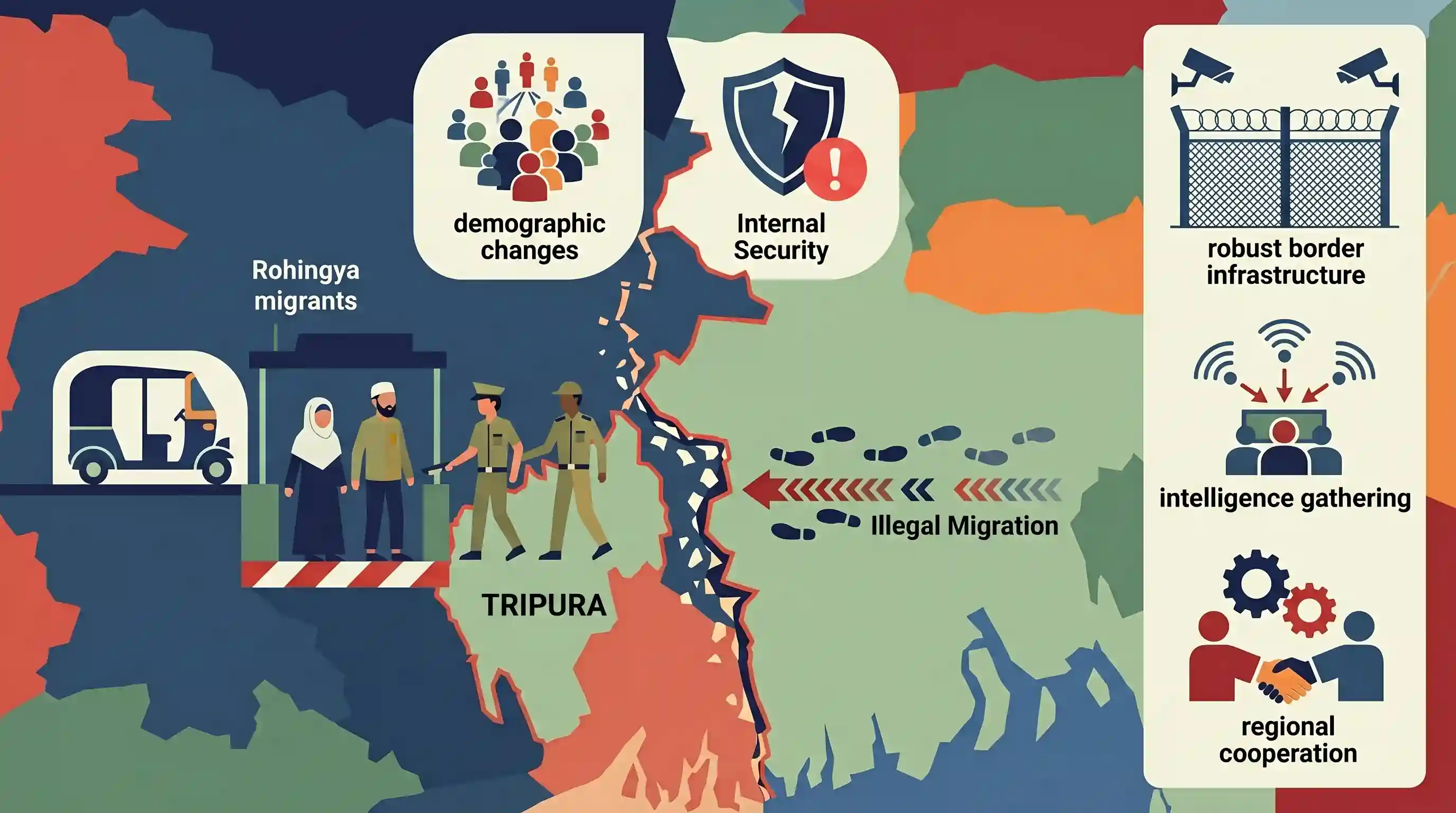
The event exemplifies the practical challenges of policing the porous borders in North-East India. Illegal transborder migration, specifically involving Rohingya refugees, remains a potent internal security concern linked to demographic shifts, human trafficking, and strain on local resources.
Summary
Two Rohingya migrants and a local auto-rickshaw driver were arrested by Tripura Police for illegal border crossing from Bangladesh. The incident underlines the vulnerability of the porous India-Bangladesh border in the North-East to illegal migration and human smuggling networks. This ongoing influx poses demographic and internal security challenges, requiring robust border infrastructure, intelligence gathering, and regional cooperation to manage the fallout of the Rohingya displacement crisis.
Key Points
- Tripura Police detained two Rohingya individuals who crossed the international border illegally from Bangladesh into India.
- An Indian auto-rickshaw driver was also arrested for facilitating the transport of the illegal migrants.
- The incident highlights ongoing border security vulnerabilities along the porous India-Bangladesh border in the North-East.
- This reflects the broader regional challenge of managing displaced Rohingya populations and curbing illegal transborder migration.
Important Terms
Rohingya

A stateless Indo-Aryan ethnic group, predominantly Muslim, from Myanmar's Rakhine State, described by the UN as one of the most persecuted minorities globally.
UPSC context
Relevant for GS Paper II (International Relations) regarding refugee crises and GS Paper III (Internal Security) concerning infiltration and national security threats.
Internal Security
The act of maintaining peace and law within a sovereign state's borders, defending against threats like insurgency, ethnic conflict, and organized crime.
UPSC context
A core topic in GS Paper III, testing understanding of domestic stability, border management, and non-traditional security threats.
Porous Borders
Borders that lack physical barriers or strict surveillance, often due to difficult terrain like rivers or forests, facilitating unauthorized movement of people and goods.
UPSC context
Critical for GS Paper III (Border Management), focusing on challenges in India's North-East and the limitations of traditional physical fencing.
Illegal Migration
Migration across national borders that violates the destination country's immigration laws, often without valid travel documents.
UPSC context
Tested in GS Paper III (Internal Security) for its impact on regional demographics, social stability, and resource distribution.
India-Bangladesh Border
Stretching 4,096.7 km, it is India's longest international boundary, characterized by complex riverine, hilly, and densely populated terrains.
UPSC context
Significant for GS Paper III (Border Management) and GS Paper II (Bilateral Relations), involving issues like cattle smuggling and the Land Boundary Agreement.
Comprehensive Integrated Border Management System (CIBMS)
A technological project using sensors, drones, and infrared cameras to create a seamless, non-physical surveillance barrier in difficult border terrains.
UPSC context
Key for GS Paper III (Internal Security), highlighting modernization and technological solutions in border guarding.
Prelims Trap
Rohingya migrants entering India are processed and protected under the 1951 UN Refugee Convention.
India is not a signatory to the 1951 UN Refugee Convention or its 1967 Protocol. Rohingyas are legally treated as "illegal immigrants" under the Foreigners Act, 1946.
Static Concepts Connected
What is the legal framework governing illegal immigrants in India?
- Foreigners Act, 1946: Grants the central government absolute power to restrict the entry, presence, and departure of foreign nationals, and empowers deportation.
- Citizenship Act, 1955: Defines an "illegal migrant" and prescribes pathways to citizenship, explicitly excluding illegal migrants from naturalization or registration.
- Passport Act, 1920: Mandates foreigners to carry valid passports/visas to enter India, penalizing unauthorized entry from porous borders.
How does India technologically secure the porous India-Bangladesh border?
- CIBMS: Comprehensive Integrated Border Management System uses sensors, cameras, and radars to create an invisible electronic wall in unfenced terrains.
- Project BOLD-QIT: Border Electronically Dominated QRT Interception Technique secures difficult riverine borders (e.g., Brahmaputra) using microwave communication, cameras, and sonar.
Cross-Topic Patterns
Demographic shifts and citizenship laws
Porous borders in Tripura and Assam fuel local anxieties about demographic inversion, directly linking internal security failures to the demand for NRC and CAA exemptions in the North-East.
Refugee policy vs Humanitarian diplomacy
India balances its strict domestic 'illegal immigrant' stance with regional diplomatic efforts like 'Operation Insaniyat', which provided humanitarian relief to Bangladesh for managing Rohingya refugee camps.

Expect a mixed-statement question in 2026 linking India's non-signatory refugee status, the Foreigners Act, and border tech like CIBMS.
Linked PYQs · 4
Linked PYQs · 4
- 2014MainsGS3
How does illegal transborder migration pose a threat to India's security? Discuss the strategies to curb this, bringing out the factors which give impetus to such migration.
- 2019MainsGS3
Cross-border movement of insurgents is only one of the several security challenges facing the policing of the border in North-East India. Examine the various challenges currently emanating across the India-Myanmar border. Also, discuss the steps to counter the challenges.
- 2020MainsGS3
Analyze internal security threats and transborder crimes along Myanmar, Bangladesh and Pakistan borders including Line of Control (LoC). Also discuss the role played by various security forces in this regard.
- 2016PrelimsGS1
Consider the following pairs: Community sometimes mentioned in the news : In the affairs of 1. Kurd : Bangladesh 2. Madhesi : Nepal 3. Rohingya : Myanmar Which of the pairs given above is/are correctly matched?
